Eugene has bulldozed hundreds of historic homes and commercial buildings over the years, many with architectural as well as historic value, and the destruction continues. But not all have been lost. So what is it like to get an old and significant home or office building designated as a City Historic Landmark (CHL) or other designation in Eugene? The benefits include tax credits and assessment freezes, low-interest loans for rehabilitation and more.
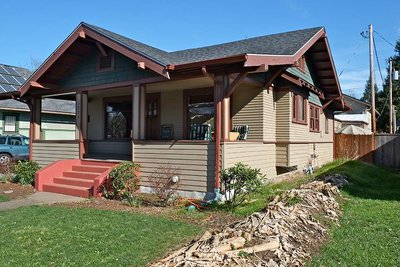
Owners of a circa-1920 bungalow at 1325 Jefferson St. in Eugene are going through the process of acquiring CHL designation, and a public hearing is on the agenda of the Historic Review Board this Thursday, with city staff recommending approval. The house has its original siding, doors and windows and interior woodwork, and it was once owned by the Skinner family.
“Our experience has been positive so far, but I would not describe it as either ‘simple’ or ‘straightforward,’” says Gina Graham, who owns the home with her mother, Lynne Graham.
The bungalow, known as the Skinner Rental House, is next door to the historic Skinner House, owned and preserved by David Atkin. Atkin got his CHL designation several years ago and has assisted the Grahams in going through a complex process that can take years of rewarding but also frustrating work.
The process in this case involved extensive research and documentation of the building’s ownership and usage over the years, including deciphering handwritten title transfers and city staff time in preparing a written report looking at the application’s compliance with historic designation criteria, various city policies, public agencies, the Jefferson/Westside Neighborhood Organization, the Metro Plan and more.
“I wish the process was more streamlined,” says Heather Kliever, chair of the Eugene Historic Review Board and registrar at the Lane County Historical Society. “If it had been someone other than Gina I think they may have given up entirely. The process shouldn’t be too easy, however. Then it loses its meaning as a special designation.”
Gina Graham describes confronting a “quagmire of language” at times in dealing with city bureaucracy but also appreciates the help she received from city planning staff. One indication that the rules need updating is the requirement to submit “slides” of photos.
Other cities in Oregon appear to have a less convoluted route to historic designation, Kliever says. “Eugene seems to look at codes as written in stone — difficult to change, a burden on tight budgets and short staff. Medford, Ashland and Jacksonville periodically revise codes and are very proactive in historic preservation.”
Kliever notes that Medford is currently going through a code revision process to protect its historic structures, and the city of Medford “offers yearly awards for individuals and business owners for preservation efforts.”
She says Jacksonville has a “super strong economy around its historic architecture, and Ashland has a strong cultural economy and was a Google eCity [demonstrating a strong online business community] two years in a row and celebrates its history almost on a daily basis.”
The Historic Review Board meets from 8:30 to 10:30 am Thursday, Feb. 19, at the Atrium Building, 99 W. 10th Ave. Comments on this application can also be emailed to jacob.l.callister@ci.eugene.or.us.