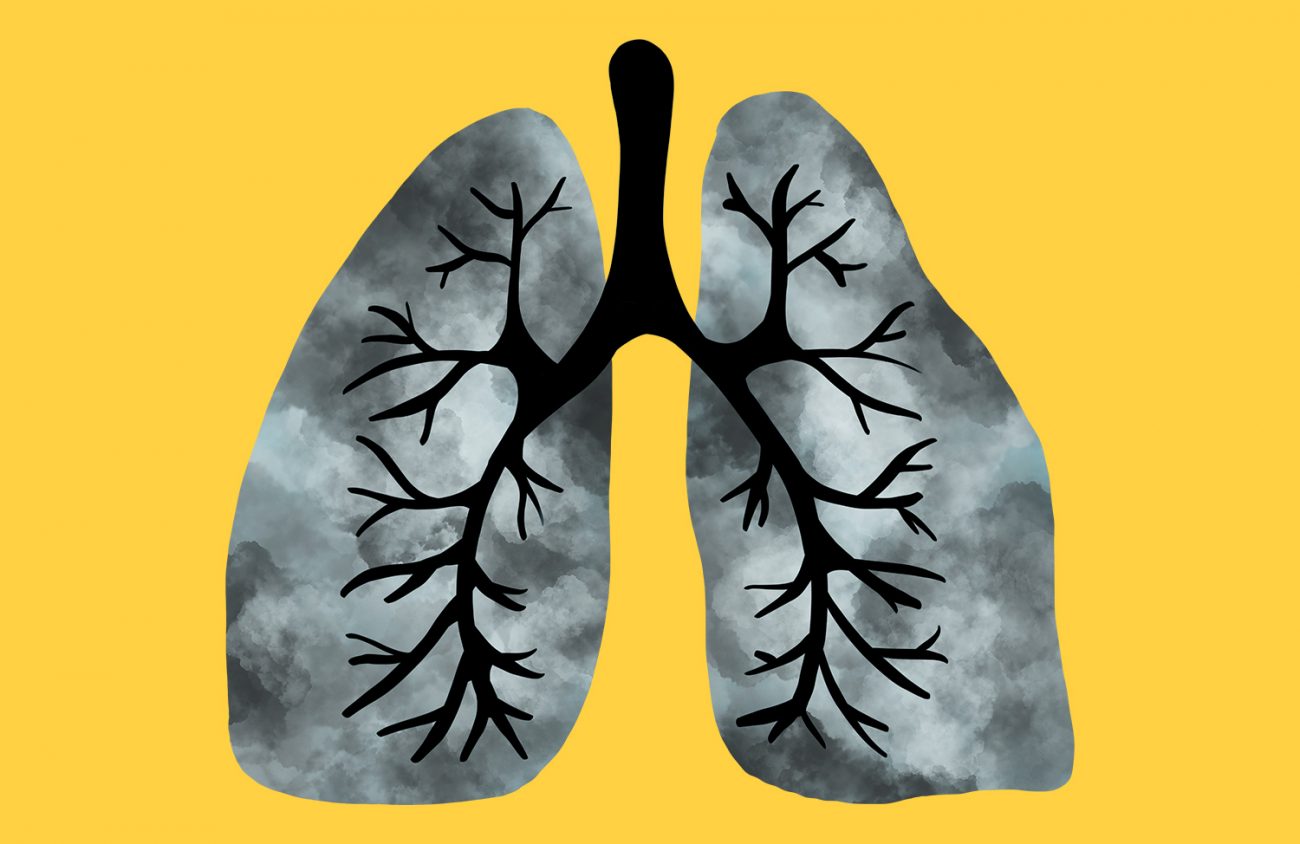
The American Lung Association’s (ALA) 2018 State of the Air report lists Eugene as one of the top 25 U.S. cities contaminated with short-term particle pollution. The data, though, isn’t necessarily representative of just Eugene, and that, according to our local air agency, skews things a little.
Air pollution can worsen health effects for vulnerable groups such as people with diseases like asthma and emphysema The ALA goes on to say that short-term particle pollution can last anywhere from several hours to several days.
Particle pollution also increases the risk of exposure to chemicals emitted by industrial manufacturers, according to Eugene-based Beyond Toxics.
The historical timber town Oakridge, roughly 40 miles east of Eugene, has only recently met federal standards for particulate matter pollution. Oakridge’s failure to comply with regulations is what has landed Eugene on the 25 Worst Cities with Short-Term Particle Pollution list, according to the Lane Regional Air Protection Agency (LRAPA).
LRAPA says the ALA ranking isn’t indicative of Eugene’s actual air quality since the ALA factored Oakridge in Eugene’s ranking.
Particulate pollution is defined in terms of size. Smaller, finer particles like those from combustion, are called PM 2.5 while larger particles like pollen are known as PM 10.
Jo Niehaus, a spokeswoman for LRAPA, says Oakridge has only recently met the federal standard for PM 2.5.
Niehaus says the ALA’s report contains data from 2014, 2015 and 2016, but not from 2017. LRAPA’s 2017 annual report shows that Amazon Park in Eugene has a consistently lower 24-hour average of PM 2.5 particles than Oakridge does.
Niehaus says that Oakridge’s use of wood stoves, which emit combustion particles, is a legacy of the community’s timber heritage that has caused difficulties when it comes to complying with regulations.
“If you ask the city of Oakridge, they would say it’s a cultural problem because it’s a lumber community and people have grown up burning wood,” she says. “There’s no natural gas pipeline that goes through the town, so people would have to fill up propane or use electric heating as alternatives.”
Niehaus adds that Oakridge may have larger economic problems to focus on, and that using alternative sources of energy may not be the town’s top priority.
LRAPA has worked with Oakridge’s City Council, mayor and city administrator in an effort to reduce the city’s emission of contaminants, Niehaus says. With funding from the state and federal government, LRAPA established a woodstove exchange program in 1993 and has done several rounds of wood stove swaps over the last 25 years. From 1993 to 2011, LRAPA exchanged 279 wood stoves from Oakridge residents.
While LRAPA’s report covers PM 2.5 contamination, Lisa Arkin, the executive director of the environmental group Beyond Toxics, says LRAPA’s report is missing data about air toxins from manufacturers like International Paper. Arkin says pollutants like formaldehyde can carry a significant risk in areas that have forms of particulate contamination.
“Air toxins like formaldehyde cling to particles like wood smoke, and the fact that our county has a high level of particle pollution means that we are being exposed to these chemicals,” she says. “If you have a lot of particle pollution, it increases your risk of being exposed to harmful toxic chemicals as well.”
In its 2016 Title V operating permit review, International Paper acknowledges that its Springfield plant is a major source of hazardous air pollutants. According to the report, International Paper estimated that it releases 413 tons of hazardous air pollutants a year, including 16.3 tons of formaldehyde, but that the estimates are “based on the worst-case production potential of the individual devices.”
LRAPA provides daily air quality updates which you can view at LRAPA.org.
Sponored by
