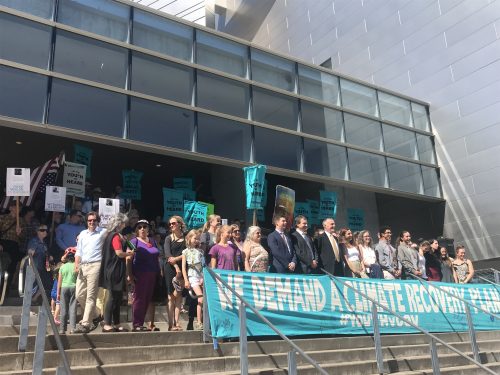
A court order today, Nov. 21, from federal Judge Ann Aiken states that the Our Children’s Trust (OCT) trial is still delayed pending a decision by the Ninth Circuit Court of Appeals on an interlocutory appeal. The order also discusses the potential to split the trial into two parts — a liability and a remedy phase.
The Our Children’s Trust case, formally known as Juliana v. United States, is a court case in which 21 young plaintiffs are suing the federal government on the grounds of its affirmative actions in climate change, and thus its liability in harming future generations.
The trial was originally set to begin in October of this year, but has been delayed by the Trump administration’s filing of multiple motions to the Ninth Circuit Court of Appeals and the Supreme Court in attempt to get the case thrown out.
Today’s court order, from the Oregon District Court, states that before discussion of this appeal, the earliest a new trial date was anticipated would be in January or February of 2019.
An interlocutory appeal is an appeal made before a trial has concluded — or in this case, even started. The U.S. District Court for the District of Oregon denied the defendants’ request for interlocutory appeal in 2017, according to a previous court order, stating that district courts should not have the power to make such decisions.
But today, after further review, the District Court has reconsidered. “At this time, the Court finds sufficient cause to revisit the question of interlocutory appeal as to its previous order,” the court order reads.
“Thus, this court now exercises its discretion and immediately certifies this case for interlocutory appeal,” it says. “Accordingly this case is stayed pending a decision by the Ninth Circuit Court of Appeals.”
There is no timeline on when the Ninth Circuit Court of Appeals will be making a decision.
Julia Olson, executive director and chief legal counsel of OCT says in a press release that the federal government has been making unfounded claims of “supposed irreparable harm” in order to attempt to get the case dropped before trial.
“These claims are not supported by a shred of evidence,” she says. “In contrast, our youth have thousands of pages of evidence and the best experts on the planet ready to testify under oath that these plaintiffs’ lives, liberties and property are threatened by these defendants, that their world is being endangered and destroyed as we speak.”
She continues: “I hope a favorable decision will not come too late for a real remedy.”
If the trial does go forth, the court order also discusses the potential for a bifurcated trial, or a trial split into two parts.
“The Court has discussed on the record dividing the trial into a liability phase and a remedy phase,” the order reads.
The court order says that this technique could be better for both parties, as it would allow the plaintiffs to make their case for governmental liability and then allow the defendants to make an appeal after the fact, if necessary, before moving onto the remedy phase.
“The Court believed that such a course would allow reviewing courts to consider the parties’ arguments on appeal with the benefit of a fully developed factual record,” the order reads.
“It is upsetting to watch the people in charge completely disregard my future by allowing further delays to our trial,” Miko Vergun, a 17-year-old plaintiff from Beaverton, says in an OCT press release. “I feel like the people leading this country are failing young people like me.”
This story has been updated to add comment from Our Children’s Trust.
A Note From the Publisher

Dear Readers,
The last two years have been some of the hardest in Eugene Weekly’s 43 years. There were moments when keeping the paper alive felt uncertain. And yet, here we are — still publishing, still investigating, still showing up every week.
That’s because of you!
Not just because of financial support (though that matters enormously), but because of the emails, notes, conversations, encouragement and ideas you shared along the way. You reminded us why this paper exists and who it’s for.
Listening to readers has always been at the heart of Eugene Weekly. This year, that meant launching our popular weekly Activist Alert column, after many of you told us there was no single, reliable place to find information about rallies, meetings and ways to get involved. You asked. We responded.
We’ve also continued to deepen the coverage that sets Eugene Weekly apart, including our in-depth reporting on local real estate development through Bricks & Mortar — digging into what’s being built, who’s behind it and how those decisions shape our community.
And, of course, we’ve continued to bring you the stories and features many of you depend on: investigations and local government reporting, arts and culture coverage, sudoku and crossword puzzles, Savage Love, and our extensive community events calendar. We feature award-winning stories by University of Oregon student reporters getting real world journalism experience. All free. In print and online.
None of this happens by accident. It happens because readers step up and say: this matters.
As we head into a new year, please consider supporting Eugene Weekly if you’re able. Every dollar helps keep us digging, questioning, celebrating — and yes, occasionally annoying exactly the right people. We consider that a public service.
Thank you for standing with us!

Publisher
Eugene Weekly
P.S. If you’d like to talk about supporting EW, I’d love to hear from you!
jody@eugeneweekly.com
(541) 484-0519