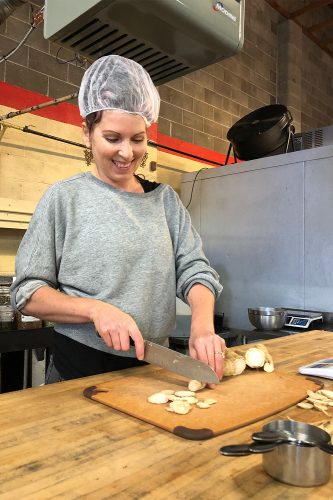
Annie Fisher pulverizes horseradish roots in a motorized industrial grater, and the warehouse where she’s working fills with a sharp, nose-crinkling smell.
She puts the grated horseradish in a five-gallon plastic bucket along with chopped onion, garlic and ginger; halved grapefruits and lemons; and powdered herbs and spices. Fisher pours apple cider vinegar over everything and covers the bucket with a lid.
She’s making fire tonic, a potent blend of medicinal plants and apple cider vinegar meant to boost the immune system and fend off colds. The brew is the product of her first business, Wildfire Elixirs.
Fisher was able to start her business six months ago with the help of Bohemia Food Hub, a shared commercial kitchen in Cottage Grove. She rents the space for $12 an hour from Kim Johnson, the building’s owner.
Johnson is lowering barriers to entry for small businesses like Wildfire Elixirs by providing an affordable kitchen. “There’s enough expenses involved with starting your own food businesses that it is often cost prohibitive to rent a commercial kitchen space,” she says.
Johnson just received a $67,000 grant from Business Oregon, the state’s economic development agency, to expand the warehouse for more tenants. The money is coming from the agency’s Small Business Sustainability Fund. She’s been talking to the organization for a few years, and says they see that Bohemia Food Hub is creating jobs.
Cottage Grove also just received $61,000 from Business Oregon’s Rural Opportunity Initiative, a program that supports small business in rural Oregon communities. Johnson will be able to use some of this money to expand Bohemia Food Hub as well.
In addition to Wildfire Elixirs, the warehouse is currently home to eight food businesses: Hot Winter Hot Sauce, Real Live Food, SOHR Foods, SnakTak, Ketovore Life, BOHO BOTO and My Brothers’ Farm.
“What we’re doing here is working for economic development in rural Oregon,” Johnson says. “Cottage Grove is this kind of depressed community that was really vibrant and vital in the logging industry.”
She says 13 companies have launched from the warehouse as well as a food truck court she owns across the street. About 37 people work in these places. She says small food businesses could help revitalize economies in rural Oregon, many of which have been hurt by the decline of the timber industry.
Johnson bought the warehouse six years ago for $125,000. She needed a kitchen for her nori roll business, which was then called Tsunami Sushi. But she only was using a small corner of the building, so she started looking for other people who could use the space.
SOHR Foods bought Johnson’s nori roll business, which is now named Real Live Food Oregon, and moved into the warehouse a few years ago. Hot Winter Hot Sauce also moved in. These two established businesses pay monthly rents that allow Johnson to keep prices low for businesses that are just starting.
People that work for these companies, as well as Johnson, advise smaller, younger businesses like Wildfire Elixirs on how to be successful.
Fisher says this advice has helped her get her company off the ground. Besides low rents, she says, advice from other local businesspeople is what makes working in the warehouse so special. She was a bartender in Eugene for 16 years before she started Wildfire Elixirs and didn’t have much business experience.
Fisher had been making fire tonics for years, giving them as Christmas and birthday presents for friends and family. She landed on the idea to make it into a full-time gig in summer 2018, when she got pneumonia and shingles at the same time.
Fisher made a particularly potent fire tonic to try to cure herself. And she posted a picture of her potion of fruits, vegetables, herbs and spices on Facebook. She says 200 hundred people commented on the post, asking for bottles of their own.
Fisher then made her first large batch of tonic, and each of the 30 bottles had a buyer within a week. So she made another batch. And another.
Fisher quit her bartending job soon after and committed full-time to the business — though she says her background as a mixologist helped her craft a good tasting drink.
“My background is in balancing cocktails and elixirs, so I think there’s this really amazing balance with the sweet, the spicy, the savory,” she says. “I’m still making cocktails — they’re just giant elixirs now.”
Johnson says she isn’t making a profit on the warehouse or the food truck court right now, but she says the system pays for itself. She wrote another grant request to Business Oregon that includes pay for her role in the project.
The low property prices in rural places like Cottage Grove make the model work.
“The key is affordable space,” she says. “I don’t think this would necessarily work in Eugene.” She says high property prices mean higher rents for kitchen tenants.
Johnson is using the grant money to buy more equipment for the kitchen. She’s also buying a food truck where aspiring restaurant owners can test out their ideas in public before sinking money into their own trucks or restaurants. And she wants to build three restaurant spaces inside the warehouse. Two of these would also be used for piloting business ideas.
You can find Wildfire Elixirs products at Sundance, Capella, Friendly Street Market, Wynant’s Family Health Foods and Hummingbird Wholesale, among other stores. Find out more at wildfireelixirs.com.