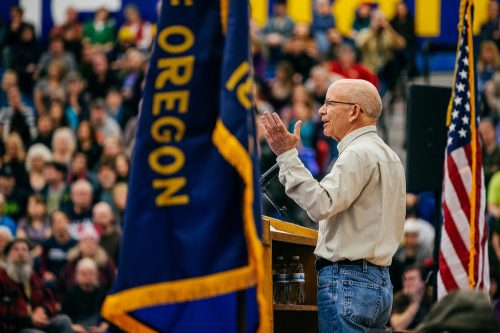
Rep. Peter DeFazio says he is working on a variety of tactics to combat the spread of the COVID-19 virus by creating funding relief packages and pushing for better testing and communication with doctors.
The congressman says on Monday, March 16, after a phone call with major health providers, restrictions for tele-health phone calls were lifted. This allows for people to contact a health provider about their possible coronavirus symptoms instead of showing up at the doctor and would also be helpful for those who live in more remote areas.
As the chair of the House Committee on Transportation and Infrastructure, DeFazio is also addressing public transportation. In the relief package, he is proposing $12 billion for transit districts and commuter rails to keep transportation in Eugene and bigger cities operating.
The airlines are also facing a huge crisis, losing money every day.
“They were in good shape,” DeFazio says. “Some say they will be exhausted in four weeks, others say four months.”
He says Democrats on the committee are supporting the union position, which helps airlines in a way similar to the 9/11 response. The airlines will get bailed out and will most likely file for bankruptcy. The money from the bailout will go directly to the workers and the airline doesn’t make any money off the top.
With this, DeFazio is also proposing adding $1 billion into the relief package to develop a better stream of aviation fuel. Then, Congress can require any airline that took bailout money to buy sustainable fuel.
“We will see what we get in the end,” he says. “We are going to push for what we see are very, very needed reforms.”
While working on current relief packages, DeFazio says Democrats on the committee are beginning to plan ahead for a future recession. He says he hopes to pass bills on helping the nation’s infrastructure.
“This third part is how do we get the economy chugging again?” DeFazio says. “I think one of the best ways to do it is building a 21st century infrastructure that will be green and climate resilient.”
The Trump administration, DeFazio says, missed the opportunity to on top of testing weeks ago and that now the country is playing catch up. Now, improvements are being made. Local labs are now able to test and analyze results.
DeFazio says he also spoke with one provider who told him that CAT scans can be used to diagnose patients. DeFazio says he is also advocating to get more protective equipment. Oregon currently has only 10 percent of the gear it needs and and another 15 percent is on its way.
“I’ve been banging on the fence to get this. Things will accelerate quickly and we need that stuff.”
Although he says he acknowledges the issues with the Trump administration when the virus was first spreading, DeFazio says this isn’t the time to dismantle those issues.
“At the moment, we gotta push and draw together and get through this,” he says.
He hopes that some of these efforts can provide overall relief.
“Don’t panic,” DeFazio says at the end of the interview. “We will get through this, but it will not be easy.”
A Note From the Publisher

Dear Readers,
The last two years have been some of the hardest in Eugene Weekly’s 43 years. There were moments when keeping the paper alive felt uncertain. And yet, here we are — still publishing, still investigating, still showing up every week.
That’s because of you!
Not just because of financial support (though that matters enormously), but because of the emails, notes, conversations, encouragement and ideas you shared along the way. You reminded us why this paper exists and who it’s for.
Listening to readers has always been at the heart of Eugene Weekly. This year, that meant launching our popular weekly Activist Alert column, after many of you told us there was no single, reliable place to find information about rallies, meetings and ways to get involved. You asked. We responded.
We’ve also continued to deepen the coverage that sets Eugene Weekly apart, including our in-depth reporting on local real estate development through Bricks & Mortar — digging into what’s being built, who’s behind it and how those decisions shape our community.
And, of course, we’ve continued to bring you the stories and features many of you depend on: investigations and local government reporting, arts and culture coverage, sudoku and crossword puzzles, Savage Love, and our extensive community events calendar. We feature award-winning stories by University of Oregon student reporters getting real world journalism experience. All free. In print and online.
None of this happens by accident. It happens because readers step up and say: this matters.
As we head into a new year, please consider supporting Eugene Weekly if you’re able. Every dollar helps keep us digging, questioning, celebrating — and yes, occasionally annoying exactly the right people. We consider that a public service.
Thank you for standing with us!

Publisher
Eugene Weekly
P.S. If you’d like to talk about supporting EW, I’d love to hear from you!
jody@eugeneweekly.com
(541) 484-0519