In 2003, at the age of 92, revolutionary philosopher and activist Grace Lee Boggs delivered an impassioned speech titled “These are the times to grow our souls.” Reflecting on decades of struggle for Black liberation, Boggs concluded the urgent need to “recognize that we must each become a part of the solution because we are each a part of the problem.”
We must move beyond denial, identity politics and paralysis to create a new paradigm of selfhood and solidarity. But how? The task of developing a practice and orientation for a sustained response requires both literacy and action. At some point over the weekend, after watching several hours of media coverage, when I craved a deeper analysis than what I could gather from my social media feed, I walked to my bookshelf and began re-reading Alice Walker’s Overcoming Speechlessness. Her words remind me of the necessity to think beyond inherited ways of framing the moment we are in.
That is part of the work we are currently faced with. As we witness the manifestations of racialized apartheid in the U.S., we are challenged to think about our racial identities and capitulation differently. We will be confronted with questions of our own complacency and responsibility. But we can’t stop there. We will be asked to name the failures and also direct our energy toward alternatives.
This requires having new conversations, cultivating new ways of seeing and orienting ourselves toward anti-racism. I believe this work will be amplified through engagement with voices old and new who provide us with essential tools to push our thinking forward.
Here are some books that can help. Find them at such local stores as Tsunami Books, J. Michaels Books and Smith Family Booksellers.
Books defining the conversation
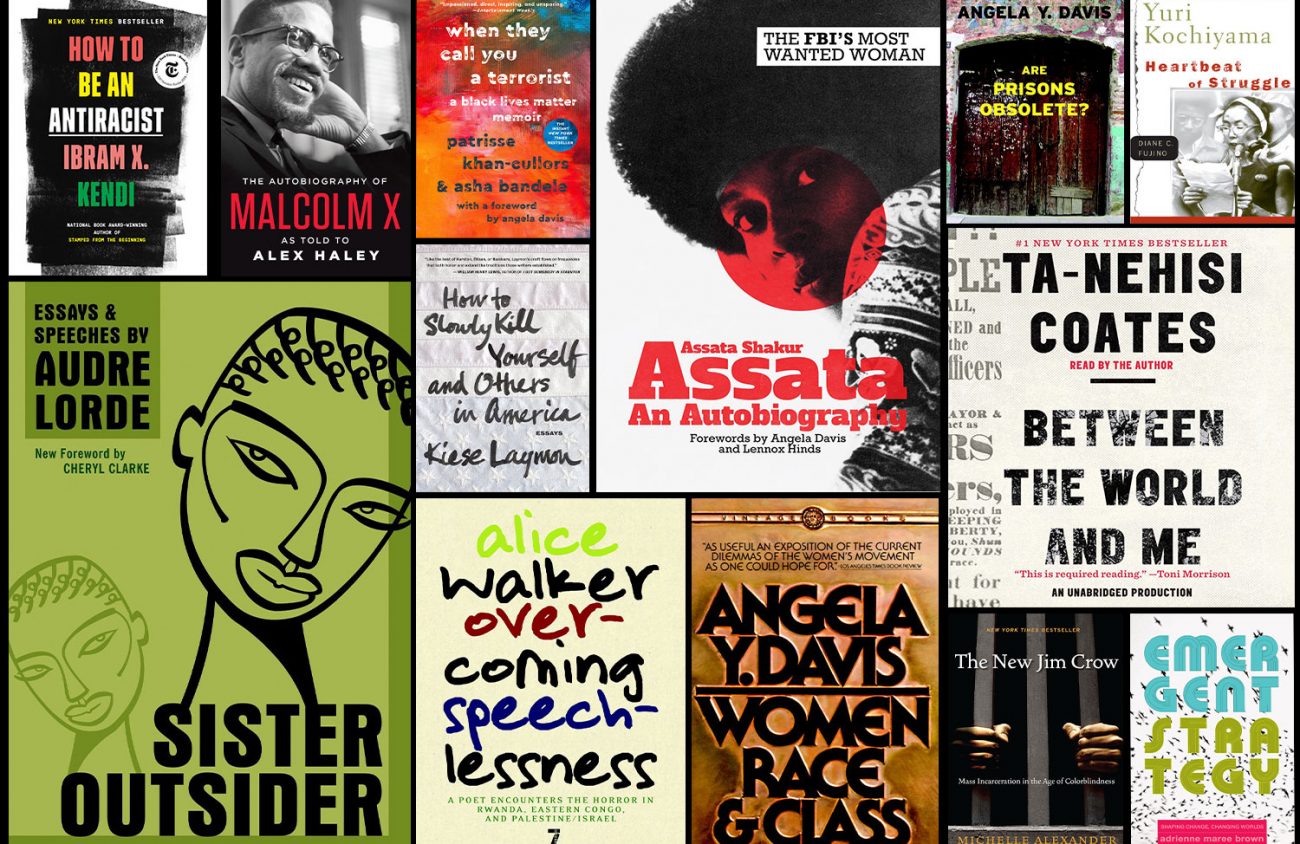
How to Be Antiracist by Ibram X. Kendi. Random House, $27
When They Call You a Terrorist: A Black Lives Matter Memoir by Patrisse Khan-Cullors and asha bandele. St. Martin’s Griffin, $13.99
The New Jim Crow: Mass Incarceration in the Age of Colorblindness by Michelle Alexander. New Press, $17
Emergent Strategy by adrienne maree brown. AK Press, $16
Essential women of color feminist analysis
Sister Outsider: Essays and Speeches by Audre Lorde. Crossing Press, $14.99
Women Race & Class by Angela Y. Davis. Random House, $16.95
Biographies
Assata: An Autobiography by Assata Shakur. Foreword by Angela Davis. AK Press, $18.95
Heartbeat of Struggle: The Revolutionary Life of Yuri Kochiyama by Diane Carol Fujino. University of Minnesota Press, $19
The Autobiography of Malcolm X by Malcolm X. Random House Publishing, $18
Books that fit in your back pocket
and you can read in a day
Are Prisons Obsolete? by Angela Y. Davis. Seven Stories Press, $7.96
Overcoming Speechlessness by Alice Walker. Seven Stories Press, $7.96
Books that will change you
Between the World and Me by Ta-Nehisi Coates. One World, $14
How to Slowly Kill Yourself and Others in America by Keise Laymon. Agate, $15