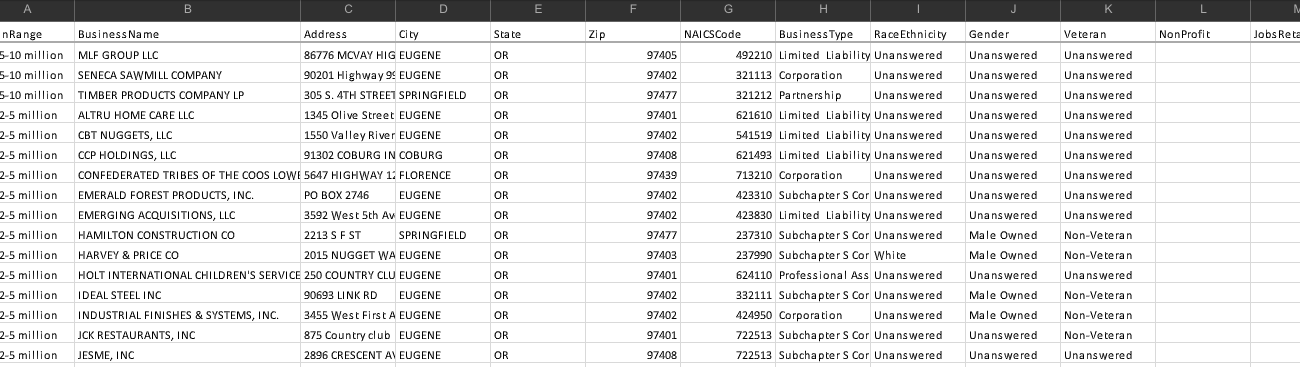
Since mid-April, more than 4.8 million businesses have received loans from the Small Business Association (SBA) as a part of the Payroll Protection Program that was created by the federal government to help small businesses stay afloat during the COVID-19 pandemic. In Oregon, many of those businesses are timber companies, including Eugene’s own Seneca Sawmill.
Recent data published by the SBA shows which companies across the U.S. received loans over $150,000. The specific number of each loan is not given and instead shows the companies according to different amount brackets. Seneca, one of the biggest timber companies in the state, was one of three companies in Lane County to receive between $5 million and $10 million dollars.
“We were tremendously impacted by the coronavirus and the uncertainty of it,” Seneca VP of public relations Casey Roscoe says. “We work with a volatile industry and volatile market.”
Though the pandemic did not shut down or cease work for those working in the industry, Roscoe says that the pandemic really affected the company. At one point, they had to reduce employee hours, she says and there was a time that they ceased production in one of their mills.
Seneca’s timber projects have been controversial. Most recently, activists have criticized Seneca for buying land in the Thurston Hills and accusing the timber company of clearcutting. Seneca prefers the term “regeneration harvest.” The company also received millions of dollars in tax breaks because of its use of enterprise zones.
The SBA data also shows that local timber companies and timber product companies make up 17 percent of businesses that received loans within top two dollar brackets: $5-10 million and $2-5 million. The businesses listed also include Emerald Forest Products and Lane Forest Products.
When looking at loan receivers across all of Oregon, there are a handful of timber companies that have also received funds within the top loan dollar brackets.
In order to be eligible for a PPP loan, these companies had to fill out a form that took into account financial need as well as the number of employees, which had to fall under 500 to be considered a small business. Seneca is listed as having 434 jobs retained. Roscoe says there are around 470 employees total. Businesses also had to be not engaged in any illegal activities to get the loan.
When the program started, the PPP loans were originally intended for small and local businesses, but lobbyists were able to work in a loophole that allows for bigger companies to receive the loan — so long as a single location didn’t exceed 500 people. Then, chain restaurants like Shake Shack received a loan, but didn’t accept the money after pushback.
The SBA also released data of businesses that received loans under $150,000, but did not release the names of those businesses aside from the North American Industry Classification System (NAICS) code, which shows what type of business it is (hair salon, auto parts etc.). Eugene Weekly received one of those loans.
Roscoe says the organization had both accepted the loan and are eligible for loan forgiveness. According to the SBA, a business is only eligible for loan forgiveness if the funds are used for payroll costs, rent and utilities. At least 75 percent of the forgiven amount must go to payroll.
She says the company implemented procedures to keep people safe, one of which is heavy cleaning of areas where people are gathering.
“Every day at 4 o’clock we go around with gloves and masks on, and Clorox wipes, and clean the whole office — the bathrooms, the handles and doors, and the same for out at the mills.”
Seneca has also been the subject of a four-part complaint with the Occupational Health and Safety Administration (OSHA) covering dates ranging from the end of March to mid-April, which allege the company was not following social distancing rules and following sanitizing protocols. One part of the complaint also alleges that Seneca held meetings in a small room with 20 people in it daily.
Roscoe says she didn’t know how to answer that. She adds later that the company has tried to prioritize taking care of employees during the last few months of uncertainty.
“So often companies are allowed to say ‘Oh our employees are number one’, but do they mean it? Do their actions show that? For us they did,” Roscoe says.
It is unclear whether or not the complaints has been resolved. Hundreds of OSHA complaints have been filed against businesses in the Eugene-Springfield area including Zip-O-Log Mills, which received an SBA loan in the $2-5 million dollar bracket.
This story has been updated to clarify that Seneca Sawmill received one complaint with four aspects to it, rather than four complaints .
A Note From the Publisher

Dear Readers,
The last two years have been some of the hardest in Eugene Weekly’s 43 years. There were moments when keeping the paper alive felt uncertain. And yet, here we are — still publishing, still investigating, still showing up every week.
That’s because of you!
Not just because of financial support (though that matters enormously), but because of the emails, notes, conversations, encouragement and ideas you shared along the way. You reminded us why this paper exists and who it’s for.
Listening to readers has always been at the heart of Eugene Weekly. This year, that meant launching our popular weekly Activist Alert column, after many of you told us there was no single, reliable place to find information about rallies, meetings and ways to get involved. You asked. We responded.
We’ve also continued to deepen the coverage that sets Eugene Weekly apart, including our in-depth reporting on local real estate development through Bricks & Mortar — digging into what’s being built, who’s behind it and how those decisions shape our community.
And, of course, we’ve continued to bring you the stories and features many of you depend on: investigations and local government reporting, arts and culture coverage, sudoku and crossword puzzles, Savage Love, and our extensive community events calendar. We feature award-winning stories by University of Oregon student reporters getting real world journalism experience. All free. In print and online.
None of this happens by accident. It happens because readers step up and say: this matters.
As we head into a new year, please consider supporting Eugene Weekly if you’re able. Every dollar helps keep us digging, questioning, celebrating — and yes, occasionally annoying exactly the right people. We consider that a public service.
Thank you for standing with us!

Publisher
Eugene Weekly
P.S. If you’d like to talk about supporting EW, I’d love to hear from you!
jody@eugeneweekly.com
(541) 484-0519