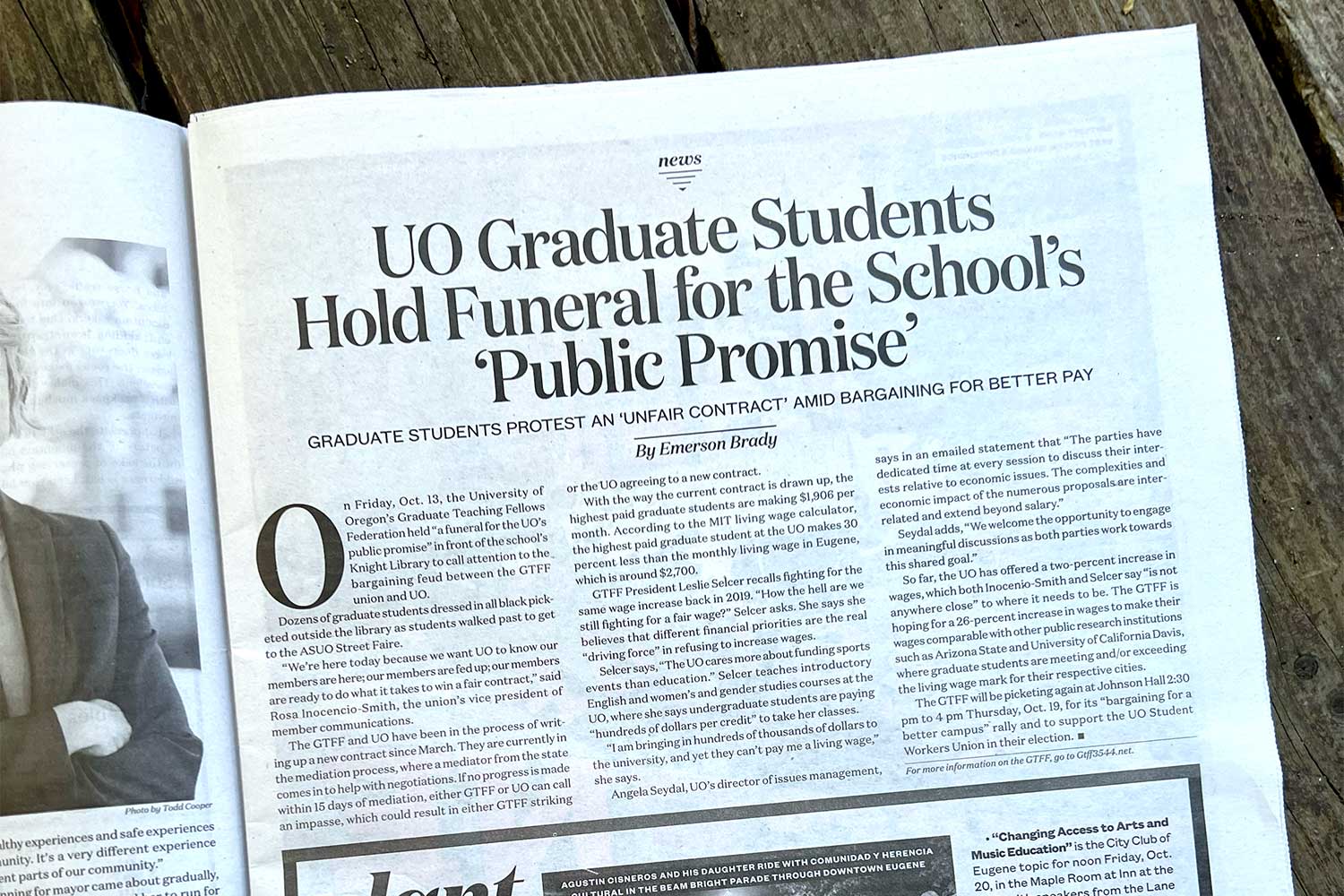
On Friday, Oct. 13, the University of Oregon’s Graduate Teaching Fellows Federation held “a funeral for the UO’s public promise” in front of the school’s Knight Library to call attention to the bargaining feud between the GTFF union and UO.
Dozens of graduate students dressed in all black picketed outside the library as students walked past to get to the ASUO Street Faire.
“We’re here today because we want UO to know our members are here; our members are fed up; our members are ready to do what it takes to win a fair contract,” said Rosa Inocencio-Smith, the union’s vice president of member communications.
The GTFF and UO have been in the process of writing up a new contract since March. They are currently in the mediation process, where a mediator from the state comes in to help with negotiations. If no progress is made within 15 days of mediation, either GTFF or UO can call an impasse, which could result in either GTFF striking or the UO agreeing to a new contract.
With the way the current contract is drawn up, the highest paid graduate students are making $1,906 per month. According to the MIT living wage calculator, the highest paid graduate student at the UO makes 30 percent less than the monthly living wage in Eugene, which is around $2,700.
GTFF President Leslie Selcer recalls fighting for the same wage increase back in 2019. “How the hell are we still fighting for a fair wage?” Selcer asks. She says she believes that different financial priorities are the real “driving force” in refusing to increase wages.
Selcer says, “The UO cares more about funding sports events than education.” Selcer teaches introductory English and women’s and gender studies courses at the UO, where she says undergraduate students are paying “hundreds of dollars per credit” to take her classes.
“I am bringing in hundreds of thousands of dollars to the university, and yet they can’t pay me a living wage,” she says.
Angela Seydal, UO’s director of issues management, says in an emailed statement that “The parties have dedicated time at every session to discuss their interests relative to economic issues. The complexities and economic impact of the numerous proposals are interrelated and extend beyond salary.”
Seydal adds, “We welcome the opportunity to engage in meaningful discussions as both parties work towards this shared goal.”
So far, the UO has offered a two-percent increase in wages, which both Inocencio-Smith and Selcer say “is not anywhere close” to where it needs to be. The GTFF is hoping for a 26 percent increase in wages to make their wages comparable with other public research institutions such as Arizona State and University of California Davis, where graduate students are meeting and/or exceeding the living wage mark for their respective cities.
The GTFF will be picketing again at Johnson Hall 2:30 pm to 4 pm Thursday, Oct. 19, for its “bargaining for a better campus” rally and to support the UO Student Workers Union in their election.
For more information on the GTFF, go to Gtff3544.net.