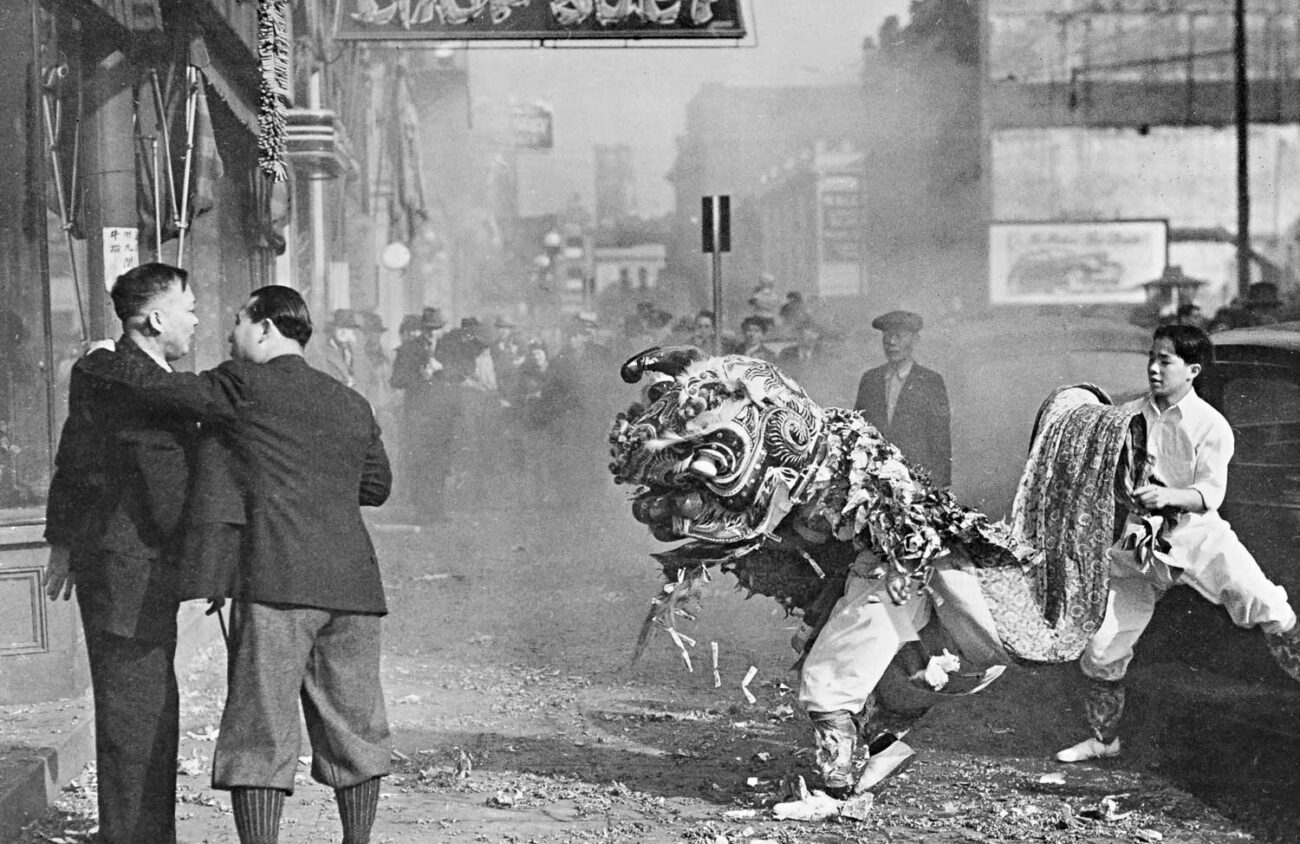
Fragments from a Chinese mining camp dated to the late 1800s found at Malheur National Forest, a gong used in the Portland Rose Festival in 1928, a mahjong set from Portland, dating to about 1929: These things are on display through March 2026 at the Museum of Natural and Cultural History, along with a lot of other objects from our state’s past, in the exhibit Roots and Resilience — Chinese American Heritage in Oregon.
Some materials are shown behind display cases and others, like games and puzzles, are left out on tables, inviting visitors to play.
Material culture, historic images and documents are all part of a show that aims to present an accurate picture of the role that early Chinese immigrants had in Oregon’s history — which is that they helped to shape it.
Ask anyone how the West was populated, that is after the first Americans migrated to the Pacific Northwest thousands of years ago, and you’ll likely hear a story about the Gold Rush. Co-curator of the exhibit, Chelsea Rose, says she grew up in Gold Rush country in California and refers to that story as “the myth of the West.”
In popular culture, and even in schools, the story of how the West was formed has often excluded Chinese immigrants. If depicted at all, they have been presented as laborers, stereotypes who did not make any significant contribution. Moving through this exhibit, some early Chinese workers are pictured as miners. But also, we find out, they brought advanced mining technology with them from China.
They held dangerous jobs building the railroad but also worked in agriculture and salmon fishing. They were merchants and created communities where they continued to practice customs brought from home and where they formed networks that allowed them to send money back to their families.
You may not be surprised to learn that the first Chinese immigrants who came to America during the mid-19th century did so because their own country was in social, political and economic turmoil. While they found work in Oregon, they also found discrimination. Exclusionary laws against them were written in Oregon’s constitution in 1859, the year the state was admitted into the union.
A page from this part of our history is blown up and on display: “No Chinaman, not a resident of this State at the time of the adoption of this constitution shall ever hold any real estate…”
Enlarged images of historical documents are often grainy, but the photographs, especially, bring to life faces and places to go along with the names. Like the image of Gee Deen, an early Eugene Chinese resident who was born in 1865 and worked at a laundry near where the Eugene Hotel stands today. The photo, courtesy of Lane County History Museum, shows Deen with a bicycle, illustrating that at least this one mode of transportation in Eugene has remained the same over the past 150 years.
Roots and Resilience reflects about a decade’s worth of work done by the Oregon Chinese Diaspora Project, an organization that describes itself as a “grassroots local/state/federal partnership.”
Rose is a historical archaeologist and director of the multidisciplinary team of archaeologists, historians, anthropologists and academics whose research specializes in fields ranging from lithic technology and GIS-mapping to zooarchaeology and education.
Her introduction to Oregon’s early Chinese residents occurred about 20 years ago when she was a graduate student at the University of Oregon going out to John Day, an eastern Oregon town historically home to a Chinese community that included a store, medical center, residence and community center.
Now, after co-founding the Oregon Chinese Diaspora Project, being its director, and co-curating this exhibit (along with Jennifer Fang), Rose hopes that one day soon Chinese immigrants will simply be known as Oregonians.
This simple hope doesn’t seem all that unattainable. But the times we are living in present new challenges. Discrimination against immigrants in general has recently grown to alarming heights. As one display on exhibit suggests, might we be experiencing echoes of the past? And on the local level, Asian Americans have been targets of a series of robberies, which law enforcement officials are referring to as a trend.
Nevertheless, Rose says, we’re “moving the needle” on the myth.
Museum of Natural and Cultural History is open 10 am to 5 pm Wednesday through Sunday and until 8 pm on Thursdays at 1680 East 15th Avenue. Admission starts at $7, free for Lane Community College and UO students/staff. Check Natural-history.uoregon.edu for holiday hours.