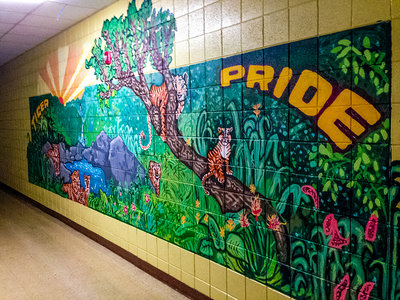
Walking through the dark empty corridors of Oaklea Middle School on a muggy August day, Principal Brian Young opens a door and flicks on the light. The classroom that comes into focus is filled with tables, colorful cabinets and student artwork tacked to the walls — all covered in the patina of art projects lingering from yesteryear.
“It’s kind of sad coming in here knowing,” Young pauses. “I think it’s probably been seven to 10 years since Oaklea had an actual art elective as a class.”
This year at the Junction City middle school, however, is going to be different. In June, the Oregon Community Foundation (OCF) awarded its first-ever “Studio to School” grants for collaborative projects between schools and community arts organizations across the state. Each grantee will receive $70,000 a year for three years, with the potential of receiving $35,000 in both the program’s fourth and fifth years if proven successful.
Jeff Geiger, a Eugene program officer for OCF, notes, “I was a grant writer for five years and I’ve never seen a grant like this. Not only is it $70,000 year after year, but it’s really geared towards transformation and really geared towards innovation.”
OCF chose 18 projects, two of which are in Lane County — The Shedd’s music education program with Agnes Stewart Middle School and Lane Art Council’s arts enrichment program with Oaklea.
The Oaklea progam will provide arts education in 10-12 week sessions beginning with 2014’s sixth-grade class, and following the group through eighth grade. The curriculum will then be in place for future classes to use. For Oaklea — a Title 1 low-income school of 500 students where 62 percent of the students qualify for free or reduced lunch — the Studio to School grant’s size and scope can transform a community.
“Still to this day, students come up to me saying, ‘We would really like more opportunities for the arts,’” Young says, now sitting in the principal’s office. “This Studio to School grant is really going to magnify everything that we’ve attempted to do for enrichment.”
Oaklea and Lane Arts Council (LAC) have been partnering for five years to bring art back into the school, but it was always a piecemeal effort. A five-year afterschool arts program at Oaklea, made possible by a federal 21st Century Learning grant, expired at the end of the 2014 school year.
That program, Young notes, was only available to 50 students, but because of its success, two years ago Oaklea also began using LAC’s artist residencies program, which brings professional artists into the classroom to subsidize curricula teachers already have in place. One artist, Samuel Becerra, whose focus is ancient Latin American cultures, taught students how to make sundials, wooden flutes and clay sarcophagi while they studied ancient civilizations.
“It was a really exciting partnership,” says Lauren Suveges, LAC’s arts education program manager. “He was bringing their lessons to life.”
“That project actually specifically set the stage for our Studio to School grant,” Lane Arts Council Executive Directo Liora Sponko says. “It was the success we had from last year that really showed that wow, this is something schools are telling us they really want.”
This autumn, a planning team of Sponko, Suveges, Eugene artists Kate Ali and Betsy Wolfston, as well as Young and Oaklea teachers, will come together to create an arts program that enhances the current curriculum as well as providing professional development for teachers. The first-year module will begin in January with drawing and painting taught by Ali, followed by sculpture and 3D art with Wolfston. As the program progresses, students will study multimedia arts, graphic design, theater and technology.
Back in the principal’s office, Young discusses the lasting effects of the new program. “My hope is that the art and music classes at the high school will be completely packed,” he says. “That kids are going to be wanting to stand in line to be in those classes.”
A Note From the Publisher

Dear Readers,
The last two years have been some of the hardest in Eugene Weekly’s 43 years. There were moments when keeping the paper alive felt uncertain. And yet, here we are — still publishing, still investigating, still showing up every week.
That’s because of you!
Not just because of financial support (though that matters enormously), but because of the emails, notes, conversations, encouragement and ideas you shared along the way. You reminded us why this paper exists and who it’s for.
Listening to readers has always been at the heart of Eugene Weekly. This year, that meant launching our popular weekly Activist Alert column, after many of you told us there was no single, reliable place to find information about rallies, meetings and ways to get involved. You asked. We responded.
We’ve also continued to deepen the coverage that sets Eugene Weekly apart, including our in-depth reporting on local real estate development through Bricks & Mortar — digging into what’s being built, who’s behind it and how those decisions shape our community.
And, of course, we’ve continued to bring you the stories and features many of you depend on: investigations and local government reporting, arts and culture coverage, sudoku and crossword puzzles, Savage Love, and our extensive community events calendar. We feature award-winning stories by University of Oregon student reporters getting real world journalism experience. All free. In print and online.
None of this happens by accident. It happens because readers step up and say: this matters.
As we head into a new year, please consider supporting Eugene Weekly if you’re able. Every dollar helps keep us digging, questioning, celebrating — and yes, occasionally annoying exactly the right people. We consider that a public service.
Thank you for standing with us!
Publisher
Eugene Weekly
P.S. If you’d like to talk about supporting EW, I’d love to hear from you!
jody@eugeneweekly.com
(541) 484-0519