Alongside baseball, the sport of boxing has provided a seemingly inexhaustible supply of stories for movies to tell. Brutal, lonely and intimately attuned to the American experience of aggressive individualism, boxing exposes the loutish violence that is the secret endgame of all conflict. It just reverses the order.
Crudely put, boxing movies typically break into two distinct categories: the underdog who triumphs (Rocky) and the champion who unravels (Raging Bull). There are variations on the two themes but, in general, these tragic-heroic categories have offered more than enough mythological fuel to keep boxing movies on the screen long after the sport itself has fallen into general disregard.
Working with a script co-written by Jerry Stahl (Permanent Midnight), Canadian-born director Philippe Falardeau complicates the Rocky–Raging Bull paradigm with Chuck, a boxing movie that touchingly overflows its own limited pretensions. The film is warm, funny and surprisingly moving. It dances like a butterfly and stings like a bee.
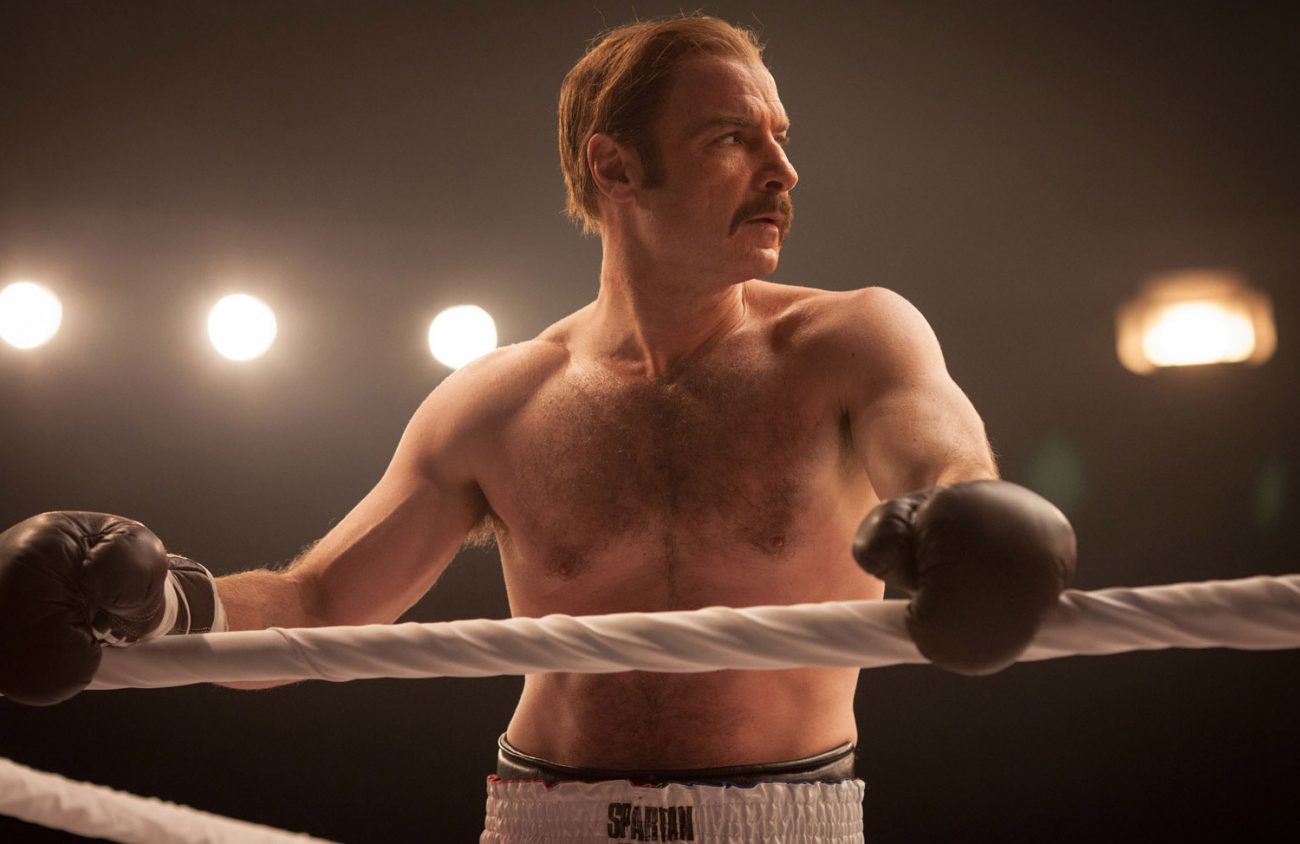
Based on a true story, Chuck centers on the moderate rise and unspectacular fall of Chuck Wepner, the New Jersey fighter who challenged Muhammad Ali for the heavyweight title in 1975. Nicknamed the “Bayonne Bleeder,” Wepner — famous for his ability to take a punch — was the real-life inspiration for Sylvester Stallone’s Rocky Balboa.
As Wepner, Liev Schreiber is pitch-perfect; he brings an irresistible charm to the role of an immature, star-struck goon of a man who is less concerned with winning than with the adulation he receives as a punch-drunk folk hero. The film is by turns wince-worthy and heartbreaking, as Schreiber bumbles and flails through life, the bemused fuck-up you want to forgive just one more time.
And Schreiber is surrounded by a dream cast: Elisabeth Moss as his distressed, impossibly dignified wife; Ron Perlman as his gruff manager; Jim Gaffigan as the toadying friend, always hovering by his side; Pooch Hall, who excels in the difficult role of Ali; and Michael Rapaport as Chuck’s estranged brother.
One of the film’s greatest pleasures is watching the embattled chemistry that develops slowly between Chuck and the wise, wizened bartender he romances, played by Schreiber’s real-life wife, Naomi Watts. It’s a treat to watch two such accomplished actors bounce off each other with such poise — think of the wry, sexy heat that sparked between Bogart and Bacall.
Chuck adds absolutely nothing to the outward architecture of the standard biopic; it hits all the familiar points of interest, and it does so on a reduced scale that is completely in keeping with its subject. The film is so formalized that, at times, it plays like an expert homage to Martin Scorcese by way of Paul Tomas Anderson, complete with coked-up boogie nights, slapstick masculinity and a marble-mouthed voice-over by Schreiber.
And yet, because it never swings wildly for the knockout punch, Chuck achieves a level of authenticity that is rather remarkable, thanks in large part to the vulnerability of Schreiber’s performance. This is a quietly explosive film that moves with uncommon grace within its own squared parameters, like Ali dancing around the ring. And it pulls a kind of rope-a-dope on your emotions, wearing you down with beautiful, excruciating scenes of humanity. Unlike most movies of its kind, its posture is defensive, forever throwing up the gloves against the next haymaker.
In a season of endlessly recycled aliens and superheroes, Chuck is one of the sleeper hits of the year — a bittersweet boxing film whose toughest jabs come from the hard knocks of everyday life: marriage, family, parenting and surviving our own stupidity before, on quaking knees, we stand up to take another swipe. (Bijou Art Cinemas)
A Note From the Publisher

Dear Readers,
The last two years have been some of the hardest in Eugene Weekly’s 43 years. There were moments when keeping the paper alive felt uncertain. And yet, here we are — still publishing, still investigating, still showing up every week.
That’s because of you!
Not just because of financial support (though that matters enormously), but because of the emails, notes, conversations, encouragement and ideas you shared along the way. You reminded us why this paper exists and who it’s for.
Listening to readers has always been at the heart of Eugene Weekly. This year, that meant launching our popular weekly Activist Alert column, after many of you told us there was no single, reliable place to find information about rallies, meetings and ways to get involved. You asked. We responded.
We’ve also continued to deepen the coverage that sets Eugene Weekly apart, including our in-depth reporting on local real estate development through Bricks & Mortar — digging into what’s being built, who’s behind it and how those decisions shape our community.
And, of course, we’ve continued to bring you the stories and features many of you depend on: investigations and local government reporting, arts and culture coverage, sudoku and crossword puzzles, Savage Love, and our extensive community events calendar. We feature award-winning stories by University of Oregon student reporters getting real world journalism experience. All free. In print and online.
None of this happens by accident. It happens because readers step up and say: this matters.
As we head into a new year, please consider supporting Eugene Weekly if you’re able. Every dollar helps keep us digging, questioning, celebrating — and yes, occasionally annoying exactly the right people. We consider that a public service.
Thank you for standing with us!
Publisher
Eugene Weekly
P.S. If you’d like to talk about supporting EW, I’d love to hear from you!
jody@eugeneweekly.com
(541) 484-0519