You know how you can see a movie or read a book and not like it, and then revisit it years later and love it, or vice versa? That sort of experience reminds us that our response to an artwork isn’t absolutely dependent on the work. It depends, as well, on where we are in life and the experiences we are having.
I happen to be reading a novel about time travel at the moment. I’m thinking about living in a world in which you can go back and try to fix what you’ve done. So when Eugene painter Robert Schlegel told me how he had altered his artwork CM 3 years after creating it, and just before this show of his work at the Karin Clarke Gallery, I appreciated the painting in terms of how the artist was able to change the past to make it better.
This is what happens sometimes, Schlegel says, when he keeps a painting around for years: “It becomes less precious.”
With time he is less attached to what he did and is more willing to take a chance and change the picture.
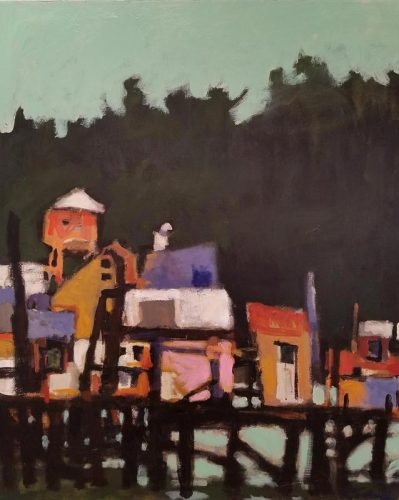
CM 3 depicts a familiar scene to anyone who has lived or traveled the coastal Northwest. The subjects are buildings on a pier, a bit lopsided as if they have been around for a long while. They are painted in bright pastel colors that render them beautiful in contrast to a dark, almost black background, recognizable as trees.
It’s the green color of the sky in this painting, a green that complements these pastel colors, that first caught my eye, a green that didn’t exist in the painting until just before this show went up at Karin Clarke Gallery. The painting had a gray strip for sky before.
“It was okay,” Schlegel says. “It was a different mood, more somber.”
He likes the painting better now.
Before looking at this painting with the artist I looked at it with Emma Rose Lynn and Alex Abrams, local musicians out for the First Friday ArtWalk. They were taken by the color, too, and the three of us speculated about what time of day Schlegel was trying to represent — dawn or dusk.
Neither, the artist said to me later. “It’s about the color.”
In an Oregon Art Beat episode on October 20, 2016, Schlegel discusses the past in relation to his interest in painting structures.
“There’s something about the structures within me,” he says, “that I can’t seem to ever get rid of.” He thinks part of it has to do with his grandmother’s house in Washington state, where he spent holidays as a child.
“Maybe it came from there?” he wonders.
Schlegel isn’t interested in time travel, as I am at the moment (though maybe he is — I didn’t ask). But he is fascinated by what was. He sketched Centennial Mills along the Willamette River in Portland as it was being torn down. Of that experience he said, also on OPB, “There’s a building there one day, and then a week later there’s a big gap.”
Looking at Schlegel’s colorful acrylic and oil paintings, and his smaller mixed-media works, one of which is inspired by the demolition of Centennial Mills, I am struck — as were others at the opening of this show — by the familiarity of the subject matter.
Lynn, who was raised in Oregon, described it as, “I know that.”
She recognized the landscapes and the portraits, especially the man in the painting called Yellow Bibs, because that’s what fishermen look like where she is from. And even I, a relatively recent transplant to Oregon, “knew that,” too.
Robert Schlegel: Varied Themes runs at the Karin Clarke Gallery, 760 Willamette Street, through June 30.