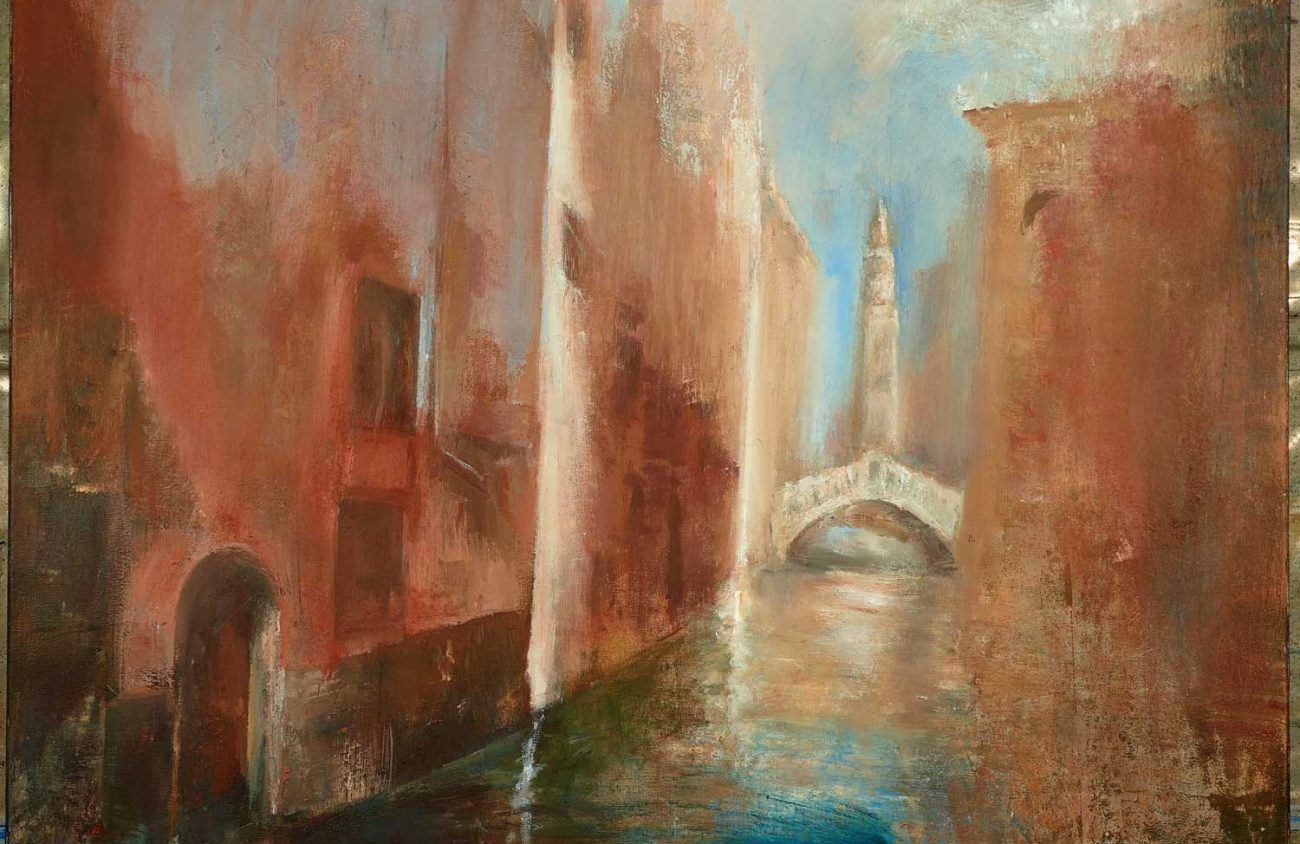
I’m guessing Margaret Coe has been asked before why she goes to Venice to paint. She began her talk at the opening of her show of new paintings at Karin Clarke Gallery earlier this month by asking the question herself.
“Why Italy?”
Paris is typically thought of as the City of Light, she explained, but when she’s been to Paris the light was mostly overcast. Coe told the crowd that she found better light in Venice, hence the title: Margaret Coe: The City of Light.
In Venice she saw light reflected from the canals onto almost everything. It is this light that we see represented in her impressionistic paintings of the city she refers to as a “jewel.”
Venice’s recent flooding reminds Coe that the city is vulnerable to rising sea levels, and so this jewel is not necessarily always going to be around. This seemingly opposite combination of concerns — light and loss — is present in the 22 paintings that fill the gallery. The views of Venice are filled with light. Loss is addressed in the form of appreciation for what we can still see.
The English artist J.M.W. Turner (1775-1851), one of Coe’s favorite painters, is known for saying, “My job is to paint what I see, not what I know.”
The sentiment could stand as a rallying cry for the first movement of modern art, Impressionism, and also for working en plein air — painting outdoors. Working out of the studio, artists respond to a changing environment. A breeze, a movement of a cloud, can affect the way light falls and require a response different from one that might have been planned.
Except for five larger paintings in the show, Coe painted outside on the streets in Venice, on the spot rather than in a studio using photographs, sketches, memory or working from what she “knows.”
Coe says when Turner went to Venice it changed the way he painted. It seems she had this change in mind for her own work even before she left Eugene. She ordered a new type of canvas before the trip, and the switch from standard cotton canvas to fine-grade linen meshed with the way she saw her subjects. As a result her paintings “took on a new lightness,” the artist says.
Karin Clarke, gallery owner and Coe’s daughter, is pictured looking directly at the viewer in A Refined Quandary and Bargain With Death, one of the larger paintings (30”x40”) in the show. This painting took several months to complete; it depicts a scene common to Venice: a canal, a bridge and passersby.
The initial scene wasn’t populated when Coe painted it. Working in the studio she thought it needed to be. She referenced photographs she had taken and inserted figures: a few pedestrians, a woman standing and wearing a hat — her daughter — and another woman in the foreground painting the scene — herself.
Even an artwork that has no people as subjects in it, such as An Unlived Life, has autobiographical overtones. A canal leads the viewer through the painting to a bridge and a tower beyond. As she was painting Coe thought of her late grandson Marcus Schwartz, whose life tragically ended in 2011 while he was still an infant.
An Unlived Life may be a painting of a place, but it is also a tribute and homage to a person: a painting of light and of loss.
Margaret Coe: The City of Light continues at Karin Clarke Gallery through Saturday, Dec. 1.
A Note From the Publisher

Dear Readers,
The last two years have been some of the hardest in Eugene Weekly’s 43 years. There were moments when keeping the paper alive felt uncertain. And yet, here we are — still publishing, still investigating, still showing up every week.
That’s because of you!
Not just because of financial support (though that matters enormously), but because of the emails, notes, conversations, encouragement and ideas you shared along the way. You reminded us why this paper exists and who it’s for.
Listening to readers has always been at the heart of Eugene Weekly. This year, that meant launching our popular weekly Activist Alert column, after many of you told us there was no single, reliable place to find information about rallies, meetings and ways to get involved. You asked. We responded.
We’ve also continued to deepen the coverage that sets Eugene Weekly apart, including our in-depth reporting on local real estate development through Bricks & Mortar — digging into what’s being built, who’s behind it and how those decisions shape our community.
And, of course, we’ve continued to bring you the stories and features many of you depend on: investigations and local government reporting, arts and culture coverage, sudoku and crossword puzzles, Savage Love, and our extensive community events calendar. We feature award-winning stories by University of Oregon student reporters getting real world journalism experience. All free. In print and online.
None of this happens by accident. It happens because readers step up and say: this matters.
As we head into a new year, please consider supporting Eugene Weekly if you’re able. Every dollar helps keep us digging, questioning, celebrating — and yes, occasionally annoying exactly the right people. We consider that a public service.
Thank you for standing with us!
Publisher
Eugene Weekly
P.S. If you’d like to talk about supporting EW, I’d love to hear from you!
jody@eugeneweekly.com
(541) 484-0519