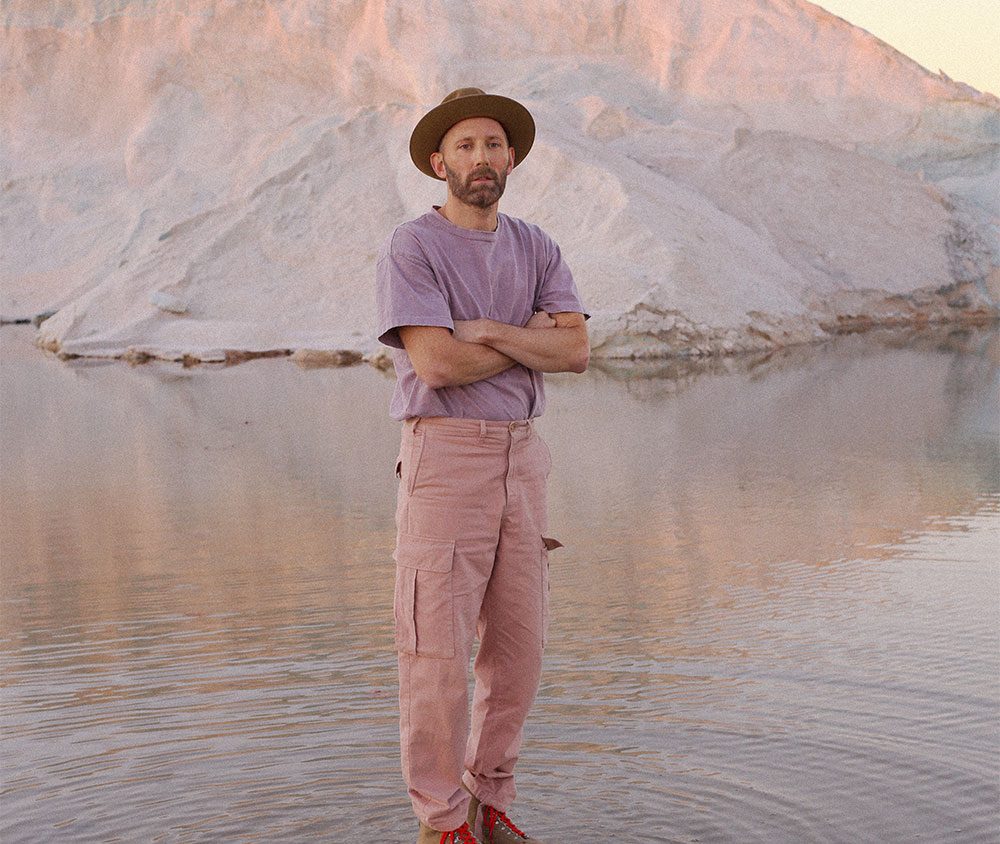
In 2019, when it was time for acoustic-pop songwriter Mat Kearney to work on new material, he reached out to his best friend from South Eugene High School. Pitching the idea to his buddy, Marshall Roeman, who is an artist himself, Kearney said, “Let’s create together.” Kearney would write and record, and Roeman would paint. Along with the songwriter Eli Teplin, the two friends rented a place in Joshua Tree National Park.
The writer of a score of top-20 adult contemporary hits from the past two decades, Kearney, who now lives in Nashville, graduated from South Eugene in the mid-‘90s. With recent millennial folk-pop sensibilities, Kearney’s seventh studio album, January Flower, is out now.
Kearney says it’s his most personal record to date, and much of the music was written at Joshua Tree.
Shortly after the two old friends arrived at the park, a record rainfall came. “Wiped the whole house out,” Kearney remembers: no power, no Wi-Fi, no phone. All the recording equipment Kearney packed was useless. “We were in the middle of nowhere,” Kearney says.
Kearney thought, “What am I going to do? I’ll just start writing songs,” he says. The solitude, with only the company of Teplin and his best friend, reminded Kearney of how it all started, picking up a guitar for the very first time as a college student back at Cal State University, Chico.
Until now, Kearney’s best-known song is perhaps “Coming Home (Oregon),” a sweeping and cinematic acoustic tune with an accompanying music video of quintessential Oregon scenes and Ducks football footage from throughout the ages. The song has been adopted as an anthem by Duck fans near and far — and sung at games — as well as by homesick Oregonians all over the world and from every corner of the state.
Growing up in Oregon, and in Eugene specifically,
a city that’s supportive of the arts but a long way from anything resembling the entertainment industry, taught Kearney some valuable lessons.
“The beauty of growing up in Eugene: the heroes were idealists,” Kearney says, like the Bobs, both Dylan and Marley.
Creativity in Eugene, Kearney says, “had nothing to do with the entertainment industry. It had to do with passion and artistic expression. Eugene was a really special place because people valued the arts. It’s a worthy pursuit, a beautiful pursuit. I’ve traveled the world. That’s not the norm.”
And neither was it the norm for Kearney, a touring musician, to spend so much time at his Nashville home in 2020, much like the rest of us.
Shortly before the pandemic, Kearney became a father. Making the best of a bad situation, he took the opportunity to get to know his brand-new daughter. This gives the record an autumnal tone.
That extra time also allowed him to work, blending older material with stuff written at Joshua Tree, and even writing some new songs.
Kearney explains, “We let it breathe. 2020 gave us space to explore,” putting finishing touches on the music, and stripping back the production.
When grinding on a record, the songwriter continues, it’s easy to lose perspective. Last year, there was no deadline. “I found it refreshing being home,” Kearney says.
Much of Kearney’s easygoing, decaf acoustic leanings from “Coming Home (Oregon)” continue in the new album’s music, with light hip-hop influences on songs like “Grand Canyon” — freestyle rap was the first music he fell in love with as a teenager, he says — and some Southern sense from his adopted hometown emerging on songs like “Boulder.”
Throughout, Kearney’s voice — sounding an awful lot like Chris Martin from Coldplay at times, and other times a bit like Mark Knopfler — sings personal lyrics aimed squarely at the post-millennial generation: the optimism and freedom of youth contained in a single electronic device held in the palm of our hand.
On “Say it Now,” he sings, “Just you and me and the light of the screen and it don’t change/ I keep staring at three dots on my phone/ Wanna know your thoughts before they’re gone.”
Still, there is a more mature voice in the music, with songs about the passage of time and watching your child grow.
“Time tested, bigger ideas,” Kearney says: the kind of stuff he wouldn’t have written about five or six years ago.
While making the record, Kearney says, “We really concentrated on creating a body of work rather than a collection of singles,” with a natural flow, almost like a movie.
To get that job done, though, Kearney had to keep his deliberative tendencies in check.
“I’m a recovering perfectionist,” he says.
Mat Kearney’s January Flower is out now on all major streaming platforms and wherever music is sold.
A Note From the Publisher

Dear Readers,
The last two years have been some of the hardest in Eugene Weekly’s 43 years. There were moments when keeping the paper alive felt uncertain. And yet, here we are — still publishing, still investigating, still showing up every week.
That’s because of you!
Not just because of financial support (though that matters enormously), but because of the emails, notes, conversations, encouragement and ideas you shared along the way. You reminded us why this paper exists and who it’s for.
Listening to readers has always been at the heart of Eugene Weekly. This year, that meant launching our popular weekly Activist Alert column, after many of you told us there was no single, reliable place to find information about rallies, meetings and ways to get involved. You asked. We responded.
We’ve also continued to deepen the coverage that sets Eugene Weekly apart, including our in-depth reporting on local real estate development through Bricks & Mortar — digging into what’s being built, who’s behind it and how those decisions shape our community.
And, of course, we’ve continued to bring you the stories and features many of you depend on: investigations and local government reporting, arts and culture coverage, sudoku and crossword puzzles, Savage Love, and our extensive community events calendar. We feature award-winning stories by University of Oregon student reporters getting real world journalism experience. All free. In print and online.
None of this happens by accident. It happens because readers step up and say: this matters.
As we head into a new year, please consider supporting Eugene Weekly if you’re able. Every dollar helps keep us digging, questioning, celebrating — and yes, occasionally annoying exactly the right people. We consider that a public service.
Thank you for standing with us!
Publisher
Eugene Weekly
P.S. If you’d like to talk about supporting EW, I’d love to hear from you!
jody@eugeneweekly.com
(541) 484-0519