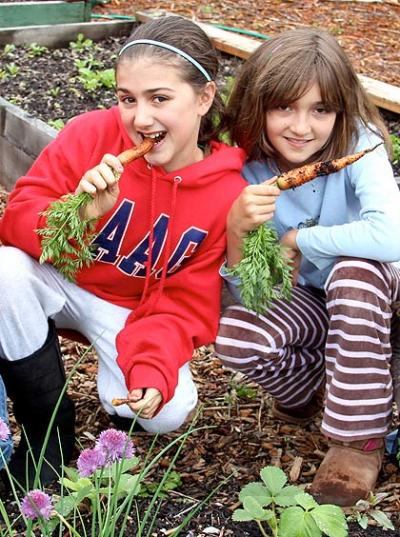
There is perhaps no better teacher than Mother Nature. Her curriculum is seasonal and her pedagogy is patience. And though we may at times ignore her lessons, her classroom remains willing to receive us. It is this truth that inspired Lydia Scott and Leela Greensberg to create the Grateful Growers Summer Camp for kids age 5-10.
“Kids need to be outside more, engaging the natural world and learning about where food comes from,” Greensberg says.
Based out of the community garden at The Village School, Grateful Growers Summer Camp will run Aug. 6-10 and Aug. 20-24, with a bilingual program focused on permaculture, Spanish and Waldorf curriculum.
“It’s going to be a lot of planting and harvesting and preparing food,” Greensberg says. “Kids will be learning about soil and insects and the communal aspects of growing food.”
During the academic year, Greensberg teaches part-time at The Village School, where Scott functions as the garden coordinator; between these two is a combined 20 years of childcare, teaching and gardening. Although Grateful Growers is its own operation and independent of The Village School, Greensberg and Scott received the go-head to base their work out of the school’s garden — a well-established plot of earth that will serve as a classroom to the campers.
“The outdoor classroom is an important one,” Scott says. “We wanted to offer kids a camp where they are connected to their food and the earth.”
Food is the best way to connect people to the natural world, Scott says, and as far as she and Greensberg are concerned, the earlier this connection is established in someone, the better.
But it won’t be all seedlings and spades for these campers. The traditional staples of any solid summer camp, such as games, field trips, storytelling and art projects, will be thrown into the mix as well — but with a bilingual twist.
“It’s really important for kids to be exposed to more than one language,” Greensberg says. “Having the bilingual part of the camp puts them around Spanish in a way that is functional and can help them learn it better.”
Greensberg says the campers will be spoken to in Spanish from time to time, as well as being told stories in Spanish as well. She says that while the camp is not intended to be a full-immersion program, the campers will be engaged in Spanish every day.
Although this is Grateful Growers Summer Camp’s first year, Scott and Greensberg foresee the program being a long-term project that will nurture the community and hopefully reach kids who would otherwise not be able to attend a summer program.
“We are looking into getting grants for next year’s program,” Greensberg says. “That way we can reach families who don’t have the money to put a kid in summer camp. It didn’t happen this year because we are so busy getting started up, but soon.”
For more information on Grateful Grower’s Summer Camp, send
an email to gratefulgrowersummercamp@gmail.com or call 343-1583.
A Note From the Publisher

Dear Readers,
The last two years have been some of the hardest in Eugene Weekly’s 43 years. There were moments when keeping the paper alive felt uncertain. And yet, here we are — still publishing, still investigating, still showing up every week.
That’s because of you!
Not just because of financial support (though that matters enormously), but because of the emails, notes, conversations, encouragement and ideas you shared along the way. You reminded us why this paper exists and who it’s for.
Listening to readers has always been at the heart of Eugene Weekly. This year, that meant launching our popular weekly Activist Alert column, after many of you told us there was no single, reliable place to find information about rallies, meetings and ways to get involved. You asked. We responded.
We’ve also continued to deepen the coverage that sets Eugene Weekly apart, including our in-depth reporting on local real estate development through Bricks & Mortar — digging into what’s being built, who’s behind it and how those decisions shape our community.
And, of course, we’ve continued to bring you the stories and features many of you depend on: investigations and local government reporting, arts and culture coverage, sudoku and crossword puzzles, Savage Love, and our extensive community events calendar. We feature award-winning stories by University of Oregon student reporters getting real world journalism experience. All free. In print and online.
None of this happens by accident. It happens because readers step up and say: this matters.
As we head into a new year, please consider supporting Eugene Weekly if you’re able. Every dollar helps keep us digging, questioning, celebrating — and yes, occasionally annoying exactly the right people. We consider that a public service.
Thank you for standing with us!
Publisher
Eugene Weekly
P.S. If you’d like to talk about supporting EW, I’d love to hear from you!
jody@eugeneweekly.com
(541) 484-0519