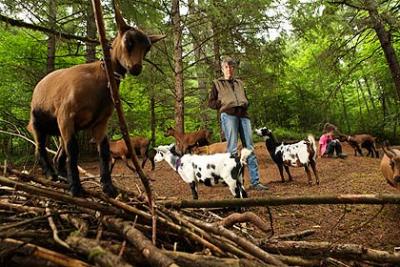
Urban homesteading, backyard farming — call it what you will, the movement for self sufficiency and sustainable living is booming. In Eugene neighborhoods from the South Hills to the Whiteaker it seems like every other house sports a chicken coop or custom greenhouse. Soon, the most dedicated local homesteaders may be able to join ranks of urban farming trailblazers elsewhere who are exploring a new way of bringing the farm to the city: raising miniature goats.
While Portland’s goat-raising community is large enough to organize bike-based tours a la Eugene’s annual Tour De Coop, potential goat farmers here face a more elementary challenge: working with the city government to legalize mini goats on normal-sized city lots. Currently, the city of Eugene’s municipal code lumps miniature goats in with all farm animals besides rabbits and chickens, banning such livestock on lots smaller than 20,000 square feet, or almost half an acre. The code also requires 5,000 square feet of space for each goat over six months old. Earlier this year, the Eugene City Council directed the planning department to come up with a revised livestock code balancing the demand for micro livestock with the requirements of an increasingly dense urban environment.
The term miniature goat covers a multitude of small goat breeds and varieties. Pygmy goats, originating in West and Central Africa, have been crossed with Nigerian, Nubian and Oberian dairy goats, Spanish, Kiko and Boer meat goats and even fiber-producing Angoras. Herd animals that need the company of other goats or friendly animals but don’t do well with most dogs, the little goats range in size from about 50 to 130 pounds.
So why would any sane city dweller want to raise goats in the first place? Aren’t they smelly and ornery and a ton of work to raise? Not really, not at all and not enough to make you quit your day job, answers Cheryl Smith, who has literally written the book on goat care. Two books actually: Goat Health Care and Raising Goats for Dummies.
“They have all of the features of the large-size goat, but just in a smaller package,” she says. “Because of that, they are ideal for the urban resident who wants to get milk.”
Smith, who raises Oberians (mini-Oberhaslis) on her Mystic Acres Farm northeast of Eugene, says that dairy goats are bred for good temperament, making them easier to milk and friendly, enjoyable companions. Only un-neutered males, good for breeding a herd but not pet goat material, are smelly. But, she adds, you can’t just expect to buy a goat, pop it in the backyard and start milking.
Prospective goat owners need to learn proper goat care and prepare their yards, fencing off roses and vegetable gardens or any other precious plants, ridding the yard of any plants or weeds noxious to goats and removing lead-based paint curious goats can nibble. “It’s not to be taken lightly; they are not as easy as chickens,” says Smith, who experienced a steep learning curve her first five years raising goats and lost some animals. “It was a really hard learning experience and I don’t want anyone else to go through that. They can live for 15, 16 years; you can bond with them.”
Bill Bezuk, owner of Eugene’s Backyard Farmer, testified before the City Council in favor of adopting code changes to allow mini goats on smaller city lots. He says he promotes micro-livestock because of their value for sustainability and local food production, and will stock goat feed once the city code changes. He notes that backyard farmers typically start with chickens and progress to beekeeping, with miniature goats being the final frontier for the most dedicated urban homesteaders — people with time on their hands who are willing to take on the extra commitment living with goats requires. “I think that, were the regulations approved, there would be less than 100 people who would want to do goats in their backyard,” Buzuk says.
City of Eugene Land Use Analyst Kristie Brown says the city is reviewing the current code and researching how other cities handle micro-livestock. Most likely, she says, the new code will allow a yet-to-be-determined number of miniature goats on most lots. The planning commission and then the City Council will hold hearings once a draft code change is complete. Anyone interested in the process can put their names on an interested parties list to receive notifications when hearings are scheduled and be able to comment on staff recommendations ahead of time.