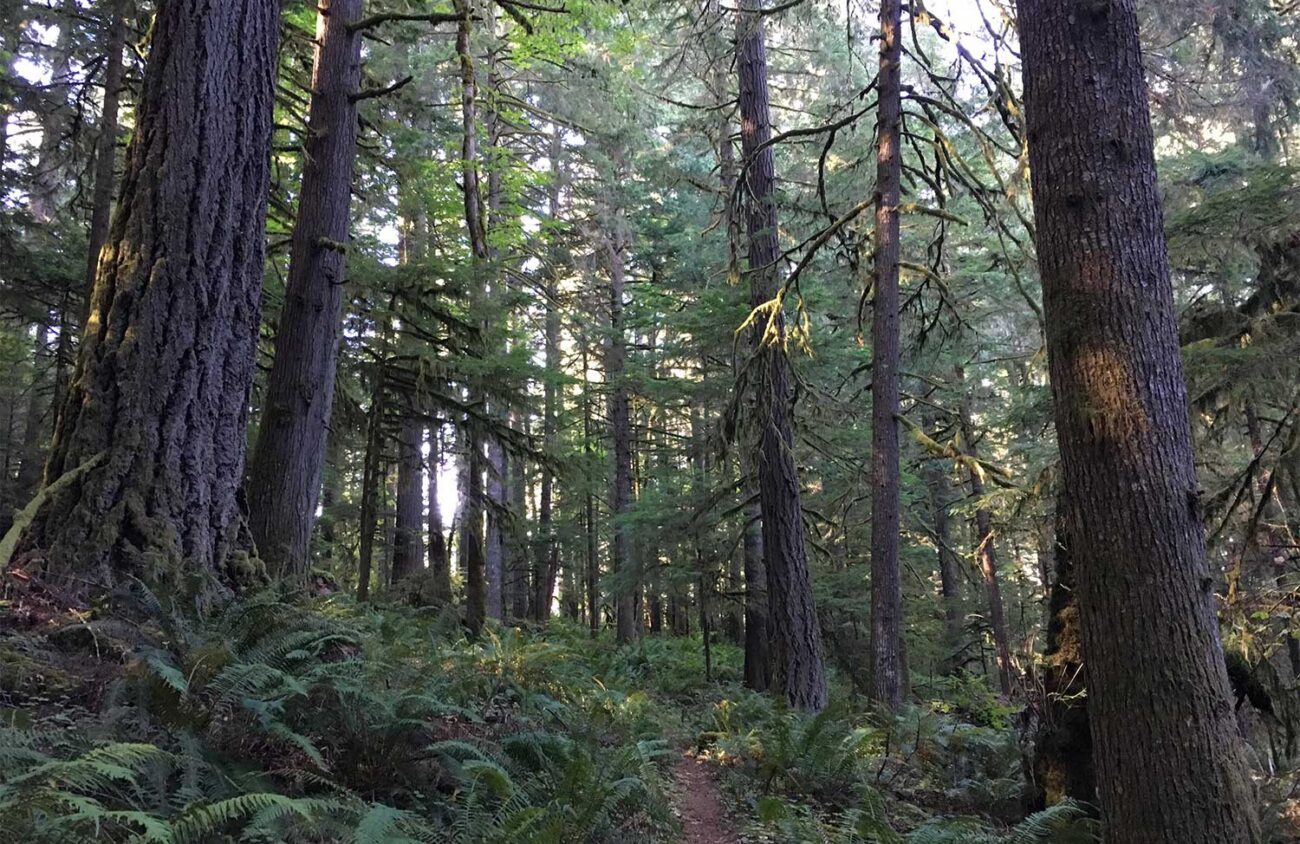
In the winter months, it’s often best to look for hikes at lower elevations and close to home unless you’re set up to deal with real adventures with possible snow, downed trees or road washouts. This year, so far, it’s easier to get to higher elevations (thanks climate chaos!), but it’s still nice to find a good hike close by. One of my go-tos is the South Willamette Trail, just 30 minutes from downtown Eugene.
Never heard of it, you say? The trailhead is better known as Eula Ridge, and you can find it just a few miles past the large and well-marked Hardesty Trailhead along Hwy 58 between Eugene and Oakridge. At milepost 24 look for a small pullout on the right side of the road, at the end of a guard rail and marked with a hiker symbol. No parking pass is required here like at the Hardesty Trailhead, where you’ll find restrooms and other trail options.
While the trailhead may not look like much, this forest trail within the Willamette National Forest is a gem and rarely busy, though you do have to contend with highway noise and use caution at intersections where mountain bikes may be coming down hill.
Heading into the forest, the trail soon crosses a small creek on a wooden bridge. In 0.2 miles, be sure to stay right at a trail junction to take the South Willamette Trail. This parallels the highway for a while, and crosses North Creek — there’s no bridge here but rocks and logs make it possible to cross unless the water is very high. The forest here, as the trail goes up and down gently, includes large Douglas-firs and hemlocks, and all the classic shrubs and ferns that make for a lush, old-growth forest understory. After descending to cross Harper Creek on a log bridge in about 1.5 miles, the trail heads uphill steadily. At about the 2-mile mark you’ll reach a younger forest — previously logged.
This is a decent place to turn around if you just came for the old growth and want a shorter hike. If you continue, the trail flattens out and goes through a few more plantation forest areas, eventually reaching Crale Creek Road and, in five miles, the Hardesty Mountain Trailhead if you want to do a shuttle hike.
As you stroll along, taking in the towering trees and running your fingers across the moss, you may well stop thinking about the troubles of the world outside this forest. Enjoy that for a beat, but then take a minute to consider the troubles that are facing this, and many other, forests and public lands.
Consider the environmental laws and policies put in place over the past several decades to help staunch rampant exploitation and damaging activities on our public forest lands — activities that clearcut ancient forests, punched roads into the backcountry, muddied streams and harmed salmon habitat, and pushed numerous wildlife species to the brink of extinction. These protective policies were fought for by environmental advocates wanting to conserve ecosystems, watersheds and wildlife habitat on our public lands.
Now, an onslaught of actions by the Trump administration, Congress and corporate interests are eroding these protections as well as the very voice the public has in what happens to our most treasured landscapes. From cutting Forest Service budgets and staffing, to repealing the Roadless Area Conservation Rule, to elevating timber production over all other uses of public lands, these attacks on nature and public lands can be overwhelming.
A new Oregon Wild report helps make sense of what’s going on and highlights places across the state that illustrate how these attacks could play out on the ground — from the Oregon Dunes to the McKenzie River headwaters.
In the coming months, we, the public who love our public lands, will have the opportunity to weigh in on efforts to repeal the Roadless Area Conservation Rule and proposed changes to the Northwest Forest Plan that could increase logging in forests like those along the South Willamette Trail. Just as importantly, our elected federal representatives will have the opportunity to stand up against the efforts to dismantle environmental laws, vote down damaging bills like the so-called “Fix Our Forests Act,” and to advance legislation that protects wild, roadless areas and rivers. Find out more with groups like Oregon Wild and Cascadia Wildlands.
Chandra LeGue of Eugene is the author of the book Oregon’s Ancient Forests: A hiking guide and is the senior conservation advocate at the nonprofit organization Oregon Wild.