
Eugene’s School District 4J has many school buildings that date to the post-war era of the 1940s and ’50s and some elementary schools have 40 doors to the outside, a security concern. Most of these cheaply built older schools would not stand in a major earthquake and some, like River Road Elementary, have such inadequate ventilation that teachers sometimes evacuate their students when air quality monitors warn of bad air.
Measure 20-210 on the May 21 ballot would authorize the district to sell $170 million in bonds to replace four old school buildings, renovate other buildings, improve technology and instructional materials, upgrade security, buy new buses and make other improvements. No organized opposition to the measure has appeared so far.
The estimated cost to the median homeowner (assessed value of $174,000) would be 24 cents per $1,000 in value or about $42 a year. The new total of bonded debt repayment would rise to $1.60 per $1,000 until 2017 when an earlier bond will be paid off. At that time, voters may see another bond measure on the ballot since school facility upgrading is a long-term process and four more schools, including North Eugene High School, are on the list for replacement or repair.
“The measure allows for smart repairs to some of the really older buildings in the district that will save money in the long run and allow more money to be spent in the classroom,” 4J School Board Chair Jennifer Geller says. “It will fund technology improvements in every school in the district.”
Geller says about 40 percent of computers in the district don’t run current software. The measure will also update instructional materials for every school: new math, new writing curricula and new science equipment at the secondary level. And it will improve school security with key card access and video surveillance.
Four of the “most dilapidated schools in the district” will be replaced, Geller says: Roosevelt and Jefferson middle schools and Howard and River Road elementary schools. The gymnasiums at Jefferson will be saved. Renovations are also planned for Gilham Elementary and Kelly Middle School. The architecturally and culturally significant 87-year-old brick Edison Elementary School will be saved for now, despite its problems. Roosevelt has a large site that will likely be rebuilt where the tennis courts are currently, rather than at the Civic Stadium site.
School bonding was restricted by the Oregon Constitution to be only for new construction, but in 2010 voters approved Measure 68, allowing capital bonding for renovations, repairs and other needs. Measure 5 and other tax-restricting laws have made it difficult for school districts to raise additional money for staffing and reducing class sizes. But bonding is not restricted like property taxes.
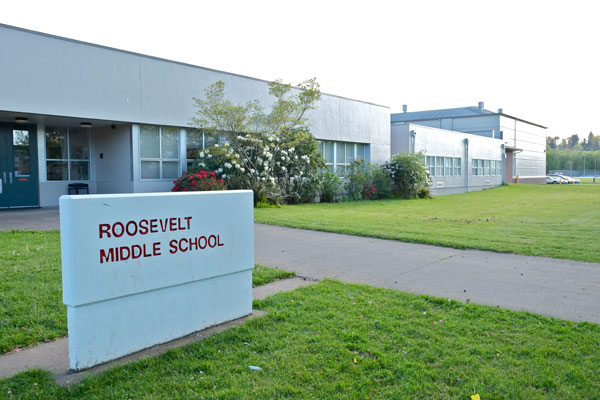 |
| Roosevelt has safety issues with bus loading and unloading around the back. Photo by Ted Taylor. |
“This is one of the only ways we can get money into this district,” says Laura Illig, chair of the Yes for 4J Schools campaign. Bonding is “really significant for our district because we have some investments we need to make and there is no money in the general fund, things like science curriculum and equipment,” she says. “We’ve been putting off replacing buses and making general repairs, and without bond funding those things would come out of the general fund.”
No dollar amount has been calculated on what the district will save with this new investment in capital improvements, but Geller and Illig figure the savings will be significant over time. The new and remodeled buildings will be more energy efficient and general funds will not be needed to cover technology and curriculum updates, new buses and general repairs. And by not delaying construction projects, the district can take advantage of low bond interest rates and the currently lower costs for materials and labor.
More about the measure can be found at yesfor4jschools.com and 4j.lane.edu.