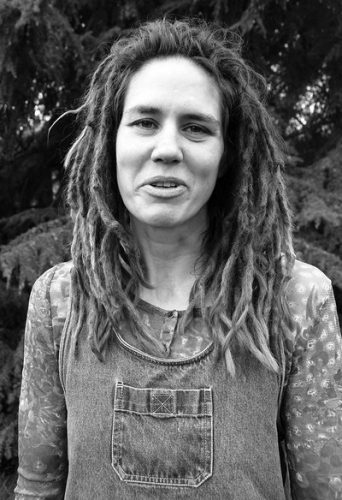
Farm girl Mia Nelson grew up outside of Glencoe, Minnesota, where her dad managed the local Green Giant packing plant. “The world’s largest corn-packing plant,” she says. “I worked there summers.” After two years at Rice University in Houston, she transferred to Oregon State to study biochemistry. “I wanted to be a vet,” she says, “but I quit school to work for the Green Tortoise bus company.” GT had a shop in Lowell, where buses were converted for cross-country touring. She worked there three years, drove a couple of trips and met her husband, Richard Johnson. In 1992, with the help of her dad, who took early retirement and moved west, they bought a 500-acre farm near Lowell, where they now raise self-reliant New Zealand Kiko goats. Learn about Kikos at the Lookout Point Ranch web site. Their land purchase included a tract within the town of Lowell. “We blundered into becoming developers,” says Nelson, who spent 15 years dividing and selling the land. “I lost my ignorance and learned how land-use decisions get made.” When she saw how population forecasts could be manipulated to influence urban growth boundary decisions, she began volunteering for LandWatch Lane County. In 2009, she was hired by 1000 Friends of Oregon as its Willamette Valley Advocate. As a member of the Technical Resource Group that advises the Envision Eugene planning process, she found an error in the way population density had been calculated. Corrected figures showed that two proposed South Hills expansions wouldn’t be needed. “My work as a developer was helpful,” she says. “Now, I can finally feel proud of what I’m doing.”
A Note From the Publisher

Dear Readers,
The last two years have been some of the hardest in Eugene Weekly’s 43 years. There were moments when keeping the paper alive felt uncertain. And yet, here we are — still publishing, still investigating, still showing up every week.
That’s because of you!
Not just because of financial support (though that matters enormously), but because of the emails, notes, conversations, encouragement and ideas you shared along the way. You reminded us why this paper exists and who it’s for.
Listening to readers has always been at the heart of Eugene Weekly. This year, that meant launching our popular weekly Activist Alert column, after many of you told us there was no single, reliable place to find information about rallies, meetings and ways to get involved. You asked. We responded.
We’ve also continued to deepen the coverage that sets Eugene Weekly apart, including our in-depth reporting on local real estate development through Bricks & Mortar — digging into what’s being built, who’s behind it and how those decisions shape our community.
And, of course, we’ve continued to bring you the stories and features many of you depend on: investigations and local government reporting, arts and culture coverage, sudoku and crossword puzzles, Savage Love, and our extensive community events calendar. We feature award-winning stories by University of Oregon student reporters getting real world journalism experience. All free. In print and online.
None of this happens by accident. It happens because readers step up and say: this matters.
As we head into a new year, please consider supporting Eugene Weekly if you’re able. Every dollar helps keep us digging, questioning, celebrating — and yes, occasionally annoying exactly the right people. We consider that a public service.
Thank you for standing with us!

Publisher
Eugene Weekly
P.S. If you’d like to talk about supporting EW, I’d love to hear from you!
jody@eugeneweekly.com
(541) 484-0519