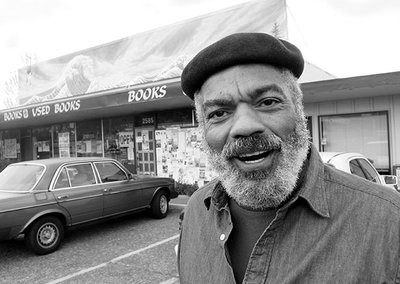
Born on the farm near Cairo, Georgia, where his great-granddad was a sharecropper, Hershell Norwood migrated north with his family as a young child and started school in Orange, New Jersey. After one year of high school, he got a scholarship to Hampton School, a boarding school in New Hampshire. He excelled at football and moved on to Tufts University near Boston. “I played quarterback in high school and running back in college,” he says, “and got a degree in theater.” He began work on an MFA in acting at Brandeis in the late 1970s, then spent a decade selling ad time on NBC Boston. “I did some talent work, acted in programs and TV commercials,” he says. “I finished my MFA in 1990. I wanted to pursue a Ph.D.” He taught at a junior college in Newark, New Jersey, and at Virginia State in Petersburg, and pursued the Ph.D. at Tufts, at the University of Maryland, and at Texas Tech, where he wound up with a master’s in playwriting. Since moving to Eugene in 2009, he has acted in local productions and spent his time writing, working on six plays and a book on African American theater. “Ultimately, I’m a playwright,” he says. Norwood’s newest play, Fell the Tallest Tree, Judgment of Paul Robeson, celebrated its world premiere May 2 as part of the Tsunami Books Play Reading Series. The story envisions Robeson’s death-bed recollections, from the Jazz Age to Red Scare-era persecution. The cast featured LCC professor Stanley Coleman as the singer/actor/activist Paul Robeson and included Lane County NAACP President Eric Richardson. Paperback copies of the play are available for purchase at Tsunami Books.
A Note From the Publisher

Dear Readers,
The last two years have been some of the hardest in Eugene Weekly’s 43 years. There were moments when keeping the paper alive felt uncertain. And yet, here we are — still publishing, still investigating, still showing up every week.
That’s because of you!
Not just because of financial support (though that matters enormously), but because of the emails, notes, conversations, encouragement and ideas you shared along the way. You reminded us why this paper exists and who it’s for.
Listening to readers has always been at the heart of Eugene Weekly. This year, that meant launching our popular weekly Activist Alert column, after many of you told us there was no single, reliable place to find information about rallies, meetings and ways to get involved. You asked. We responded.
We’ve also continued to deepen the coverage that sets Eugene Weekly apart, including our in-depth reporting on local real estate development through Bricks & Mortar — digging into what’s being built, who’s behind it and how those decisions shape our community.
And, of course, we’ve continued to bring you the stories and features many of you depend on: investigations and local government reporting, arts and culture coverage, sudoku and crossword puzzles, Savage Love, and our extensive community events calendar. We feature award-winning stories by University of Oregon student reporters getting real world journalism experience. All free. In print and online.
None of this happens by accident. It happens because readers step up and say: this matters.
As we head into a new year, please consider supporting Eugene Weekly if you’re able. Every dollar helps keep us digging, questioning, celebrating — and yes, occasionally annoying exactly the right people. We consider that a public service.
Thank you for standing with us!

Publisher
Eugene Weekly
P.S. If you’d like to talk about supporting EW, I’d love to hear from you!
jody@eugeneweekly.com
(541) 484-0519