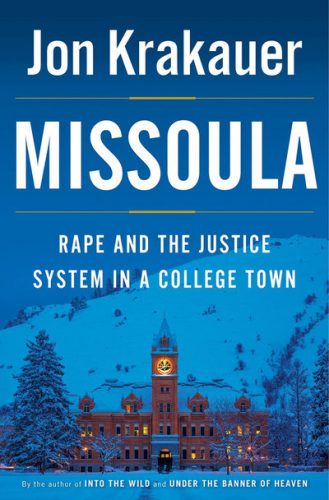
Jon Krakauer doesn’t start Missoula: Rape and the Justice System in a College Town (Doubleday, $28.95) with one of the worst scenes in the book; he eases into it with the police pulling up to tell a young woman named Allison Huguet that her rapist has confessed.
Only a couple pages later does Krakauer tell of the assault and of Beth Huguet’s horror when her daughter calls her at 4 am gasping with panicked sounds into the phone before screaming, “He’s chasing me! Help me! Save me! Mom!”
Huguet’s attacker, Beau Donaldson, a University of Montana football player and Huguet’s childhood friend, later pleaded guilty, but Huguet had to face the intense backlash that accompanies accusing a local sports star of rape. Montana Griz fans are as maniacal about football as Ducks fans.
When the book came out, residents of the small Montana college town objected to its name, saying it made Missoula sound like a rape capital, but as Krakauer himself points out, the real problem is that what went wrong in Missoula — everything from victim blaming and police not prosecuting — goes on across the country, and should sound familiar to readers here in Eugene.
Last year EW collected rape statistics for Eugene, Springfield, the UO and Lane County from 2009 through roughly (depending on the jurisdiction) 2014. We found that out of more than 700 reported rapes, 19 were prosecuted by the Lane County District Attorney’s office.
Krakauer follows several sexual assault cases in Missoula as he tracks just what led the U.S. Department of Justice to launch a federal investigation into the University of Montana and into the area’s police and prosecutors. Between January 2008 and May 2012, the DOJ found that of 85 Missoula rape cases sent to prosecutors by the police, only 14 resulted in charges.
Krakauer, an investigative journalist who made his name with books like Into the Wild and Into Thin Air, grabs the reader not only through his use of narrative but also by flexing his investigative chops (and I’ll note here he draws heavily on the work of former Missoulian reporter Gwen Florio, who is a friend of mine).
Sometimes his prose tends to the purple — alleged and guilty rapists wail and weep in confessions and courtrooms — but the research and passion he puts into the writing make it worth a wail or two.
Krakauer delves into the fascinating research of David Lisak, a clinical psychologist who testified at the rape trial of Jordan Johnson, another Grizzlies football player and one who happens to hail from Eugene. Lisak points out his research shows that far from a creeper in the bushes, rapists can be likable, sociable, even outwardly kind, and some of these congenial-seeming folks are actually serial rapists.
Lisak also testified that based on his research, there is no one way victims respond to rape, as seen in EW’s recent story about UO student Laura Hanson: “Victims of non-stranger rape are often very confused about what happened. They may be very upset. Distressed. But they don’t automatically label what happened to them as rape.”
The book should be mandatory reading at the UO from fraternities to administration. Don’t read Missoula thinking, “This could happen here.” Read Missoula knowing it does happen here.