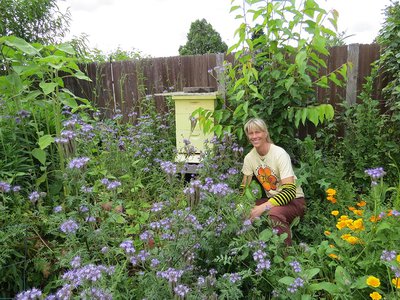
Although last year the city of Eugene banned neonicotinoids, a category of pesticide harmful to bees, Eugene is far from pesticide free. Local beekeeper Jen Hornaday says she’d like to see a change in city policy after the city of Eugene sprayed an herbicide on May 28 in the park adjacent to nine of her honeybee hives without alerting her first.
“It just shows a lack of respect for pollinators,” says Hornaday, a founder of the Healthy Bees = Healthy Gardens education project and a longtime volunteer at the park off River Road. The park is known as both Cadojen Park and Maynard Park. Occupying 4.5 acres, the park and its flowers help provide food for Hornaday’s bees, which live on Hornaday’s property right next door to the park. “I work extremely hard creating pesticide-free spaces for all people, pets, plants and pollinators,” she says.
According to Ryan Turner, a natural resources specialist with the city of Eugene, a city employee sprayed Garlon 3A, which contains the chemical triclopyr, in Cadojen Park to remove meadow knapweed, an invasive, nonnative plant. A report from Cornell University says that triclopyr is not known to be toxic to bees, but is toxic to fish, other wildlife and dogs and takes 30 to 90 days to break down halfway in the soil.
“The population of knapweed in that park is pretty small, probably about 20 plants, and we try to deal with a population of weeds while it’s still small instead of letting it become rampant,” Turner says, adding that “not all control is herbicide — it’s one of many different things we do.”
Turner says herbicide was used because other control methods within the city’s abilities would not be effective in this case.
The herbicide application followed city policy, Turner says, which requires posting 24-hour notice before and after spraying. “It’s terribly unfortunate that Jen didn’t see the signs until after the application had occurred,” Turner says. “She feels very strongly about pesticides not being used in that park, and I completely understand that.”
Hornaday says that she noticed a sign in the park on the night of May 27, and she was unable to reach anyone from the city until after the park was sprayed. “When the poison was sprayed at 9:40 am, the bees and other pollinators were foraging in the clover and other wildflowers within the park,” she says.
Hornaday hired a friend to dig up the knapweed plants in the park and cover the sprayed areas with cardboard and bark mulch to keep anyone from coming in contact with the herbicide. Going forward, Hornaday says she’d like to see more advanced warning and better communication with park volunteers, since she would have volunteered to dig up the plants herself if she had known.
Hornaday says she’s meeting with Eugene Mayor Kitty Piercy to discuss policy change, and she’s considering the possibility of signing a formal volunteer adoption agreement with the city, as long as the contract clearly states that the city won’t spray as part of the agreement. That could increase the likelihood of Hornaday being contacted, Turner says, adding that although he followed city policy, if he had to do it over again, he would have reached out to Hornaday ahead of time.
“Jen’s concerns are understandable,” Turner says. “She’s a beekeeper, and bees don’t adhere to property lines or read signs.”
Hornaday’s Healthy Bees = Healthy Gardens education project will be in full swing this summer with an Aug. 2 Save the Bees event in Washington City Park, and Hornaday will host a honey tasting from 3 to 6 pm Friday, June 12, at The Kiva, 125 W. 11th Ave. Learn more at healthybeeshealthygardens.com.