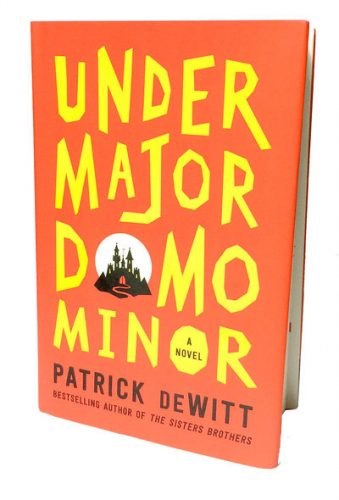
Portland author Patrick deWitt is a pig for romance.
“I’m an old softy, you know,” deWitt tells EW, “a fool for love and all that; a pig for it.”
DeWitt’s 2012 novel The Sisters Brothers (shortlisted for the Booker Prize) is both satire and homage to the Western genre. DeWitt’s latest release, Undermajordomo Minor (HarperCollins, $26.99), again turns a wildly original eye to the period piece, mixing the buttoned-down austerity of Downton Abbey-style manor house drama with the darkly gothic romance of the Brontë sisters.
The novel tells the story of Lucien (Lucy) Minor, a hapless, big-hearted loser — a 19th-century schmo, if you will. Minor bumbles his way into a house job at a grand, mysterious castle. The castle, like Lucy’s employer the Baron Von Aux, conceals a dark and sinister past. The resulting tale is romantic, adventurous, funny and completely bonkers.
DeWitt sat down with EW to talk about eavesdropping, Stanley Kubrick and the dull modern world.
Tell me a little about why genre and period pieces inspire you? Were there any specific genre pieces that inspired Undermajordomo Minor? I thought frequently of Wuthering Heights while reading it — Wuthering Heights, but funny.
It’s not so much that I have an interest in period writing, as that I have a disinterest in the contemporary world. More and more I find myself pulling away from it. This is unfortunate, and I sometimes feel I’m shirking, but I don’t know what to do about it. I guess in my work and life I’m trying for the same thing, which is to create a world outside of time.
You have such a distinctive ear for dialogue — how do you get inside the heads, pacing and cadence of individuals from other eras?
In terms of my patter being historically accurate, I can’t say that it is. But my ongoing interest in dialogue is borne of the fact of my being a snoop and voyeur. If you listen in on enough conversations, it’s inevitable that you’ll become a competent mimic.
While reading Minor, I was reminded of the pacing of melodramatic silent films, which put the story in the early 20th century for me. Can you confess the time and place the story occurs in?
I can’t confess for the very good reason that I myself don’t know the time and place. Historically, I suppose we’re somewhere in the mid-19th century. In terms of location, it’s a bit of a mishmash. It’s central or Eastern European, while the dialogue seems to be in the British comedy-of-manners school.
If you could pick one film director to adapt your work, who would you choose?
Can I pick 10 instead? And can most of the directors be not alive? Stanley Kubrick, Paul Thomas Anderson, Joseph Losey, Claire Denis, Ermanno Olmi, Azazel Jacobs, Kelly Reichardt, Werner Herzog or Orson Welles.
Undermajordomo Minor is available Sept. 15 wherever books are sold.
A Note From the Publisher

Dear Readers,
The last two years have been some of the hardest in Eugene Weekly’s 43 years. There were moments when keeping the paper alive felt uncertain. And yet, here we are — still publishing, still investigating, still showing up every week.
That’s because of you!
Not just because of financial support (though that matters enormously), but because of the emails, notes, conversations, encouragement and ideas you shared along the way. You reminded us why this paper exists and who it’s for.
Listening to readers has always been at the heart of Eugene Weekly. This year, that meant launching our popular weekly Activist Alert column, after many of you told us there was no single, reliable place to find information about rallies, meetings and ways to get involved. You asked. We responded.
We’ve also continued to deepen the coverage that sets Eugene Weekly apart, including our in-depth reporting on local real estate development through Bricks & Mortar — digging into what’s being built, who’s behind it and how those decisions shape our community.
And, of course, we’ve continued to bring you the stories and features many of you depend on: investigations and local government reporting, arts and culture coverage, sudoku and crossword puzzles, Savage Love, and our extensive community events calendar. We feature award-winning stories by University of Oregon student reporters getting real world journalism experience. All free. In print and online.
None of this happens by accident. It happens because readers step up and say: this matters.
As we head into a new year, please consider supporting Eugene Weekly if you’re able. Every dollar helps keep us digging, questioning, celebrating — and yes, occasionally annoying exactly the right people. We consider that a public service.
Thank you for standing with us!
Publisher
Eugene Weekly
P.S. If you’d like to talk about supporting EW, I’d love to hear from you!
jody@eugeneweekly.com
(541) 484-0519