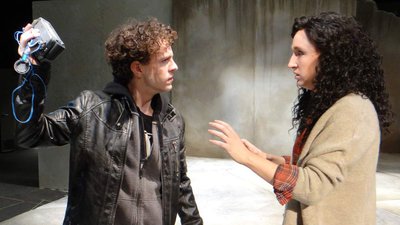
Clocking in at nearly four hours, University Theatre’s production of Scorched is something of an endurance test, and the stamina it requires is more than just physical. Bloody and unrelenting, the play transports the audience front and center to hell on earth, and its emotional impact is undeniable, like a seizure of post-traumatic stress that won’t let you go.
Written by Wajdi Mouawad, a Lebanese-Quebecois playwright whose parents were refugees of the Lebanese Civil War, Scorched takes a close, almost paralyzing look at the indiscriminate cycles of violence unleashed by perpetual warfare. It follows the journey of a pair of twins, Simon (Alex Mentzel) and Janine (Mallory Oslund), as they return to their homeland in search of their father.
This journey, however, which trips through time in flashbacks revealing the nightmarish trials of their deceased mother Nawal (played at different phases by Samantha Lee, Jerilyn Armstrong and Mary Unruh), is more like a descent — a spiraling down into the profound and insidious human toll of civil war. The explosive revelation at the end of their quest reverberates like some cosmic yowl at the endless inhumanity and perversion that result from centuries of conflict and displacement (the play’s original title in French was Incendies).
Scorched is directed by Michael Malek Najjar, whose own family was touched directly by the ongoing Mideast conflict; his mother worked in a hospital during the 1958 crisis in Beirut, and his Lebanese-born wife experienced the terrors of shelling as a child. Such intimate knowledge of nationalist violence informs Najjar’s helming of this production, which draws the audience into its claustrophobic grip — seats in the Hope Theatre are pulled so close they dissolve the fourth wall, and it feels as though you are a participant in the chaos. When a gun goes off, you jump. You see the blood ooze down the wall.
And that, in a sense, is the point, and the importance of this play. It gives a face and a name and a voice to those faraway statistics — those almost daily body counts — to which we risk growing numb. In Scorched, the effects of such violence are immediately discernable at a very personal level, as individuals are forced to respond to the atrocities surrounding them, sometimes monstrously.
At times, the show meanders into strange territory, and it’s not always effective; the playwright’s exhaustive efforts to bring home the violence lead him into artsy passages of fantasia and poetry that tend to jam up the narrative momentum.
More often than not, however, the production is riveting. As a piece of confrontational theater, Scorched is fearless in its determination to gaze without flinching at the wages of war. It is difficult to behold, and dangerous to ignore.
Scorched runs through March 13 at UO’s Hope Theatre; tickets and info at 346-4363.