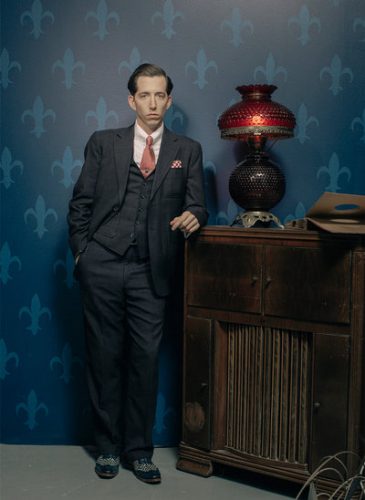
Muddy Waters changed Pokey LaFarge’s life. “I was, like, 13,” LaFarge tells EW, recalling the time some “older cats” played him Waters’ classic 1963 album Folk Singer at a pizza joint. “I thought, ‘Wow, the blues are acoustic?’” LaFarge recalls. “It changed my life.”
Pokey LaFarge has built a career exploring and reviving musical styles that, while occasionally veering toward jazz or country, remain resolutely pop-centric, though not the kind of music commonly thought of as pop these days. More like the old-timey pop of your grandma and grandpa’s time, a simpler time when everything was less fragmented and compartmentalized — when a singer could sing a country weeper and a hot jazz scorcher and a bluesy swinger and no one batted an eyelash. Instead, they just drank up and kept dancing.
No, it probably wasn’t really like that back then, but listening to LaFarge you almost believe it could’ve been.
“I love a good song,” LaFarge says. “I have my own style and my own personality,” he continues, adding “that personality and identity will enhance any song and make it identifiable to me. I have a pretty original voice at this point.”
LaFarge says that for him, as a teen, older pop music styles — from dirty blues to jazz — felt almost avant garde.
“It’s the acoustic-it-y,” LaFarge explains. “At a young age you don’t really listen to a lot of acoustic music. You’re hearing electronic dance music, or rap, or metal or whatever,” he says, explaining the influence older pop music had on him. “It’s the style itself, the ensemble playing, melody, the stories that they’re telling.”
Along with commonly expected vintage influences, LaFarge lists artists like Chuck Berry, The Kinks, Tom Waits and Hoagy Carmichael as favorites. For LaFarge, however, classic country singer Jimmie Rodgers is particularly important.
“He’s kind of like the musician version of Steinbeck or Kerouac,” LaFarge says. “He’s kind of like the Mark Twain of country music. He laid the foundation of what country music is today.”
LaFarge won’t go so far as to say modern pop is missing something, but he does urge listeners to look to the underground for the good stuff. “There’s so much amazing music these days,” LaFarge says. “There’s just as much good music today, if not more, than there ever was. I would encourage people to keep digging.”
Last year, LaFarge released Something in the Water. He says he’s coming to Eugene prepping a new record, but feels it’s a little too fresh to talk about, and he likely won’t be playing any new songs this time through town.
With his unreleased material, LaFarge finds his songwriting approach subtly changing. “It was almost always melody first,” he explains, “and then it’s kind of become more lyrically driven, going into this next album-making process.”
Overall, LaFarge says he feels deeply rooted in tradition and yet he’s established a sound all his own, calling his current band a “family.”
“I’ve been around for awhile but I’m just as hungry as ever,” LaFarge says. “I’m just as passionate about making music as I ever was.”
Pokey LaFarge plays with Minnesota old-time country band Cactus Blossoms 9 pm Tuesday, May 3, at Hi-Fi Music Hall; $15 adv., $18 door, 21-plus.
A Note From the Publisher

Dear Readers,
The last two years have been some of the hardest in Eugene Weekly’s 43 years. There were moments when keeping the paper alive felt uncertain. And yet, here we are — still publishing, still investigating, still showing up every week.
That’s because of you!
Not just because of financial support (though that matters enormously), but because of the emails, notes, conversations, encouragement and ideas you shared along the way. You reminded us why this paper exists and who it’s for.
Listening to readers has always been at the heart of Eugene Weekly. This year, that meant launching our popular weekly Activist Alert column, after many of you told us there was no single, reliable place to find information about rallies, meetings and ways to get involved. You asked. We responded.
We’ve also continued to deepen the coverage that sets Eugene Weekly apart, including our in-depth reporting on local real estate development through Bricks & Mortar — digging into what’s being built, who’s behind it and how those decisions shape our community.
And, of course, we’ve continued to bring you the stories and features many of you depend on: investigations and local government reporting, arts and culture coverage, sudoku and crossword puzzles, Savage Love, and our extensive community events calendar. We feature award-winning stories by University of Oregon student reporters getting real world journalism experience. All free. In print and online.
None of this happens by accident. It happens because readers step up and say: this matters.
As we head into a new year, please consider supporting Eugene Weekly if you’re able. Every dollar helps keep us digging, questioning, celebrating — and yes, occasionally annoying exactly the right people. We consider that a public service.
Thank you for standing with us!
Publisher
Eugene Weekly
P.S. If you’d like to talk about supporting EW, I’d love to hear from you!
jody@eugeneweekly.com
(541) 484-0519