As an accidental theater critic for the past 15 years or so, first in Seattle and now in Eugene, I’ve had the great good fortune to see Shakespeare performed in a variety of ways and in a variety of settings, professional and otherwise. Often upon the stage it’s just a poor player strutting and fretting, signifying very little, yet other times the work is divine beyond all reason. I’ve seen the infinite riches of Hamlet flattened to a pulp in the unventilated August swelter of a third-floor studio, and I once watched a flamboyant young actor embody Iago with such malignant glee that I never wanted to see Othello again, it was so perfect.
This is precisely why I love theater; like life, the art of the stage is spontaneous, impermanent and as prone to spells of damnation as bursts of grace. Unlike the more static arts, live theater contains an inherent risk that is thrilling, and when it goes off well, it’s truly wild and magical — a brief but glorious moment in time that leaves only a diminishing echo of itself, never to be repeated. And being true of all plays, this is exponentially true of Shakespeare.
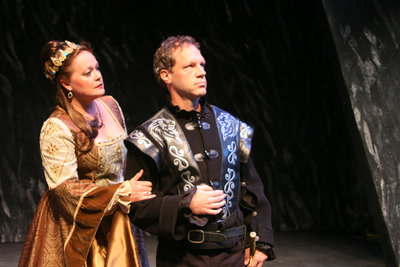
All of which is to say that Cottage Theatre has one of those glorious moments on its hands right now. Directed by Tony Rust, this production of Hamlet is as good as anything you’re likely to see from a community theater anywhere, thanks in no small part to the lead performance of Timothy A. McIntosh. McIntosh, a playwright and professor at Eugene’s Gutenberg College, imbues the melancholy Dane with an energy that is at once thoroughly modern and utterly orthodox.
Whereas so many contemporary actors encounter difficulty with Shakespeare’s poetic tangles, being too cowed by an Elizabethan argot made exotic by time, McIntosh confidently inhabits Hamlet’s words in such a way that the existential agony of the role flows outward from his performance. The soliloquies are felt rather than merely spoken. In this way, McIntosh finds not only the tragedy and dark humor in Hamlet’s dilemma, but he gives that dilemma a physical urgency that speaks volumes.
Of course, none of the expert naturalism of McIntosh’s performance would be half so effective if he weren’t well directed and surrounded by a cast and environment to match his efforts. Rust, a veteran of local theater, seems to understand this, and as director he gives Hamlet ample room to rave and move about, right down to the simple stage design, which is economical and utterly abstract, as though sprung from the imagination of Fritz Lang.
It’s no knock on the large cast to note that every actor seem elevated by the lead performance, a fact especially evident in the way the tension takes a slight dip whenever McIntosh is offstage — this is, after all, Hamlet’s tragedy, and he is something of a narcissistic prick, pulling everyone into his obsessive orbit. In a roomful of good performances, then, two of the play’s earliest victims are especially noteworthy: Patrick Torelle is just right as Polonius, and Martha Benson brings a chilling immediacy to the final stages of Ophelia’s collapse.
Perhaps the highest praise I can give to Cottage Theatre’s production of Hamlet is this: In a play where we all know that in the end (OK, spoiler alert) everyone dies, I was yet sitting on edge of my seat, completely rapt in my attention to the vagaries and convulsions of a freaky, suicidal young man struggling to overcome a paralysis of mind. I was alive to every word. I felt it to my bones.
Not only is such a Hamlet rare in the realm of community theater. It’s rare period.
Hamlet runs through Aug. 28 at Cottage Theatre in Cottage Grove; $15-$20, tickets at cottagetheatre.org or 541-942-8001