Identity is a bitch. By the time we’re grown up enough to ask ourselves who we are and what the hell we’re doing with this thing called life, we realize our so-called self is an infinitely convoluted and mysterious patchwork — a mashup of past indignities, adopted attitudes and a certain incommunicable something howling deep inside for meaning and contact.
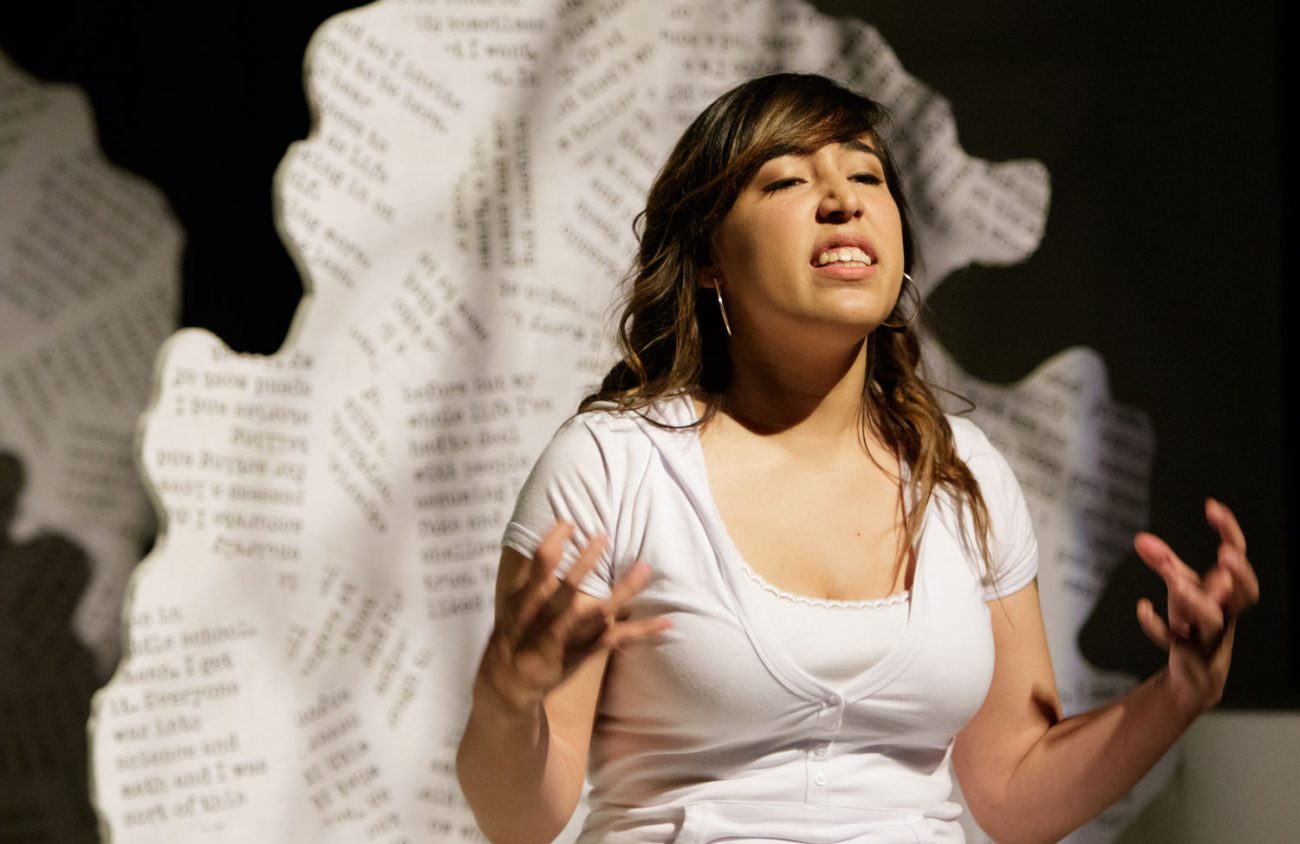
The search for identity and authenticity is at the heart of Constant Revolution, a fetching new work written and performed by students in Lane Community College’s theater arts program. The play, directed by Willow Norton, is itself something of a quilt, an assemblage of bits and pieces of individual stories stitched together by themes that are distinctly existential, and which constantly complicate the dilemma of being and becoming.
The young cast — Darius Bunce, Sabrina Gross, Pia Sosa Hildenbrandt, Milo Kent-Pettit, Emma Rain and Alex Vowles — is uniformly excellent, and boy can they write. The intersecting skits and soliloquies, which take on everything from early romance and identity politics to consumer ennui and the crunch of career choices, exhibit a surprising level of maturity and sophistication. They are by turns surreal and pedestrian, played out on a stark stage that becomes at one moment a wintery dreamscape, at another the setting for a teenage party.
Constant Revolution finds a delicate balance between narcissistic obsession and human communion, as each actor brings an isolated and beleaguered self to bear upon the world, sometimes bumping up against one another, striking sparks of recognition or fanning the flames of incomprehension. Such is life, but the play deepens our everyday experience by making our interior monologues explicit and therefore lyrical, loaded with yearning. Imagine Beckett in the land of Millennials, with their cell phones, sinister ironies and downgraded opportunities. Waiting for Go, perhaps.
But, unlike Beckett, the play refuses to wallow in a fumblesome striving that forever veers toward nihilism. Yes, Constant Revolution takes on the big ontological and existential questions of life, but it does so with a spirit that is essentially optimistic. Communication may crumble, but its crumbs can mark a path that leads to understanding. It finds its guiding principle in a poem by Jack London, a line of which states, “The function of man is to live, not to exist.” Living, unlike merely existing, is a kind of artistry — an authoring of the self that is itself a creative act, a moving from inwardness outward.
In this sense, the play’s title reveals a dual meaning: It is at once highly personal and implicitly political. To confront the world with one’s truest self, a thing of perpetual motion, is a supremely revolutionary act. The stories that comprise Constant Revolution would seem to argue that identity can’t be purchased in the marketplace, nor can it be constructed in bitterness and fear.
The play answers Beckett’s famous line — “I can’t go on, I must go on” — with a simple affirmative: Go on. This is the hope that trumps all despair, and it’s inspiring to behold in a troupe of young artists, especially in these dark days. It is, and ever has been, the only hope we have.
Constant Revolution plays 7:30 pm Thursday through Friday, Feb. 23-25, and 3:30 pm Sunday, Feb. 26, at LCC’s Blue Door Theatre; $10, students and staff free.