Sarah Ruhl is an interesting playwright. Her work achieves emotional valences that, for me, are completely contradicted by her style — a style I find myself hard pressed to describe with any satisfying accuracy. Mamet on anti-depressants? Chekhov lite? Swift with a Swiffer?
Ruhl’s writing is mannered yet silly, frivolous but somehow depthy, a bitter pill coated in sugar. Her loudest harangue remains a coo. Distinctly middle-brow and yet hardly milquetoast, she seems to set herself up as a wag and nag for the NPR glitterati, a bit preening and twee but itchy-scratchy nonetheless.
Now in production at Oregon Contemporary Theatre, Ruhl’s Melancholy Play is subtitled “a contemporary farce,” though its warm-hearted approach suggests more of a goose than a farce. The play is a gently leveraged critique of the great American pursuit of happiness at all cost, and a strong defense of the exquisite pleasures of melancholy, especially in the form of moping. It argues that our aggressive, two-dimensional chipperness has erased the profound comforts of being sad, which makes us, ironically enough, angry.
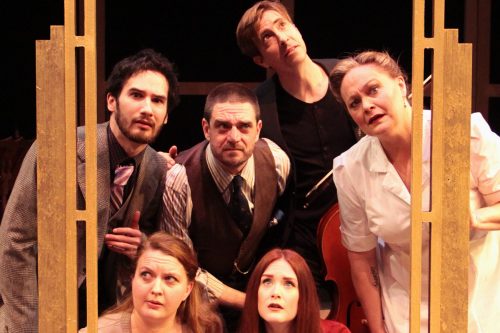
A chamber piece, Melancholy Play tells the story of Tilly (Chelsey Megli), an inconsolably sad and dreamy bank teller whose melancholy is an aphrodisiac for a clutch of emotionally bankrupt characters: her therapist Lorenzo the Unfeeling (Joseph Workman); her tailor Frank (Kelly Oristano); and Frances (Leslie Jones) and Joan (Tracy Nygard), the lesbian couple that alternately swoons and moons over Tilly’s poetic despair.
Romantic complications ensue, especially when, after her birthday party, Tilly suddenly begins to grow happier by the moment, until she becomes a modern-day incarnation of Pollyanna, preternaturally enthusiastic and optimistic about life. Ruhl brilliantly makes of melancholy a substance — an almond, in fact, both figuratively and literally — to which we can become addicted.
The play is quite funny and oddly affecting, especially in its portrayal of the disruptions that occur as each character, in turn, gets a quenching taste of sadness only to lose it when Tilly goes absolutely stupid with happiness. The structure, as the title of play suggests, is hodgepodge and skit-like; the fourth wall is continuously broken down as characters launch into monologue, song, extravagant melodrama, slapstick asides.
And this is Ruhl’s talent, in making a literal play of ideas connect on a human level, despite the absurdist slant of the narrative. It helps here that the cast is excellent, especially Workman’s over-the-top Lorenzo, and Tara Wibrew’s direction is taut and fleet, traipsing along the effervescent surfaces of Ruhl’s language with a perfect balance of silliness and sorrow. Live cello by Ben Brinkley (Julian) provides a wonderful accent to the proceedings, whether in staccato bursts and plucks, or that mournful humming that is the cello’s truest province.
If you’ve ever wallowed in The Smiths or bathed yourself in the films of Douglas Sirk as an indulgence and antidote to the forced rictus of American good cheer, Melancholy Play will strike a familiar chord: It’s okay to feel sad, it says (sad, as opposed to depressed). In fact, it’s necessary, because denying the melancholy side of life is a kind of sickness.
Perhaps, as Ruhl suggests, it’s all time we had a good laugh about how miserably happy we are.
Melancholy Play runs through March 12 at Oregon Contemporary Theatre; $15-$28, tickets at octheatre.org or 541-684-6988