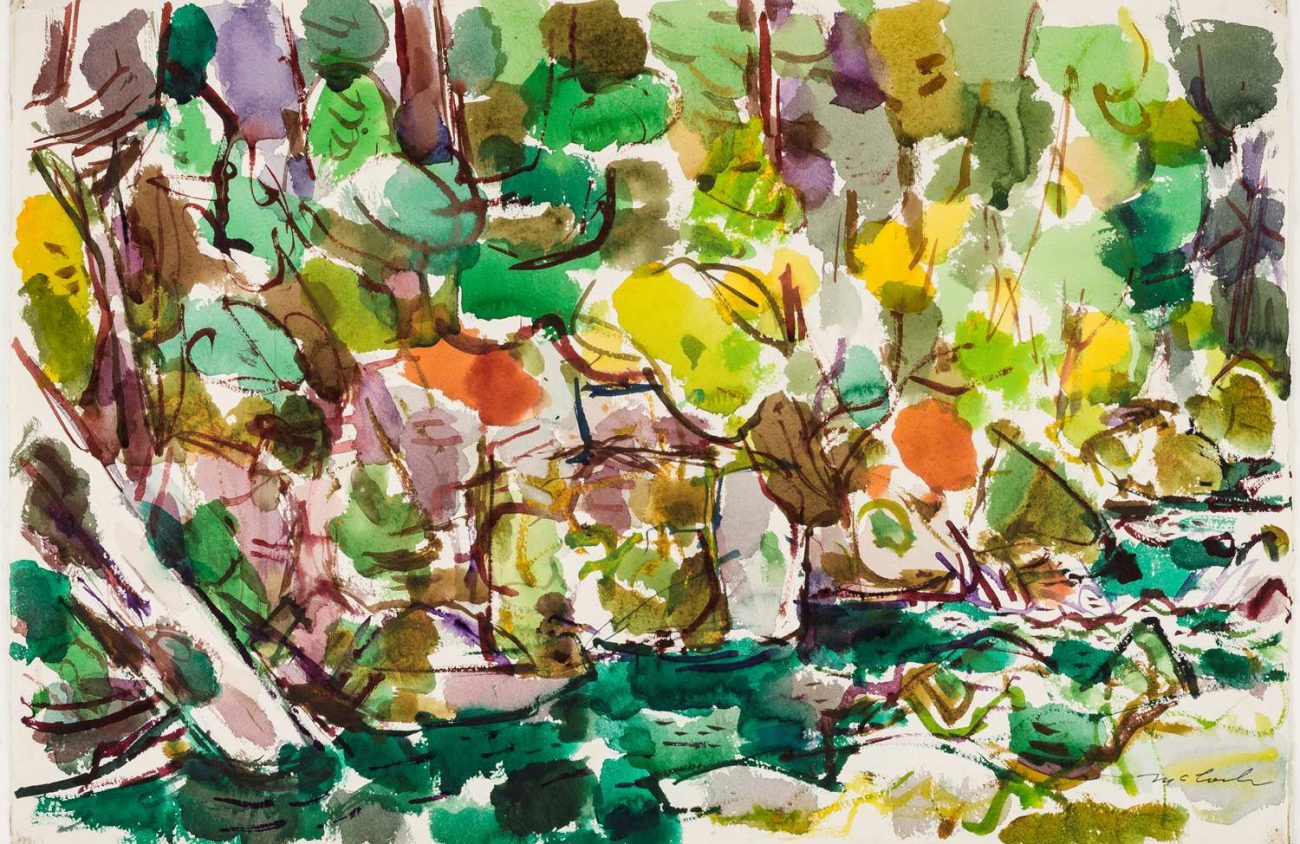
Standing in front of Fall Creek, a watercolor painting by David McCosh (1902–1981), I was aware there was someone else looking, too. Viewing the same artwork as someone else in a gallery or a museum can be awkward. Often one person will walk away to give the other their time with the piece. But not at the Karin Clarke Gallery on the day of curator Roger Saydack’s talk about the Eugene artist.
The atmosphere in the gallery was social.
“You can tell this art is McCosh’s work,” the person said.
He was already familiar with the artist’s work, as were so many others. The lively buzz that filled the gallery revolved around the more than 30 artworks on the walls by an artist some had known and others had studied under while he was art professor at the University of Oregon.
Fall Creek has a transparent stained glass feel to it. The design is an all-over pattern similar to others of McCosh’s abstract landscapes. It is composed of fluid lines and wash laid down in splashes of color. There aren’t details in it that you would associate with realism, but you can tell there is water, as well as green, yellow and orange leaves the color of fall. The painting is both abstract and relatable to what you might see if you were at the place the artist stood at the time of year he painted it.
Like a lot of other artists who moved out West from the eastern United States, McCosh was inspired by his new environment. Before he moved here his subjects were mostly human, like those in the drawing Man and Woman at a Restaurant. After he moved to Eugene he began to paint nature. He depicted landscapes at first and then evolved toward abstraction, though he did not think of himself as an abstract artist. He was grounded in reality, always beginning with observation.
The exhibit Learning to Paint is Learning to See reminds us of this by hanging photographs of corresponding places in nature on the walls. During his talk, Saydack pointed to a tree in a photograph and then to a column of brush strokes in the painting Tangle. A collective sound of appreciation could be heard as people in the gallery recognized the tree in the painting — seeing what the artist saw.
“Don’t draw a tree. Draw a particular tree,” was advice McCosh gave to his drawing class, according to a former McCosh student who was at the gallery. “He detested stereotypes.”
What’s the difference?
You can draw a stereotype of a tree without looking at one. But in order to draw a specific tree — a real tree — you have to look. You can’t make it up.
There’s no lying in art.
This is why we use words like “immediate” or “truthful” to describe paintings done with brushstrokes that are visible, like marks made in drawing. And why no matter how abstract a painting of a landscape is, it can still be real.
David McCosh: Learning to Paint is Learning to See runs through April 1 at Karin Clarke Gallery, 760 Willamette Street. Hours are noon to 5:30 pm Wednesday through Saturday.