The White Lotus Gallery has put up a new show, replacing an exhibit of contemporary art with Japanese paintings from the 19th and 20th centuries. The beautiful paintings will be up until April 1, and then they will come down, about 20 works altogether, and another group of artworks will replace them.
Switching artworks on the walls is expected in galleries but not so much in private homes. The only person I’ve known who changed art on the walls at home was an art collector. He routinely switched his art so that he could enjoy it all. Everyone else I know, though, has just the amount of artwork that corresponds to their wall space.
Hue-Ping Lin, owner of the White Lotus, says the idea of changing what we have on the wall is foreign to Western culture. That was certainly true in the house in which I was raised. Once a framed picture went up on the wall, it stayed there.
That is not the case in traditional Japanese culture. Hanging scrolls, or kakejiku, such as those currently on view at the White Lotus, are designed to be easily rolled up for storage. They are made to be displayed temporarily depending on the season, special occasion or, in some cases, even the month.
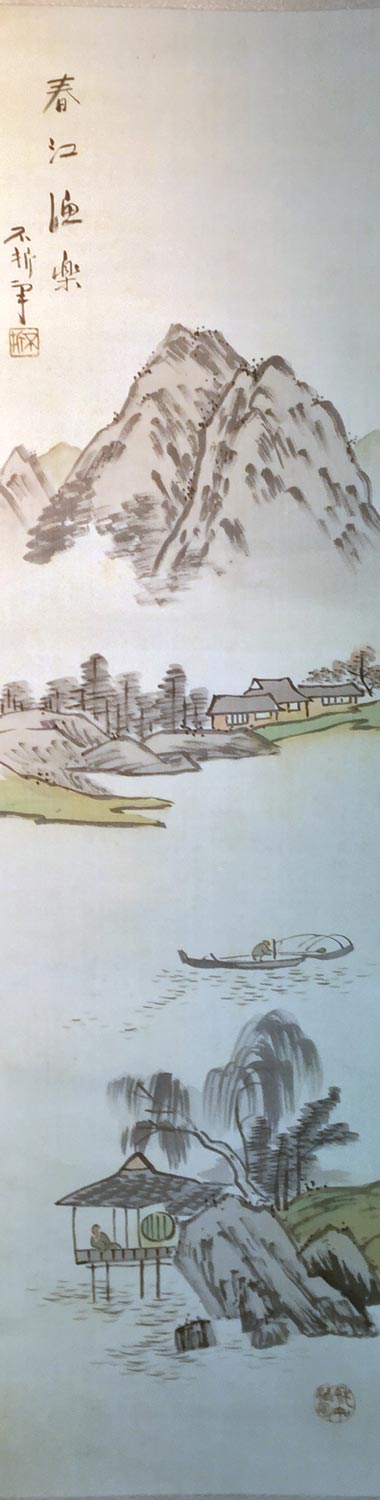
A painting on one of the scrolls by Nakamura Fusetsu (1866-1943) features a set of mountains in the background. In the foreground are trees and rocks and a house by the water. Closest to the viewer, but relatively small in size, is a person on a boat. On the upper left of the scroll this phrase is written in Japanese: The Pleasure of Fishing in the Spring. The painting, meant to be displayed in spring, has the immediate feel of a drawing. The brush strokes are bold and inspired by Chinese calligraphy. The marks have a “newness,” is the way gallery manager Claudia Ponton described it when she showed me the scroll at the gallery.
Fusetsu was a multifaceted artist: a calligrapher, painter, book designer and illustrator. He studied calligraphy in China and Western-style painting in Paris. To celebrate 150th anniversary of his birth last year, the Nakamuraya Salon Museum of Art held a solo exhibit of his work.
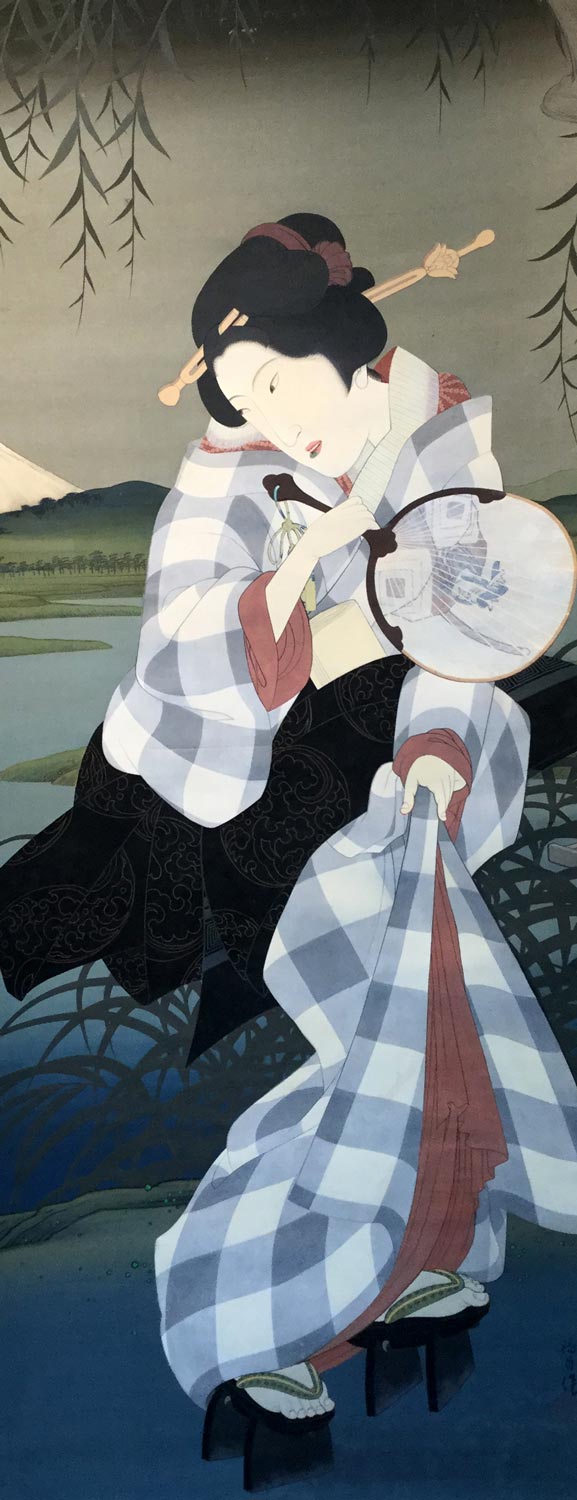
Another scroll, signed Shugetsu, has its human subject practically filling the page. She is central to the composition with the landscape entirely in the background. The gallery doesn’t know much about the artist, but the subject and style reference Ukiyo-e, a genre associated with woodblock prints and with beautiful women as subjects. Shapes are outlined precisely, filled in and built up with value and color.
The paintings on scrolls at White Lotus Gallery are by different artists and done in different styles, but the intention for their use reminds us that arranging things differently at home can energize and renew, keeping us aware that there’s a larger world out there that’s always changing.