Imagine a ghost town. The skeletons of buildings, stripped of their roofs and siding, are overgrown with trees and vines. Light shining through the rafters allows grass to grow and wildflowers to bloom in the shells of the structures.
It seems as if a hurricane passed through, if only hurricanes neatly stacked the boards of the buildings they tore apart.
What at first blush appears to be a scene of destruction is actually the remnants of an intentional deconstruction. For a week after the Oregon Country Fair finishes, more than 100 volunteers become the well-intentioned hurricane, taking apart the fairgrounds and allowing Mother Nature to reclaim the landscape.
“Nature is the predominant player here, and we get to play for a few days a year,” says OCF general manager emeritus Charlie Ruff. In the off-season, the grounds host a native plant nursery and are maintained as one of the few refuges for native plants in the Willamette Valley.
Both the construction and deconstruction of the Oregon Country Fair are done with a conscious effort toward minimal impact and a whole lot of help from the Fair’s friends.
Events like the Fair are “by nature not typically sustainable or low impact,” Ruff says. “But we do a pretty remarkable job — everything is intentional.”
Ruff admits they’ve made mistakes in the past, but says turning those mistakes into learning opportunities is one of the greatest gifts of the Fair. “Not everything works but we’ve got to try,” he says. “We learn the hard way, but we spread what we learn from taking risks. We aren’t afraid to tell people when we screw up.”
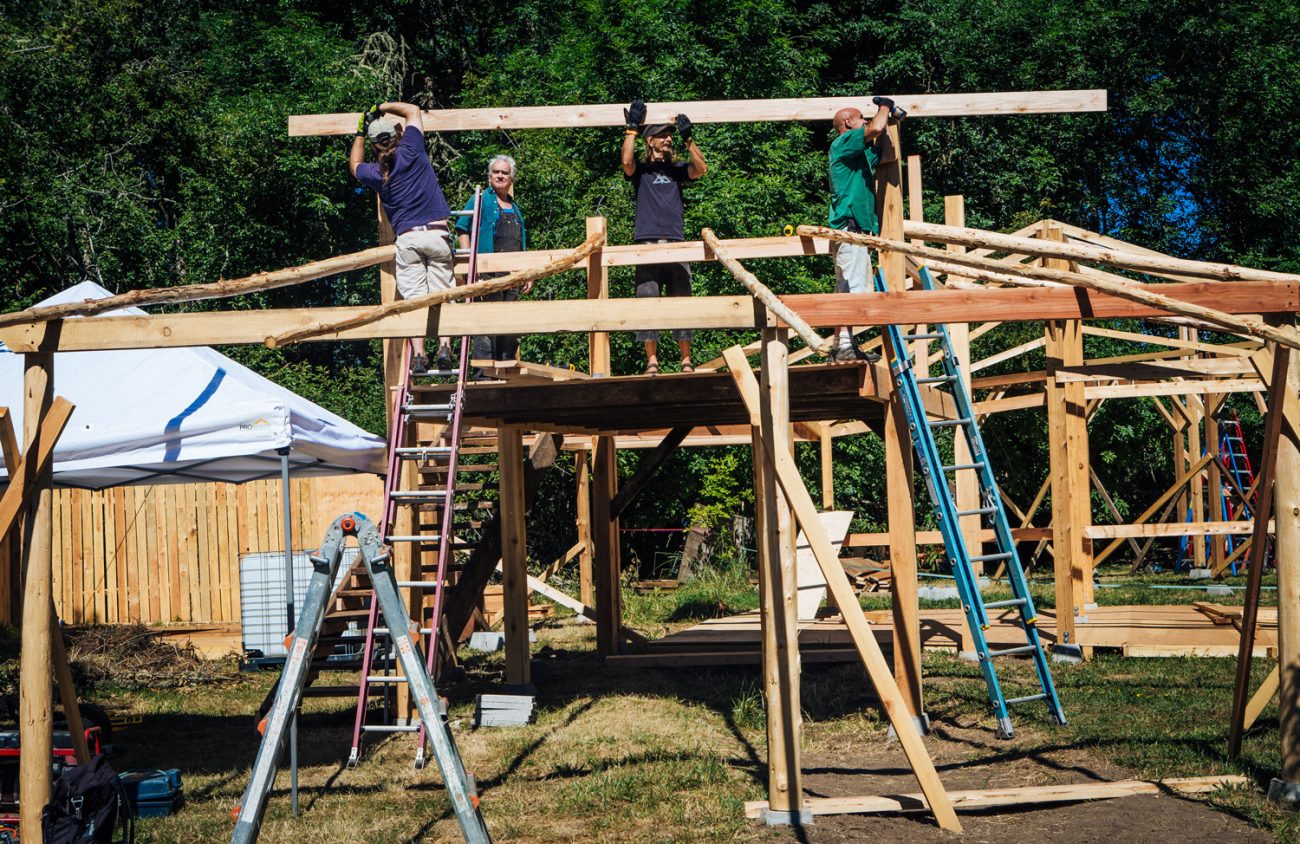
Preparation for the Fair begins about a month before the grounds open to the public. “It’s like a set of concentric circles,” says Ruff, on a tour of the fairgrounds in early June. These layers of preparation include 18 different construction phases, which include initial tagging for repairs, initial repairs, inspection, art installations and moving equipment out of storage and onto the Fairgrounds.
Volunteers are split into 65 different crews with duties such as pruning and moving overgrown trees and brush, preparing meals for staff and volunteers, planing fallen timber at the Fair’s own small-scale mill and rebuilding the bare-bones structures.
On the weekends leading up to the Fair the grounds will host as many as 1,000 volunteers a day.
For vendors, preparation for the Fair starts weeks in advance. Ritta Dreier, owner of Eugene Saturday Market staple Ritta’s Burritos, will be serving up her popular Mexican fare for the 40th year this July. When EW spoke with Dreier a few weeks before the Fair, she was already busy prepping food for the event.
For Fair veterans like Dreier, getting ready for Fair has become more predictable over the years. Ritta’s Burritos has been in its current location by the Spirit Tower since the mid ’80s. Knowing what to expect means that every year they can keep improving and investing in their operations, Dreier says.
“It’s kind of like a family reunion,” she says. To staff her restaurant for Fair she reconnects with employees who worked with her more than 30 years ago.
“It’s a lot of work to create a working restaurant out in the woods,” Dreier says. “It’s a difficult situation, but it’s amazing how it works.”
While it takes vendors weeks to get ready for Fair, the White Bird Clinic has its event medical crew, Rock Medicine, on site as soon as preparations begin. White Bird Clinic offers a range of free to low-cost medical care, crisis intervention and other community services year-round in Eugene and Springfield.
Not only does Rock Medicine play an important role in ensuring the safety of Fair volunteers and patrons, it is also the “largest ongoing fundraising effort” for White Bird, according to the organization.
Initially operating out of a canvas tent with a wood floor, White Bird has two to three staff on site in June and expands its staff and services as more people arrive at the Fair. By the time the Fair comes, they have two fully operational locations with dozens of volunteer staff.
Wren Arrington, program manager for Rock Medicine, says it’s important for them to be on-site as preparations are underway in case accidents happen.
Arrington discovered OCF in 1981 when he was hitchhiking around and serendipitously ended up in Eugene while Fair was taking place. “Once I discovered it, I started coming back,” he says. In 1995 he began coordinating with Rock Medicine — a role he continues to this day.
Though Arrington was initially drawn to the festivities, he’s found something more over the years.
“The pre-Fair experience is a unique experience because of the community and camaraderie it forms,” he says. “Sometimes it becomes more meaningful than the Fair experience itself.”
“People come out for the love of it,” he says. For Arrington, a sign at the grounds sums up the volunteer Fair experience. It reads: “We don’t work for free for nothing.”