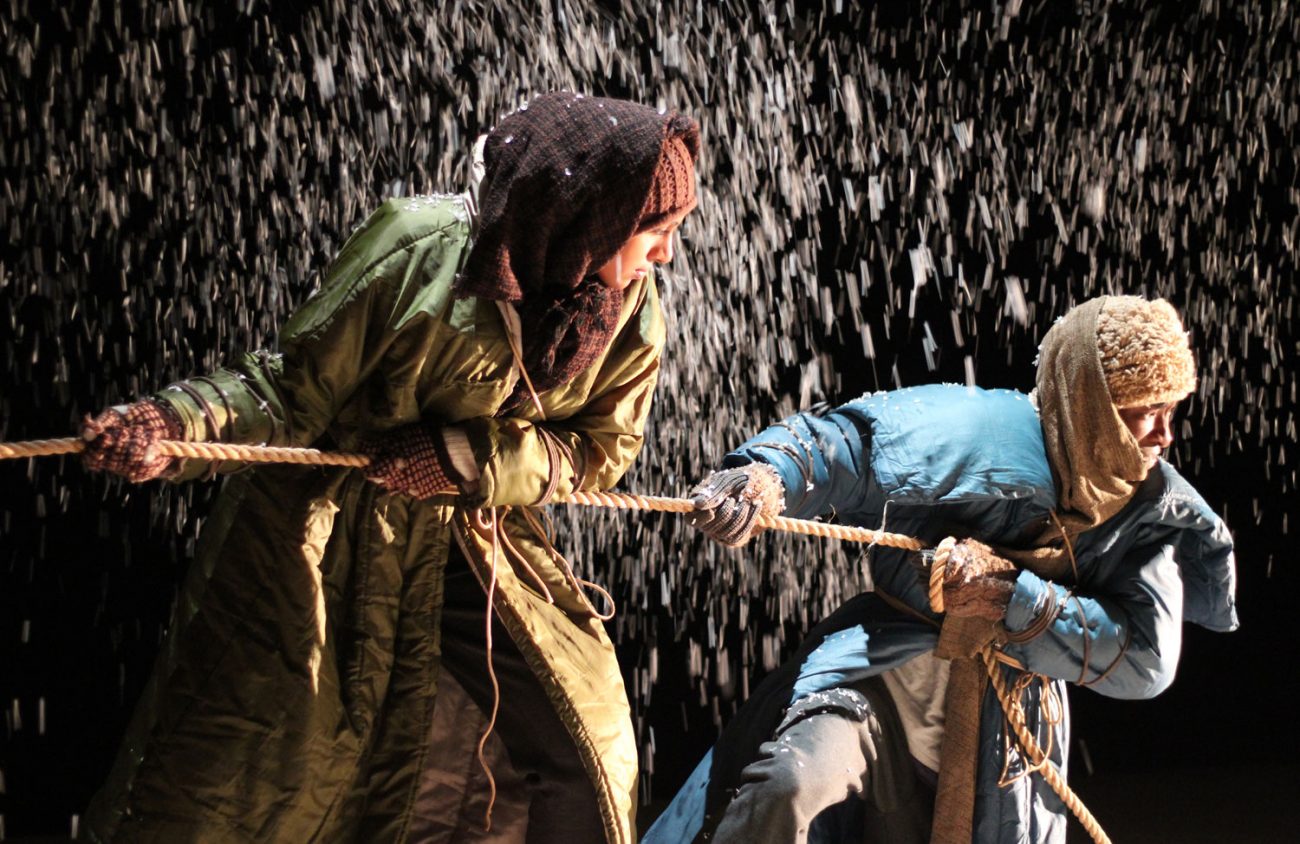
First published in 1969, Ursula K. Le Guin’s feminist sci-fi classic The Left Hand of Darkness tells the story of Genly Ai. Ai is an envoy from the Ekumen, a loose confederation of planets, and he has come to the snowy planet Gethen on a diplomatic mission to persuade the nations of Gethen to join the Ekumen.
A semi-musical original adaptation of The Left Hand of Darkness is running through Nov. 12 at the University of Oregon’s Robinson Theatre. The work is directed and adapted by University of Oregon Theatre Arts faculty John Schmor.
Schmor’s adaptation is sparse, impressionistic and lyrical, existing somewhere in the intersection of theater, music, poetry and dance.
In the story, the people of Gethen are ambisexual, with no fixed gender. During brief periods of “kemmer,” their anatomies morph into functional male and female equivalents in order to mate. Within partnered Gethenians, biological male and female roles change from period of kemmer to period of kemmer — sometimes a partner is male and impregnates the partner, sometimes a partner is female and carries the offspring.
Otherwise, Gethenian society is free of gender roles and their accompanying restrictions. Ai, played by Silas Lobnibe, is fixed-gender male and this is greeted with curiosity and revulsion by the Gethenians. “We’re told he’s a pervert,” a character says. “He’s male,” another character responds.
This dialogue drew a titter of laughter from the audience. In our time of preferred-gender pronouns, gender fluidity and an increased awareness of transgender issues, Left Hand feels very topical and, like the best sci-fi, prescient.
The beautiful costuming in this production, designed by Shelbi Wilkin, is a fascinating combination of the familiar and speculative. These are exactly the clothes a society evolving without gender roles would wear. In the text, Le Guin and Schmor extrapolate this fluidity into the Gethenian culture at large, suggesting that the idea of the other (whether it be in gender, nationality or planet of origin) is at the root of all conflict.
Ai has arrived on Gethen just as a border dispute has been ignited between Karhide and neighboring Orgoreyn, Gethen’s two most powerful kingdoms. Regarding the handling of the situation, Ai is caught in a political conflict between Karhide’s mad king, played with twisted zeal by Christian Mitchell, and the nation’s prime minister, Estraven, played with understated beauty by Maju Bangalore. This conflict leads to the banishment of Estraven.
Here, Left Hand draws postmodernist conclusions, popularized in Le Guin’s time by French philosophers like Jacques Derrida and Michel Foucault — such as the ideas that all human experience is a struggle for power, from gender to sexuality to politics, and different power paradigms act as lenses through which to evaluate the very nature of truth and reality.
Such relativism is behind lines like “Truth is a Matter of Imagination,” but in post-truth 2017, the line sounds positively Trumpian.
A series of events lands Ai and the banished Estraven traveling together through Gethen’s frozen wasteland. And here the story takes a humanist turn.
With Ai and Estraven relying on one another in extreme conditions, they come to know each other as individuals. With the rarity of sexual desire (on Estraven’s part) and the messy mechanics of sexual intercourse a non-factor, desire persists: desire for connection, to be seen and to be heard and, in the end, to be loved. And it’s these motivating factors that push us forward through the frozen tundra of existence.
The Left Hand of Darkness runs through Nov. 12 at Robinson Theatre on the University of Oregon campus; $30-$40, UO students free.