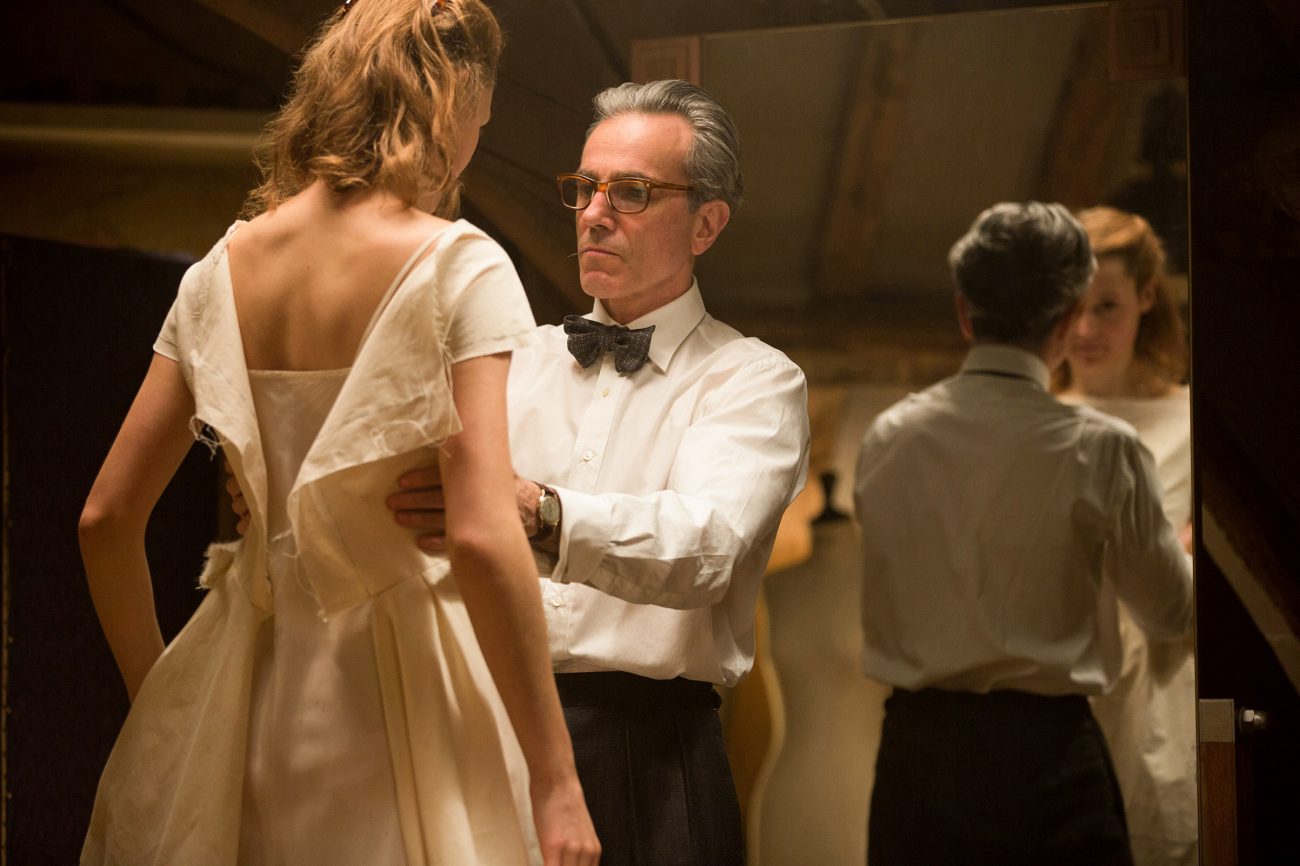
Certainly, the ghost of Alfred Hitchcock presides over the haunted atmosphere of Paul Thomas Anderson’s latest film, Phantom Thread, but Hitchcock isn’t the only cinematic poltergeist swirling and twirling and dancing across the screen.
In Daniel Day-Lewis’ masterful performance as the quietly domineering fashion designer Reynolds Jeremiah Woodcock, we find traces of James Mason at his creepy patrician best, as well as a strong hint of Jimmy Stewart, whose obsessive male gaze in Vertigo seems a direct optical ancestor to Woodcock’s almost sadistic eye for feminine idealization.
The whole film, in the end, is teeming with spirits, the foremost of which is the spirit of parody — yes, parody, not of the bubbly comic kind practiced by late-night sketch troupes but, rather, of a distinctly psychological sort. As written and directed by Anderson, Phantom Thread is an exquisitely tuned bit of camp, a film whose cloistered, hermetic atmosphere is so cramped with ulterior motives and suppressed emotions that it forever threatens to burst into slapstick or violence.
What is being parodied, in the end, is the power struggle between men and women. Anderson’s take on it is painfully muted and terrifically melodramatic, creating a tension that allows all manner of Freudian folderol and Machiavellian sexual espionage to squeak through the whispering crevices. This is an uproariously funny film at which you may never once actually laugh. It sneaks up on you, and it’s all terrific fun.
At the deliciously malevolent heart of this film is, of course, Day-Lewis, who has proclaimed this to be his final go on the big screen. As Reynolds Woodcock (Anderson’s most blatant tip of his hand … might as well have named him Rochester Batonpecker), Day-Lewis is at the peak of his considerable talents, playing a minor tyrant — part gentleman, part juvenile — so controlling of his environment that a piece of toast being buttered too loudly can ruin his day.
What elevates this film above being a mere farewell vehicle for the genius of Day-Lewis is a pair of performances that meet him head-on in a psychological ménage-a-trois that becomes a mortal battle of wills. As Alma, the young waitress who becomes Woodcock’s new fashion muse, Vicky Krieps is more than equal to the task; an incredible young actress, she brings a subterranean ferocity to a role that might otherwise have been crimped and caged by the towering ego seeking its ultimate submission.
And, as Woodcock’s exacting sister and helpmeet Cyril (several times he calls her “old so-and-so”), Lesley Manville is a joy to watch. At first, she seems cut from the same cloth as Mrs. Danvers in Rebecca — the sinister and sexless protector of filial secrets — but Anderson, forever upending expectations, gives her more to chew on, and Manville just chews away as close-up one-woman Greek chorus commenting on the sexual warfare taking place between Alma and Woodcock.
It doesn’t give away too much to say that the film takes another Hitchcockian turn late in the game — one that harkens directly to the claustrophobic domestic drama of Suspicion, albeit with wonderfully reversed roles. Even more than Hitchcock, however, Phantom Thread brought to mind another famous director, as unlikely as that may be: Clint Eastwood, whose 1992 film Unforgiven upended the classic Western by revealing the ugly roots of the vigilante violence the genre had forever celebrated as essential to its heroic sense of self.
In much the same way, Anderson’s film serves to deconstruct, and thereby complicate, a long tradition of art that comments on the male gaze — the voyeurism that seeks to control women as impossibly idealized objects of contemplation. By parodying, through amplification and exaggeration, our staid notions of what is really at stake in the battle of the sexes, Phantom Thread arrives at some devilish conclusions about the power struggle between men and women. ■