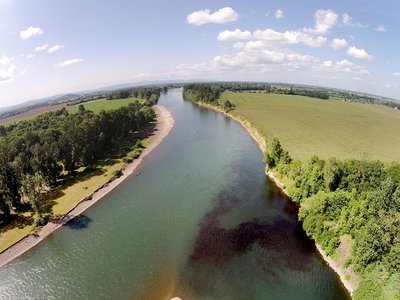
Shocked by the news of hydraulic oil leaking into the McKenzie River, just hundreds of feet from the intake for Eugene’s drinking water?
Don’t be. It’s legal for industries to discharge into the river, as long as they keep to their pollution limits. In this case however, something went awry, and oil was released into the river instead of going to the mill’s treatment plant. But why does the mill have an pipe that releases into the pristine McKenzie?
Industries are allowed to discharge into the river in areas called “mixing zones.” Legally permitted discharges from industries include stormwater as well as effluent from industries such as paper mills.
In the case of the March 13 oil spill into the McKenzie, the Department of Environmental Quality said the release of hydraulic oil was from an International Paper storm water outfall from its paper plant on N. 42nd Street in Springfield. On March 14, Lane County announced it was closing three boat ramps thanks to the sheen.
The DEQ said in its statement that “the source of the oil is located approximately 800 feet downstream from EWEB’s McKenzie River drinking water intake. The intake is located at Hayden Bridge and provides water to the city of Eugene and other communities.”
DEQ clarified that “EWEB’s water supply has not been affected.” But the public has been advised “to avoid the McKenzie River from Hayden Bridge downstream to Armitage Park.”
According to The Register-Guard:
State Department of Environmental Quality officials initially indicated that hydraulic oil from the mill is supposed to flow to a treatment plant on the mill property, but on Thursday they clarified that it’s not part of International Paper’s regular outflow.
“This is not material that should go into a wastewater line or a clean water line,” DEQ spokeswoman Katherine Benenati said.
DEQ officials consider the incident an unauthorized spill that isn’t covered by International Paper’s discharge permit. How the oil ended up in a pipe that empties into the river remains under investigation, Benenati said.
As EW has reported previously, “Many of Oregon’s biggest polluters are allowed to pour wastes into the state’s rivers and streams using outdated permits” from the DEQ.
Aside from dramatic cases like this oil spill, industries discharge into river all the time into areas called mixing zones, which are spots where pollution enters the river and it’s legal for it to be there. The zones are not marked, and “a large portion of enforcing whether an industrial source of pollution is meeting its discharge permit requirements is done through self-reporting by that same source.”
“Water quality standards do not have to be met in a mixing zone, but when the effluent hits the end of the mixing zone, the water is then supposed to meet criteria for fish and drinking water, and people could swim there,” as the DEQ told EW back in 2012 for a story on these discharges and mixing zones.
Update from Lane County March 16
Bellinger, Hendricks Bridge boat ramps reopen; Hayden Bridge Boat Ramp remains closed
The Bellinger and Hendricks Bridge boat ramps have reopened, effective immediately. Hayden Bridge Boat Ramp remains closed until further notice.
There will be significant activity on land and in the water around Hayden Bridge Boat Ramp. Boats passing through that area must stay in the center of the channel and move past Hayden Bridge without stopping.The next available boat ramp downstream from Hayden Bridge is Rodakowski Landing (also known as Harvest Landing).
The floating “booms” that had been placed across the river have been removed and smaller booms have been installed along the shore on both sides of the McKenzie near Hayden Bridge. These booms and their associated lines and underwater anchors still pose a significant hazard and boaters should stay as far away from the equipment as possible.
The clean-up effort will continue through the weekend and re-closure may be necessary. Boaters should check the homepage at www.lanecounty.org before heading out this weekend to ensure that Bellinger and Hendricks Bridge remain open and the river remains passable.