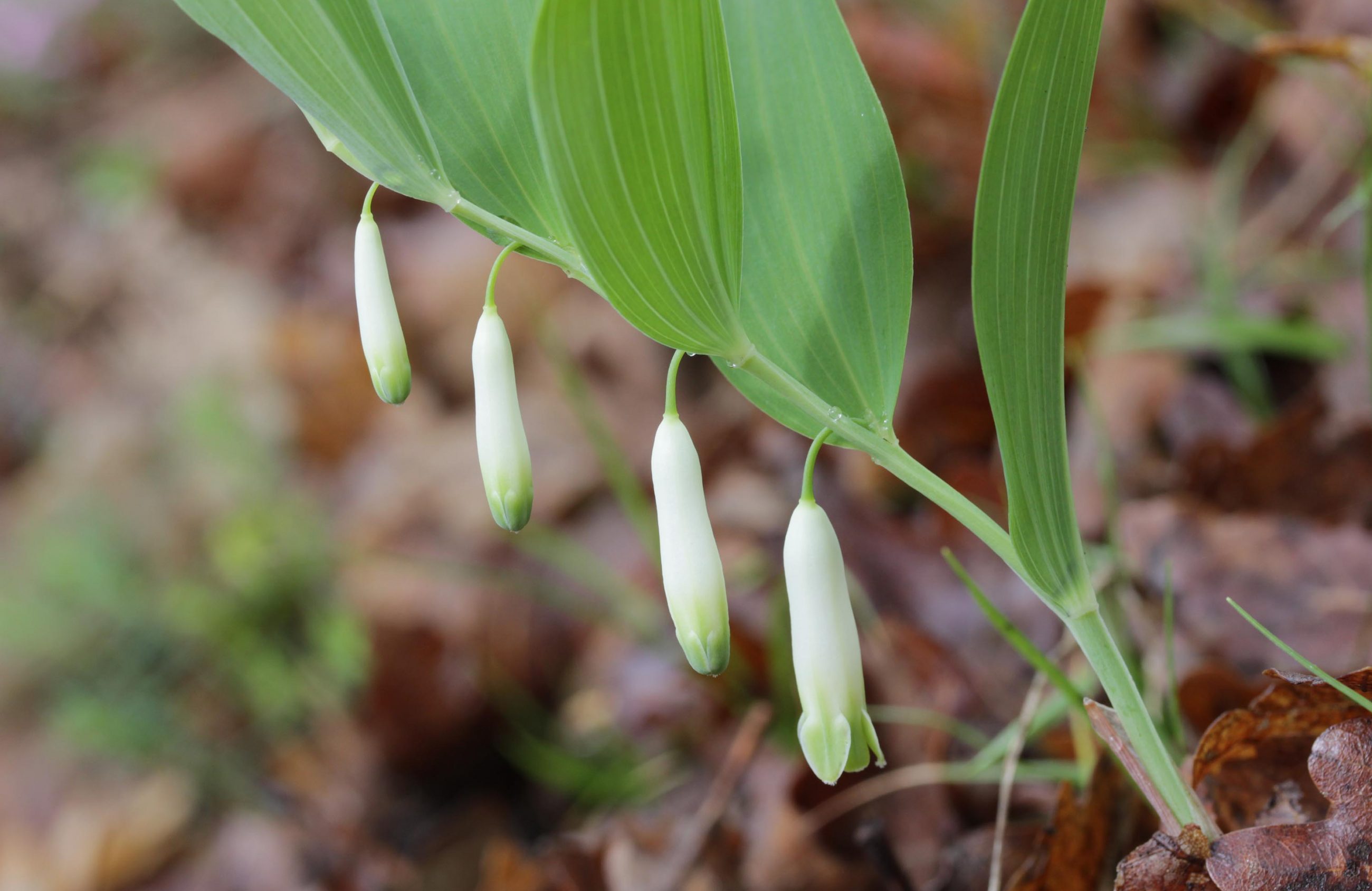
At a plant sale last year I found some nice specimens of Solomon’s seal wrongly placed on a table reserved for Oregon native plants. And a few weeks ago, while volunteering in a city park, I overheard someone who should know better refer to one of our most cherished natives as “Solomon’s seal.” I’m guessing that person does know better, but finds the correct common name, “false Solomon’s seal,” a bit of a mouthful.
Confused yet? It’s bad enough that botanical names keep changing, as DNA analysis reveals new and surprising plant lineages. When common names are confusing as well, what’s a gardener to do?
True Solomon’s seal species belong in the genus polygonatum. Several species are used in gardens, notably the Eastern U.S. native Polygonatum biflorum and the Asian P. odoratum. The latter has some attractive variegated cultivars. Solomon’s seal spreads moderately slowly by creeping rhizomes that are edible and have some medicinal properties. The leaves alternate from side to side along each arching stem. One, two or three tubular cream flowers are suspended below each leaf node.
One explanation for the name Solomon’s seal is that the rhizomes bear scars where previous years’ stems arose, scars that are supposed to resemble seals (the wax impressions you find on old documents, not the marine mammals.)
No true Solomon’s seal is native here. But two species of false Solomon’s seal are native to the Willamette Valley. When I first encountered them they were called smilacina and were assigned to the lily family. Botanists have since moved them to the genus maianthemum, in the asparagus family.
Their common name is, unsurprisingly, derived from their resemblance to true Solomon’s seal, though the resemblance is really only strong when the fleshy shoots first erupt through the soil in spring. The flowers of both false Solomon’s seals are quite different from the elongated-bell-shaped flowers of Solomon’s seal that hang below the leaves.
Another common name for Maianthemum racemosum, the larger of the two false Solomon’s seal species native to Oregon, is Solomon’s plume. That name deserves to be used more often, because it describes very well the showy cluster of small cream blossoms at the end of each upright or arching stem.
The stems of Solomon’s plume zigzag gently between leaves that alternate from side to side. Solomon’s plume increases slowly to form impressive clumps that can reach 2 or 3 feet in height. In the shade garden they contrast nicely with ferns and hellebores.
Our smaller native species (M. stellatum) is similar in form, but it spreads more rapidly and makes looser colonies. A few very small white flowers occur at the end of each stem. This species goes by starry false Solomon’s seal, starry false lily-of-the-valley, or star flower. Oregon forests seem full of very small white flowers that could plausibly be called star flower, but use the name if you are in a rush.
The best way to use starry false Solomon’s seal in a garden is to let it ramble at will among primroses and other small shade lovers.
I should add that there is another maianthemum native to Oregon that is known as false lily-of-the-valley. You could call it the true false lily-of-the-valley. The leaves of Maianthemum dilatatum are broadly heart-shaped, held roughly horizontal on short stems that form quite dense and extensive colonies. It makes a handsome (though deciduous) groundcover for rhododendrons and other shrubs, but has sometimes been described as “aggressive.”
Take warning from C.L. Hitchcock, a distinguished authority on plants of the Pacific Northwest, who wrote: “An attractive addition to the wild garden that seems happiest when invading areas where it is not wanted.”