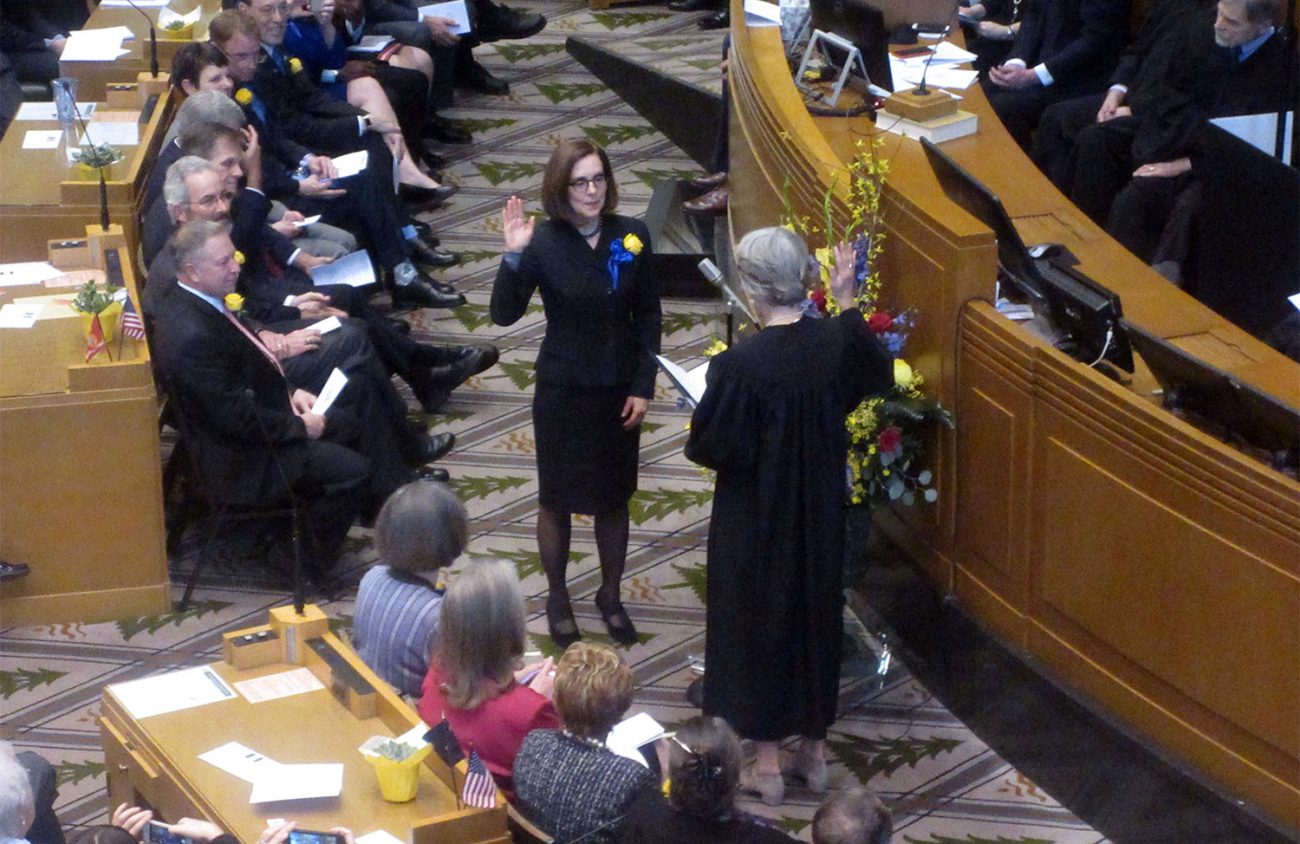
Oregon’s political season officially got underway Monday, Jan. 14, with the inauguration of Gov. Kate Brown, who is serving her first-yet-last full term as Oregon’s governor, and a joint session of the 80th Legislative Assembly in the House Chamber of the State Capitol.
In attendance were former Oregon governors Barbara Roberts and Ted Kulongoski, as well as environmental protesters speaking out against a liquefied natural gas (LNG) pipeline and export facility.
While addressing a packed House Chamber prior to the governor’s inaugural address, Senate President Peter Courtney quoted his son on several occasions, saying Oregon Legislature needs to do “some good.”
These solemn remarks provided a reminder that although Oregon Democrats can effect change in Oregon with supermajorities in the Legislature and control of the governor’s chair, the dire situation nationally is largely out of the hands of Oregonians.
Early in her address, Brown noted that her budget called for a $400 million housing investment and urged the Legislature to approve a $20-million housing bond early in this session so that construction on 200 units of housing for the chronically homeless can be sped up. Brown also called for Oregon to build a “clean energy economy.”
Brown’s address was interrupted by protesters associated with environmental advocacy group Southern Oregon Rising Tide (SORT). One of them shouted “Stop the Pacific Northwest pipeline!” from the rear gallery of the House chambers before quickly exiting, while another banged on the chamber doors from the outside.
About a dozen environmental activists rallied near the steps of the Capitol to protest the Trump administration-backed Jordan Cove LNG pipeline that is being planned for southern Oregon.
“Some protesters did attempt to display some banners and disrupt the governor’s speech. They immediately left the building. No charges are being considered,” says Oregon State Police spokesperson Capt. Timothy Fox.
SORT spokesperson Alex Budd says the group attempted to disrupt the inauguration because “for 13 years now, us Oregonians have been standing against the Pacific Connector Pipeline and Jordan Cove project; this would be the largest source of climate pollution in this state.”
Budd points out that in addition to the negative climate ramifications, hundreds of landowners potentially would also be subject to eminent domain seizures to clear a path for the pipeline.
The Jordan Cove project would feature a 229-mile pipeline with a terminus near Coos Bay that would “threaten traditional tribal territories, 2,000 acres of forest and 485 wetlands and waterways,” according to Seattle-based environmental watchdog organization Sightline Institute. And though the commodity in question features the word “natural,” Sightline studies have pointed out that the gas in question is fracked.
“Jordan Cove would be the single biggest source of greenhouse gas emissions in Oregon,” says Sightline Programs Director Eric de Place. “For Gov. Brown to live up to her aspirations of climate leadership, it’s clear what she needs to do: Stop the project from getting built.”
In response, Brown’s office says, that she expects state agencies to “follow all laws and regulations to the letter,” and she “urges Oregonians to share any concerns with state agencies, their congressional representatives and officials in the local communities where the project has implications.”