Whatever your particular feelings might be about the reality or unreality of ghosts, you must admit: A ghost is a fantastic literary device. To the age-old question, “Do you believe in ghosts?” Henry James would certainly have replied, “But of course, have you not read Turn of the Screw?” Ditto his brother William, who saw the infinite variety in spiritual experience. Why not?
And what about Scooby-Doo? The Sixth Sense? The Shining? More recently, there’s the Netflix adaptation of Shirley Jackson’s The Haunting of Hill House. Ghosts everywhere, and never a one the same!
Ghosts, in art and in our imaginations, are a stand-in for our feelings about simply everything, from the meaning of life and death to everything in-between — guilt, repression, sexual longing, family dysfunction, unresolved desires, unrealized dreams, unpunished crimes.
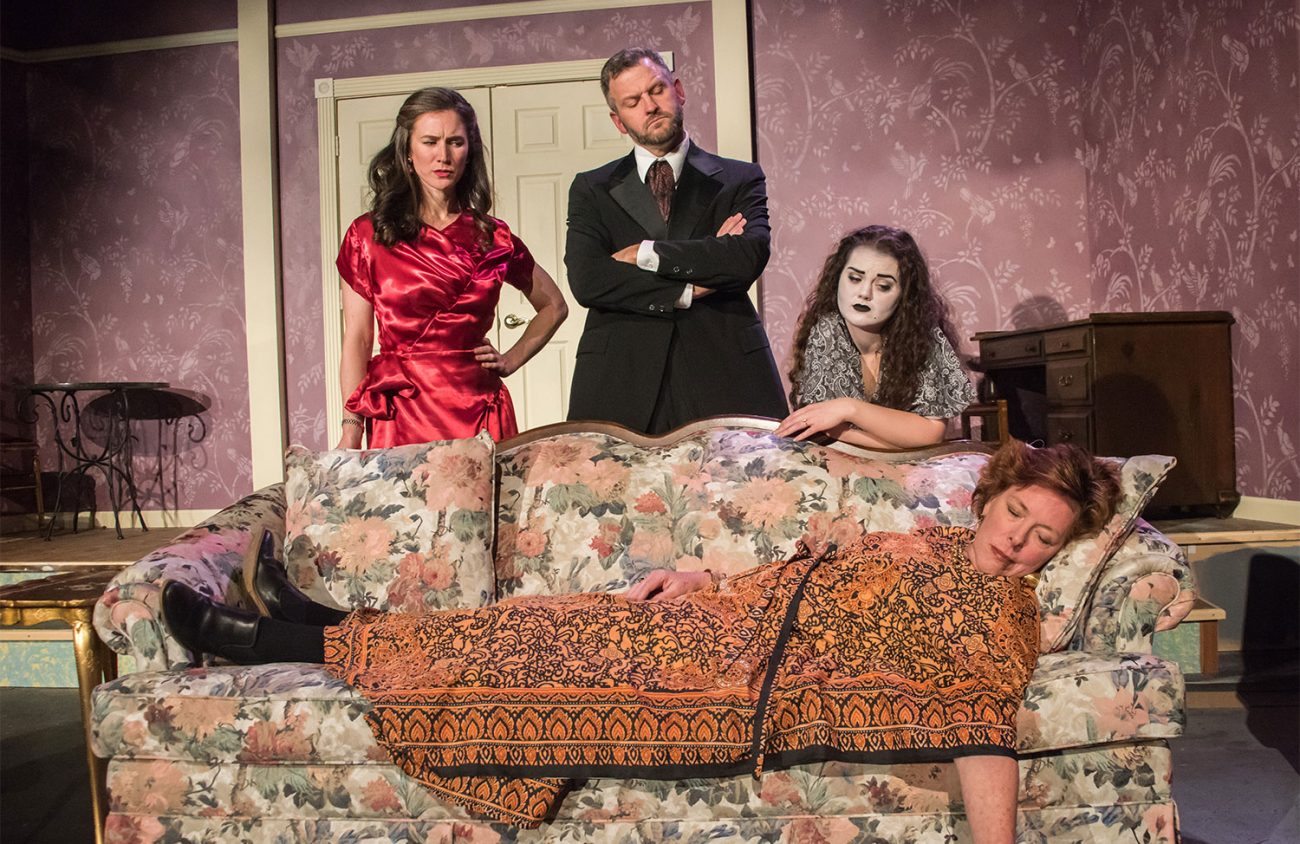
In Noel Coward’s 1941 play Blithe Spirit, now at Very Little Theatre under the direction Karen Scheeland, a ghost becomes an irritant — a goad to domestic troubles that, like the act of exorcism itself, are not easily resolved. A novelist, Charles (Daniel Squire), invites an eccentric medium (Kathy LaMontagne as Madame Arcati) to perform a séance, all in a mocking attitude of researching the novel he’s writing.
Of course, it’s all shits and giggles until the medium accidentally invokes the ghost of Charles’ catty and combative dead wife, Elvira (Aimee Hamilton), who proceeds slowly and deviously to undermine Charles’ current marriage to Ruth, who can’t see her (though Charles, hilariously, can).
Blithe Spirit is a comedy of manners, which means it is peopled by wealthy socialites whose razor wit often disguises a heartless insouciance about their own bad behavior. In traditional rom-coms of this sort, mistaken identity, thwarted desire and slapstick miscommunication drive the comedy; here, Coward brilliantly employs a gothic element — the ghost of Elvira — as the comic foil through which all the characters are revealed.
In short, Elvira’s shenanigans throw a wrench into everything, with the result that the selfishness and insecurity of everyone involved comes to the fore — a ghosted Seinfeld scenario, if you will. Coward himself considered the play heartless, noting that, “If there was a heart it would be a sad story.”
VLT’s production is competent and well balanced in performance and pacing, but it all felt just a tad flat the night I attended. Odd to say, but the play seemed either not nasty enough or too stiff and reverential to grab hold of Coward’s material, resulting in a lack of comedic zip. The acting was solid, and yet the cast seemed to exist too precisely inside the frame of an idea of what and how these characters should be, and nobody threatened to really bust out of his or her role. The action on stage lacked a sense of risk and danger.
That said, it was opening night, and this is Noel Coward. Technically and visually, the play is sumptuous to behold, and Scheeland does a crackerjack job choreographing the difficult situation of a ghost certain characters can see while others can’t — no easy feat. Whatever perceived shortcomings Blithe Spirit may have, it remains worth a visit. Or, better said, a visitation.
Blithe Spirit plays through Feb. 9 at Very Little Theatre; tickets at theVLT.com or 541-344-7751.