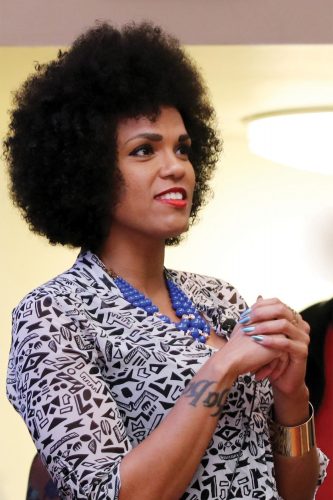
Writer and educator Walidah Imarisha was in high school when she attended a protest at the University of Oregon that first taught her about incarceration reform.
She learned of the protest through her internship with Community Alliance of Lane County (CALC). This week, CALC, along with Showing Up for Racial Justice (SURJ), will be hosting one of two events where Imarisha is speaking on incarceration as well as on Oregon’s black history.
While still in high school she went to a talk at the UO by Dr. Darrell Millner about Oregon black history. Imarisha tells Eugene Weekly that her experience at the protest in high school allowed her to “see how incarceration connects to so many different issues.”
“As a young black woman in Springfield, Oregon, I had many questions, and so hearing his talk was just really very illuminating,” Imarisha says.
Imarisha says she came to believe that the prison system is flawed and unjust for people of color. For example, after the Civil War ended in 1865, the 13th Amendment, which abolished slavery except in the case of punishment as a way to keep blacks enslaved, was passed, Imarisha says in a talk for the Oregon Humanities Conversation Project.
She went on to study at Portland State University to learn from Millner and people like him in the Black Studies department. After working on the East Coast, Imarisha moved back to Portland to teach at PSU in Black Studies. “I came full circle,” Imarisha says.
The exclusion of black people is in Oregon’s near history and systematically reaches to today through institutions set in place long ago. In 1859, Oregon became the only state in the union with a racial exclusion law written into the state constitution. “Black people had no legal standing. Their mere existence made them criminal,” Imarisha says in a CBS documentary on race in Portland.
“The language banning black folks from Oregon was in the constitution until 2001,” she says.
The events this week will be more than just compelling lectures. They will be interactive. Imarisha’s goal, in every event she speaks at, is to get people talking to each other about issues.
“The only way we are going to change the future and make a better just future is through dialogue,” she says, “and recognizing that we have to do this collectively.” Imarisha says action is important but “dialogue is the first step to being able to act collectively.”
Her talk on incarceration, titled “Transforming Justice,” is 6:30-8:30 pm Friday, Feb. 26, at Wesley United Methodist, 1385 Oakway Road.
And if you miss that, you can catch her well-known talk “Why Aren’t There More Black People in Oregon?: A Hidden History” 4:30-6 pm Wednesday, Feb. 27, at the UO in Straub 156.
UPDATED: 3:30 pm Thursday, Feb. 21