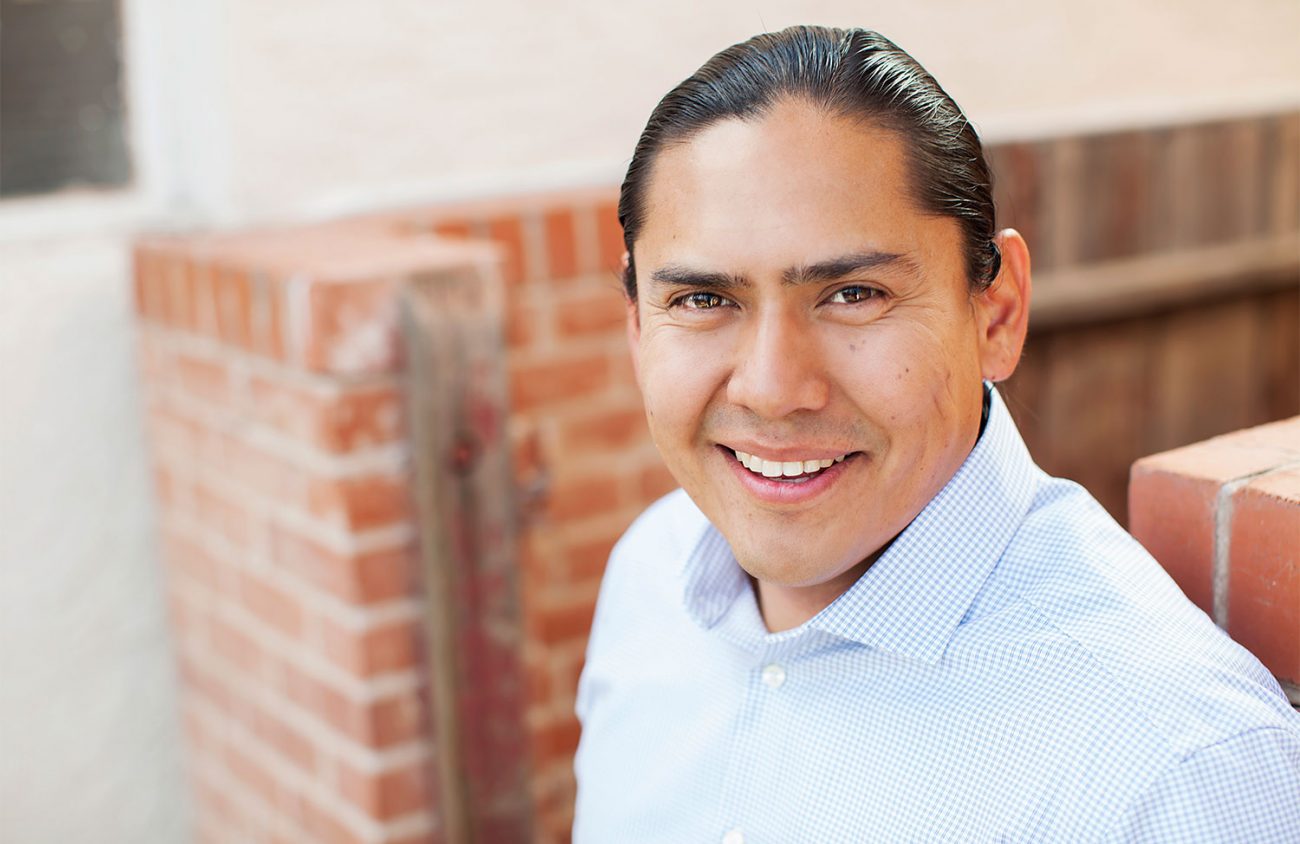
Federal land management isn’t a topic as hot in the public consciousness as others, but for former Arizona state Rep. Eric Descheenie, the way we think about our relationship to others is vital in the management of public lands.
“How can the breakthrough from federal land management planning, heeding the knowledge and wisdom in the know-how of traditional knowledge, change the course of how these federal personnel do their work?” Descheenie asks Eugene Weekly in reference to Utah’s Bears Ears National Monument, which has thousands of sacred cultural sites as well as other cultural, historical and natural resources.
Descheenie, who identifies as Navajo, speaks Thursday, Feb. 28, at the Public Interest Environmental Law Conference (PIELC).
His keynote addresses indigenous intellectual lenses of viewing the world, indigenous connections to Bears Ears and the “unprecedented possibilities” that indigenous lenses can reveal when applied to how the government manages public lands.
This is because indigenous peoples relate to land in an entirely different way from non-indigenous people, Descheenie says. Environmental sustainability is important in the sense of its place in a symbiotic relationship among humans and the Earth’s natural resources. He emphasizes reciprocation, having relationships in which no participant walks away feeling empty.
“We both walk away whole. That’s not capitalism necessarily right now,” he says.
He served as the founding co-chair of the Bears Ears Inter-Tribal Coalition in 2015, when the coalition sent a formal proposal to President Barack Obama to establish Bears Ears as a national monument, with Obama officially establishing the site in December 2016.
In December 2017, President Donald Trump cut the size of the monument by 85 percent.
Alongside our relationship to natural resources, Descheenie says we need to be more accountable for our actions. The gap between how we act in our personal and private life, he says, is larger and less consequential in a Western mindset.
“You don’t have any personal accountability or responsibility to what we do, because there’s a space between who we are as a human — who we are as a personal being — and there’s a space between that and our work, and then you close that space. You all of a sudden become accountable,” Descheenie says.
He continues: “When somebody begins to realize that they close that space between their personal accountability and what they do professionally, the world and the universe — all of a sudden — becomes scary, right?”
Descheenie says, “You begin to see that, regardless of what you do professionally, you stand to experience consequence. Or, if you do conduct yourself appropriately, you just might experience something very beautiful, something very positive.”
A first-time PIELC speaker and attendee, Descheenie says he has a passion for leadership and, as a former Democratic representative in the Arizona Legislature, he’s definitely qualified to say so.
“Going into the state Legislature, it was interesting to see this colonized government continue to colonize,” he says, “and every time you introduce a new idea that’s rooted in your own cultural-historical origins and you try to advance that within an alternative governance system — which is, of course, the current state of the existing Legislature — there’s a clash.”
Descheenie says, “When you close that gap, you actually become human again.”
Eric Descheenie speaks 6:30 pm Thursday, Feb. 28, in Straub Hall, 1451 Onyx Street. More at pielc.org.