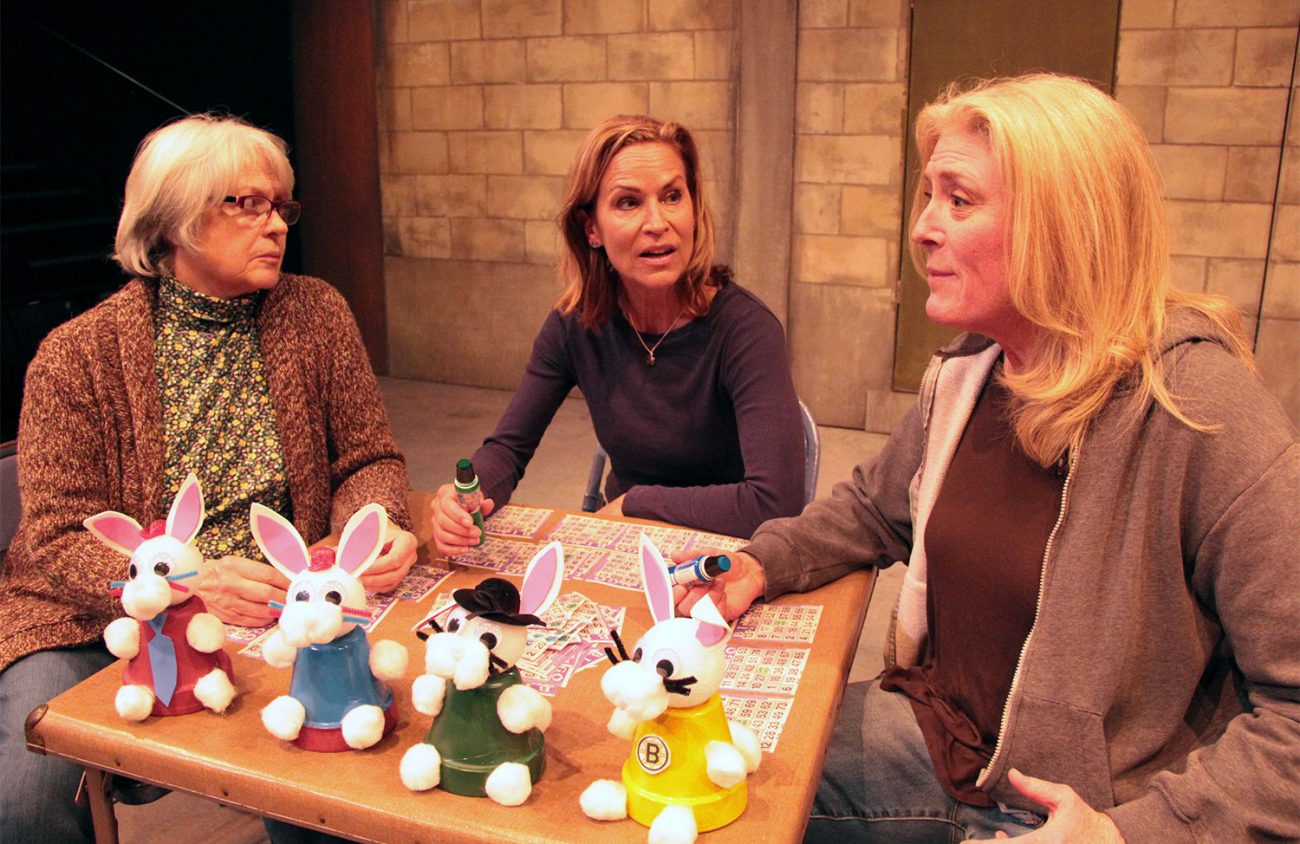
Pulitzer Prize-winning playwright David Lindsay-Abaire’s Good People, at Oregon Contemporary Theatre in a run that’s been extended through June 8, is a classically constructed play that uses familiar stereotypes to deliver a study in class divisions, the difficulty of coming to terms with the past and the power of destiny in shaping our lives.
When Margie (Storm Kennedy) loses her poverty-wage job — fired from the Dollar Store by a delightfully clueless young family friend (David Arnold) who is the store’s assistant manager — she needs another job right now. Behind on her rent, caring for her mentally disabled adult daughter, unable to find work in the hardscrabble neighborhood of South Boston, Margie has run out of options.
Then one of her bingo girlfriends suggests she get in touch with an old boyfriend, Mike (Bill Hulings), who years before had managed to escape Southie’s grinding blue-collar poverty and racism, go to the University of Pennsylvania and become a successful physician.
The kitchen-table scenes with Margie’s two girlfriends, Dottie (Ellen Chace) and Jean (Ruth Adele Mandsager), that open the play are entertaining but serve largely as window dressing for the serious drama to come.
It’s when Margie drops in unannounced to Mike’s office — unannounced, because he hasn’t been returning her telephone calls — that Good People begins to come into sharp focus. We see instantly how far apart Mike and Margie have grown in two decades. Their awkward reunion solves nothing for Margie, as Mike insists he doesn’t have a job for her, either. So she invites herself to the catered birthday party that she learns his wife is planning.
When Margie shows up for the party — not believing Mike when he calls to tell her it’s been suddenly canceled — we reach the real heart of the matter. Jeffrey Cook’s set clarifies this perfectly, as we shift from the graffitied back-alleys of Southie to the too-tasteful suburban home that Mike shares with his wife, Kate (Janelle Rae), who mistakes Margie for the caterer.
Under Kirk Boyd’s direction, Kennedy and Hulings as Margie and Mike chart a clear path through Lindsay-Abaire’s emotionally tangled script, which at times feels like a 1950s drama overloaded with social issues played out in not-always-convincing South Boston accents but updated with cellphones.
Is Mike’s success due to his hard work? Or is it simply the luck of the draw? Has he turned his back on the past? Is he the father of Margie’s child? Or is that simply a scheme, concocted by her friends, for her to get money from him?
Racism is touched on — Mike’s wife, Kate, is black, to Margie’s surprise — but seems tacked on here, an issue without particular meaning or resolution. And the play’s surprise ending leaves completely unanswered the main questions it raises.
Don’t worry about resolving the issues, though. Good People, which closes out OCT’s season, makes a solid evening’s entertainment, fast-moving and engaging. ν
Good People plays through June 8 at Oregon Contemporary Theatre; tickets and times at octheatre.org or 541-465-1506.