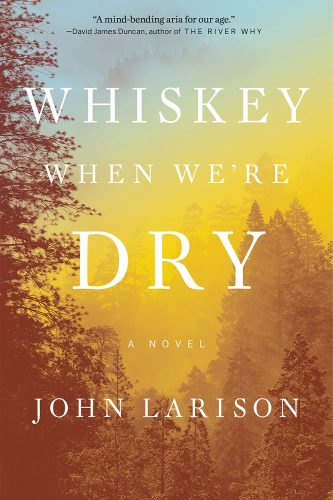
It’s not just 17-year-old Jessilyn Harney’s narrative voice that blurs gender lines, it’s author John Larison’s entire evocative portrayal of the young woman who poses as a boy in his novel Whiskey When We’re Dry.
Jessilyn, aka Jess, rides her beloved mare, Ingrid, west in search of her brother, Noah. Once her revered older brother, Noah is now the leader of an infamous Wild Bunch of outlaws, with his face and exploits adorning wanted posters in sheriffs’ offices — exploits that lean a little Robin Hood.
Jess, now an orphan, has taught herself to shoot — skillfully — and begins to rely upon those skills as she ventures out in the Wild West of the late 1800s. As her adventures continue and Jess slides further and further into her male persona, the reader slides with her, until inevitably both are reminded of the restrictions and dangers faced by women in the West — and some that are still faced today. Jess must deal with men that are more powerful than she is — not just in stature, but in their role in the world.
Larison, who lives in Oregon, takes on traditional Western literary motifs — not just gunfights but whore houses, fine horses, frontier justice and more, and he makes them modern while maintaining the old-school feel of Jess’s quest. He weaves in the evils of racism, a nod at the existence of gay cowboys and the sheer power of storytelling as Noah draws in followers through the sermons and tales he weaves.
Early on, Jess muses of her sibling, “After that I didn’t much ask if his stories were real or made up. Maybe I’d lost my belief in the difference. Sometimes I wonder if he did to.”
Despite the use of the tropes that make a Western feel like a Western, Larison does not rely on convention. Every theme he uses — a cowboy trip to the brothel — becomes a way to look into that idea with a nuance that could only arise in this era. How do you hide the fact you are woman posing as a man? How do you hide that you are a man who loves other men in the 1800s? Why does a woman become a prostitute?
The author has made mention in interviews of teaching at a local high school that experienced a school shooting — presumably Thurston High, as he notes 25 were injured and two students died. Perhaps as an outgrowth of that experience with gun violence, the novel both makes clear Jess’s enjoyment of the power of guns as well as their heart wrenching results, many of which are delicately hinted at as Jess tells the story in retrospect, long after the reverberations of her experiences have begun to fade.
The titular whiskey is both the actual liquor — one that Jess relies too much upon — and a metaphor. After shooting a man, Jess muses, “A potent whiskey come over me then, all at once. It poured from their eyes when those eyes flinched from me. In that whiskey was proof I too was made of grit and gravel and could not be blown from this earth by simple winds. I racked the Winchester, and for once found what I was after all those times I tipped a bottle.”
Those lines hint at the voice Larison has given Jess and the novel, both coarse and rhapsodic.
Whiskey When We’re Dry comes out in paperback July 2, the same day Larison appears at Powell’s Books at Cedar Hills Crossing in Beaverton. At 2 pm on June 15, Larison will be at the Salishan Resort in Gleneden Beach doing a reading and book signing, and at 6 pm, June 29, he will be at the Virginia Gillis Memorial Reading Event at the Monmouth Public Library. The television and movie rights to the book have been optioned by Amanda Silver and Rick Jaffa, the husband-and-wife writer/producer team known for rebooting Planet of the Apes.