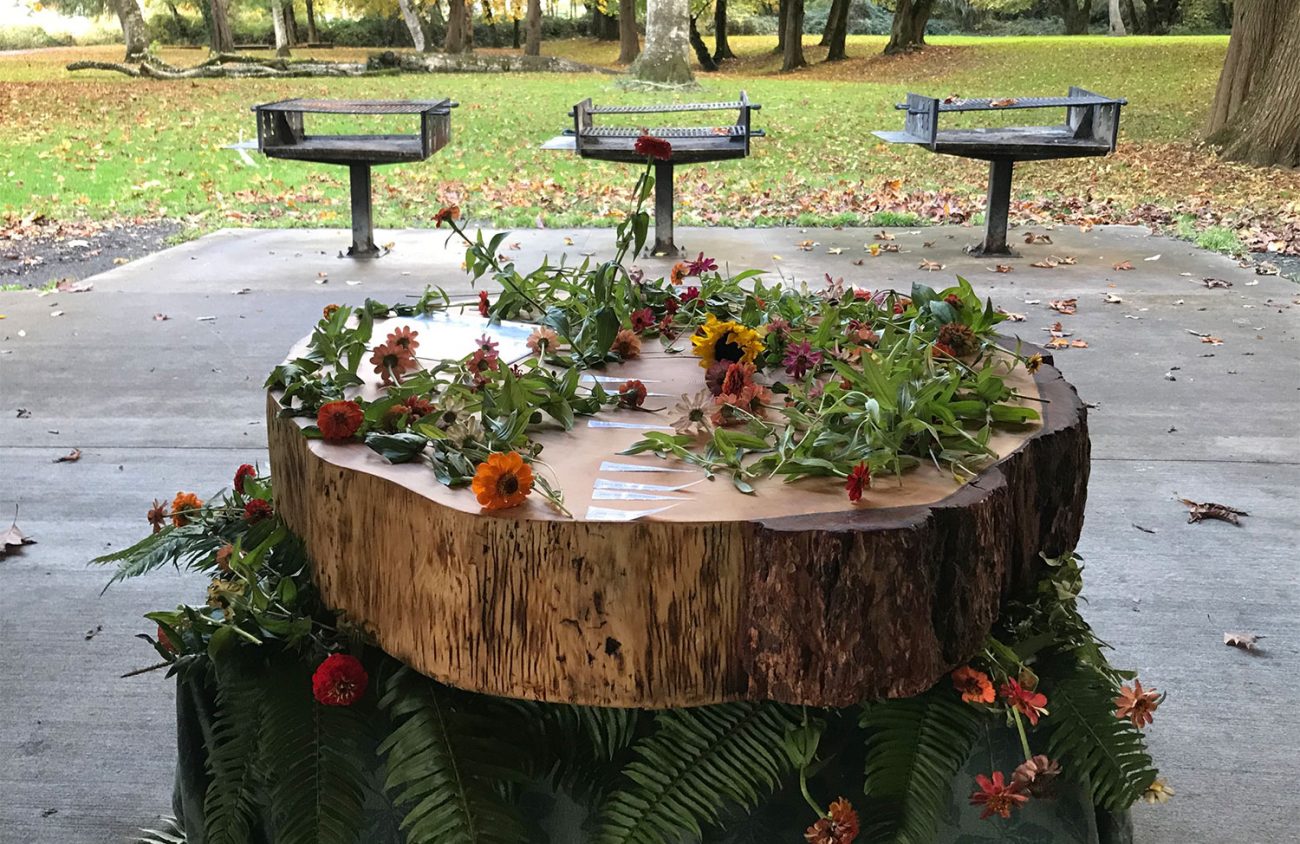
The piece of log from the 420-year-old Douglas fir was sprinkled with colorful roses. Its cut-off body took the front stage. It was the center of attention, the reason for a memorial service in Corvallis’ Willamette Park Sunday, Oct. 20. More than 200 people attended to grieve the death of one of Oregon’s oldest inhabitants.
During the service, “I was following the grief, the love, the gratitude,” said Reenie Laughingstar, who does restoration work at Willamette Park. Laughingstar spent the memorial with her eyes closed, connecting to nature around her, she said.
In May, Oregon State University’s College of Forestry cut a 16-acre area of the McDonald-Dunn Research Forest as part of what was called the “No Vacancy” harvest. One of the trees had been there since 1599, others were more than 200 years old. The school later admitted it was a mistake to cut the old-growth trees.
The log stood in front of a stage where Oregon’s poet laureate Kim Stafford and philosopher Kathleen Dean Moore read their work. Attendees experienced Stafford’s old-growth poetry and Moore’s nature writing firsthand.
“But somehow it becomes possible through the terrible anesthesia of our time to learn how to look at a forest and see only commodities,” Dean Moore read. “It becomes possible to breathe sweet forest air and smell only diesel fuel and money.”
According to a study conducted by Norman Johnson, professor emeritus at the College of Forestry, and Debora L. Johnson, consulting forester on the ecological damage of the trees’ cut, the mistake wasn’t unprecedented. The given reason for the cut was a “decline in stand health.” Norm Johnson was one of the architects of the Northwest Forest Plan, which ended clearcutting of the region’s old-growth forests but did not fully end logging old-growth trees.
Doug Pollock, the founding director of Friends of OSU Old Growth, says the health issue is unlikely. The old-growth trees were in good shape. But Pollock said that the excuse of the trees’ health plays a part in the College of Forestry’s lack of accountability and mismanagement. According to the Johnsons’ report, as long as the College of Forestry does not act responsibly, it “will not regain public trust.”
OSU has had a management plan for the forest since 2005, called the McDonald-Dunn Forest Plan. The cut, according to the Johnsons’ study, “was not consistent with (and is not permitted under) the 2005 McDonald-Dunn Plan. These clearcuts would not have occurred if the 2005 Forest Plan had been followed.” The plan was suspended in 2009.
The grief of the memorial service served a common good: uniting the community for the trees.
“Maybe this family is stronger now because we’re going to stand for those trees that we lost,” Laughingstar said. “We’re going to give them strength and they’re going to give us strength. We can’t have something like that happening anymore.”
On Monday, Oct. 21, the day after the memorial for the trees, Anthony Davis, the interim dean of the College of Forestry, announced in a letter that 36-acres of old-growth trees on the McDonald-Dunn will be protected from logging, and the 2005 forest plan is “unsuspended.”