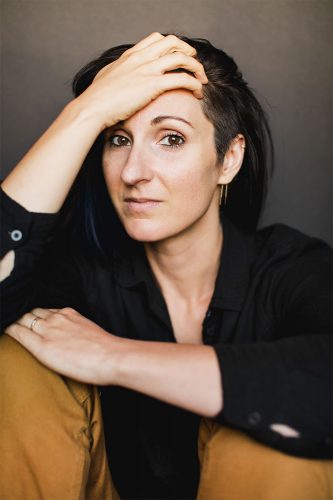
When Eugene writer Marjorie Celona was working on their (Celona prefers they/them pronouns) first best-selling novel, 2012’s Y, they used money earned from teaching to rent a cabin in upstate New York and committed to hunkering down and finally finishing a book.
Nearly a decade before COVID-19, Celona socially distanced themselves for however long it took to produce a work of fiction.
“I’ve always been obsessed with self-exile, particularly [John] Milton’s, as I used to be a great lover of poetry,” Celona says. “I was writing sometimes 14 hours a day. It was like one of those writer clichés that people talk about and, sure enough, I’ve never experienced anything like that since.”
Their second novel, How a Woman Becomes a Lake, was released in early March, just as the world was preparing for a quarantine. In contrast to their first novel, How a Woman Becomes a Lake was originally an uneven short story from Celona’s days at the Iowa Writers’ Workshop. They returned to the story only after writing their first novel, meeting their partner and having a kid. This time, the writing process was no cabin in the woods.
“For so long it was just this story about this angry boy and his father,” Celona says. “Then it became the story of Vera Gusev’s disappearance — this 30-year-old Tarkovsky-obsessed filmmaker who disappears on New Year’s Day.”
Celona ended up with a missing-person story folded into a sprawling family drama told from multiple perspectives. How a Woman Becomes a Lake easily separates itself from other contemporary genre fiction by remaining true to its literary roots. Every character is richly thought out and driven by internal motivations. The writing has an emotional maturity that allows readers to easily transport themselves through the different perspectives.
For the family at the heart of the novel, the future was always destined to be shaped and molded by past traumas. These traumas show themselves in a myriad of ways, and that’s part of the success of the novel — its ability to be more than one thing. Heavy themes like familial violence and childhood trauma are uniquely approached in order to let readers in.
How a Woman Becomes a Lake shares its title with a 2018 New Yorker essay by Jia Tolentino. In the essay, Tolentino longs for the calmness of a lake; the serenity of truly knowing everything will be all right — but when she looks around, all she sees is the utter degradation of society.
“It was one of those essays where you just think to yourself, ‘This is exactly what I needed to read right now,’” Celona says. “Once I found the title, it seemed like the book couldn’t have been titled anything else. I reached out, and she was so happy to let me use it.”
They add: “Ultimately, it’s a book about transformation — and here’s where the title really rears its head — the way grief transforms us; the way love transforms us.”
Originally from Victoria, British Columbia, Celona holds dual citizenship in the U.S. and Canada. Their previous novel, Y, won for Best Foreign Novel at France’s Grand Prix Littéraire de l’Héroïne in 2014. Their short stories have been featured in numerous publications, including The O. Henry Prize Stories, The Best American Nonrequired Reading, The Southern Review, Harvard Review and The Sunday Times.
Celona is an assistant professor in the creative writing program at the University of Oregon, where classes have been shifted to remote learning for the foreseeable future. The national book tour for How a Woman Becomes a Lake was canceled as well, but Celona doesn’t feel sorrow is justified, knowing it could be much worse.
“The travel will be rescheduled, maybe; the book will be read, maybe. I’m in control of none of it,” Celona says. “[I’m] trying to focus on the tiny pleasures of life. Our family’s daily afternoon walk, for instance. All the magnolia trees of Eugene. Hundreds of geese in a high school football field. The canals — typically full of trash and dead bodies — now clear and full of ducks.
“Okay, making up the bodies part…”
How a Woman Becomes a Lake is available everywhere books are sold. Penguin Random House Canada, $24.95.