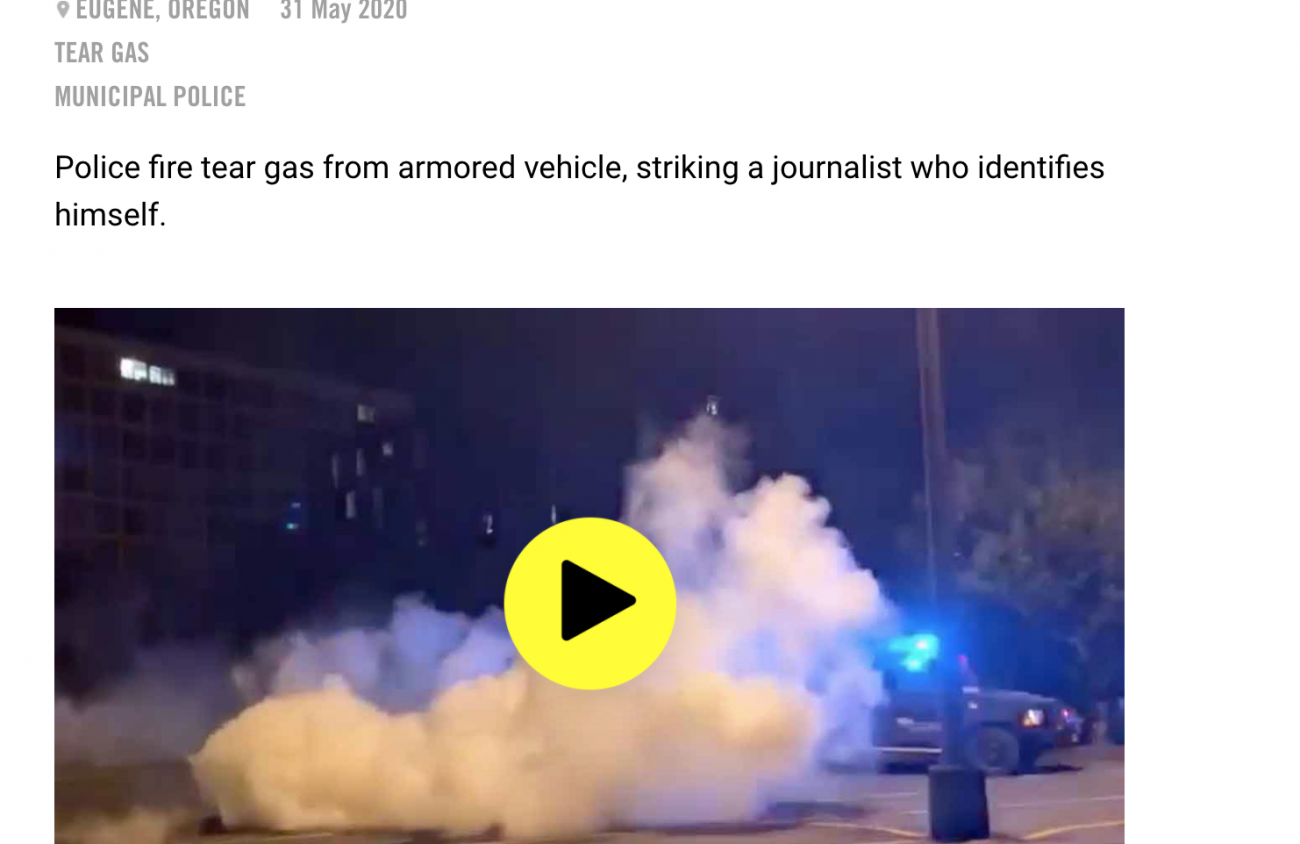
It’s been a while since the Eugene Police Department has been called out by Amnesty International.
Back in 1997, EPD sprayed tree-climbing protesters with so much pepper spray that they had to borrow cans from Springfield and Lane County. The police cut open the pants of one of the treesitters, and sprayed his anus and genitals, an act Amnesty International called “torture.” The city later settled a lawsuit over the incident for $30,000 and developed new guidelines for its use of pepper spray back in 2000.
Video by Tim Lewis/PictureEugene
Now Register-Guard reporter Adam Duvernay’s video of EPD tossing tear gas at RG reporters, shouting “it doesn’t matter” at reporters identifying themselves as press and striking Eugene Weekly reporter Henry Houston in the chest with a tear gas canister while he also identified himself as a journalist, appears as part of a new report by Amnesty International.
The report, “The World is Watching: Mass Violations by U.S. Police of Black Lives Matter Protesters’ Rights,” delves into how, despite the fact that Black Lives Matter protest arose in response to police brutality against people of color, those peaceful protests have been met with “tear gas, pepper spray, batons, kinetic impact projectiles, and flash grenades — in many cases with little or no warning.”
It says:
“This newest research documents how law enforcement responded to protests about the use of deadly force with shocking amounts of excessive force against protesters and shows that there has been a disturbing lack of progress over the past five years in ensuring police officers use deadly force only when there is an imminent risk of death or serious injury to themselves or others. Amnesty International USA recorded 125 separate incidents of police violence against protesters, in 40 States and D.C., between May 26 and June 5, 2020. The report chronicles the stories of more than 50 people in cities across the U.S. affected by police violence as Black Lives Matter has grown into the largest social movement in U.S. history. The report is the most comprehensive human rights analysis of police violence against protesters to date.”
You can find the Amnesty International map of incidents of police violence here.
Since the report spans from May 26 to June 5, the latest acts of law enforcement violence in Springfield and Portland are not included.
The report looks at how police went after peaceful protesters, “singled out journalists and legal observers,” and “targeted medical volunteers that attended protests across the country to support the health and medical needs of the protesters.”
According to the report’s executive summary, “More than 1,000 people are killed each year by police in the USA; because the U.S. government does not collect data on these deaths, the exact number of people killed by police annually is unknown. The data that does exist shows that Black people are disproportionately impacted by police killings.”
The report says that “while Black people represent 13.2 percent of the U.S. population, they represent 24.2 percent of deaths from police use of firearms.”
It points out that in the five years since Amnesty’s last report on police violence, “Deadly Force,” released after Michael Brown, an 18-year-old Black teenager, was killed by a police officer in Ferguson, Missouri, “there has been a disturbing lack of progress over the past five years in ensuring that police officers use lethal force only when there is an imminent risk of death or serious injury to themselves or others.”