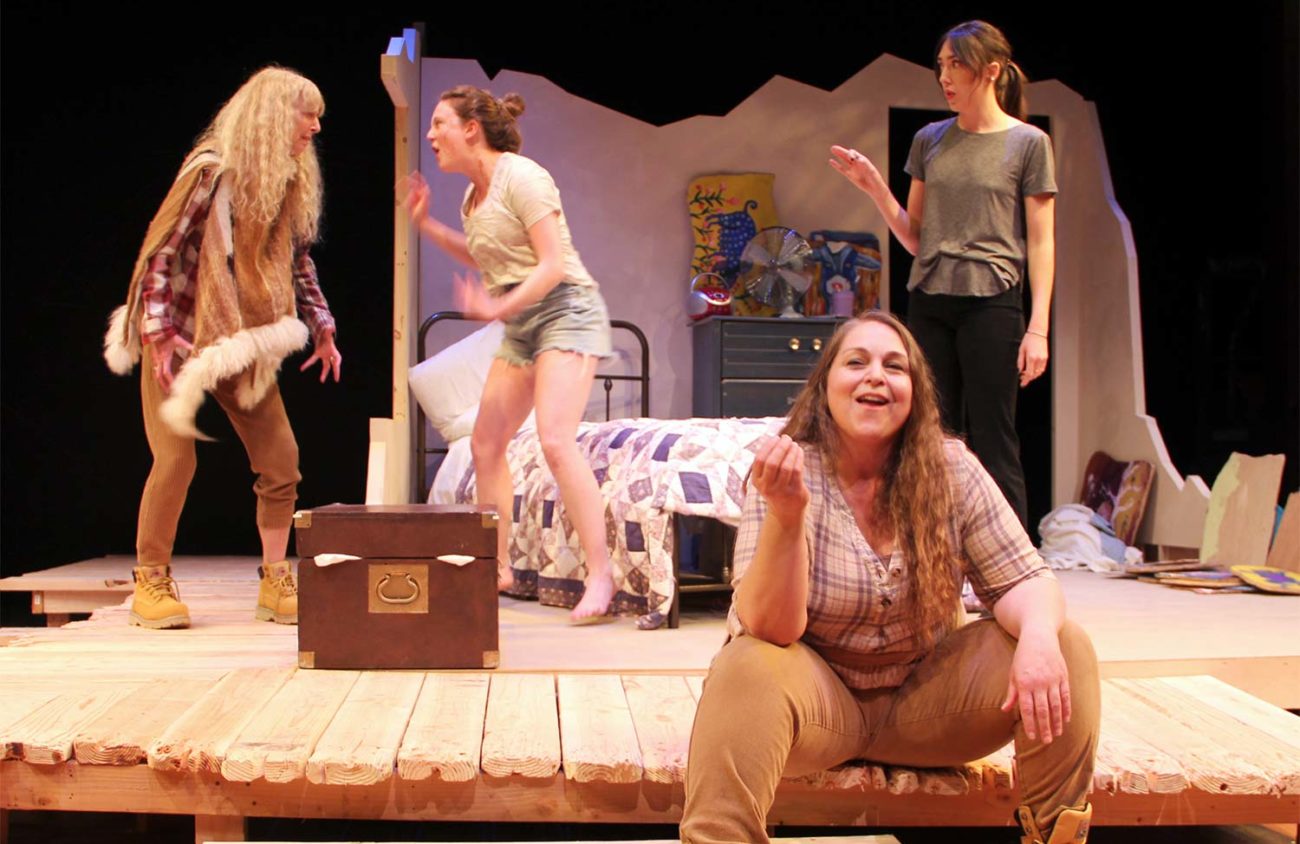
In Alabaster, a comic drama concocted by the prolific Southern writer Audrey Cefaly, Alabaster is a fictional town in Alabama, blown to smithereens by a devastating tornado. The only survivors are June, a young woman covered in scars, and her two pet goats, one of whom can speak both English and Goat.
Now playing at Oregon Contemporary Theatre in a spirited production directed by Willow Jade Norton, Alabaster is part of the National New Play Network’s rolling world premiere project, which encourages nearly simultaneous premieres at a handful of theaters. Through this program, OCT has a long history of introducing new plays, and another is expected for next season.
Just before Alabaster begins, musician Rose Heising enters, wearing brown overalls and playing a fiddle tune. Not only does she play the fiddle, but she plays around with it, producing evocative squeaks and growls and even a farting or raspberry noise, giving us a devilish grin when appropriate. Heising stays onstage as a non-speaking observer, providing innovative sound effects throughout.
While watching her before the action begins, we have time to examine the set by Amy Dunn. The post-tornado house seems to be cracked open and never repaired, and trees are missing their top halves.
The first actor who actually speaks to the audience is Kamden Flowers as Weezy, a wise, down-to-earth goat fond of okra, couscous and Red Bull. She does her best to keep things running at June’s half-destroyed home.
A little later we meet Weezy’s mother Bib, a very old goat nearing death, played by Marla Norton. Yes, the director cast her mother as an old goat! How many opportunities like that come along?
I do wish Bib had a more significant role, however. All she gets to say is a few “baaaas.” I would be curious to hear a heart-to-heart with Weezy.
But now let’s focus on June. Thanks to Hailey Henderson’s tour de force, pull-out-all-the-stops portrayal, we can see how deeply damaged she is by the loss of her family and farm. Although June rarely mingles with humans, somehow she has agreed to be photographed by Alice, an acclaimed artist from New York.
Alice is creating a coffee table book of photos featuring deeply tormented women who are learning to survive in spite of their indelible physical scars. As played by Jerilyn Armstrong, she is young, gentle and lovely. Although she looks like the picture of privilege with her flawless skin and perfect body, Alice manages to put June at ease by confessing that she, too, is traumatized, but her scars are internal.
When Alice comes across a large stack of folk art painted on slabs of wood, she learns that June paints them in a frenzy that gives her an emotional release. Alice believes they are worth showing and would result in sales. June, however, is reluctant to let anyone see them. They are private, only for her.
Cefaly’s script has already received numerous rolling premieres, but in spite of its emotional impact, it still has loose ends and faltering paths that peter out along the way.
Nevertheless, this is a vehicle that the actors can drive to emotional heights. The most powerful scene is June’s re-enactment of the devastating tornado for Alice, with Heising’s screeching fiddle intensifying the terror. In Henderson’s interpretation, June trembles violently and her arms flail in every direction as she shouts over the noise of the tornado, watching family and barn blow away. Afterward, she tells Alice that years have passed since it occurred, and she still hasn’t begun to heal.
In contrast, Alice clutches her own pain so deeply inside that it can’t boil to the surface and come bursting out. Whether noisy pain or quiet pain, both women hurt and realize they may never find consolation. Or, quite possibly, they might.
Alabaster is playing at Oregon Contemporary Theatre through June 5; times and tickets through OCTheatre.org or 541-465-1506.