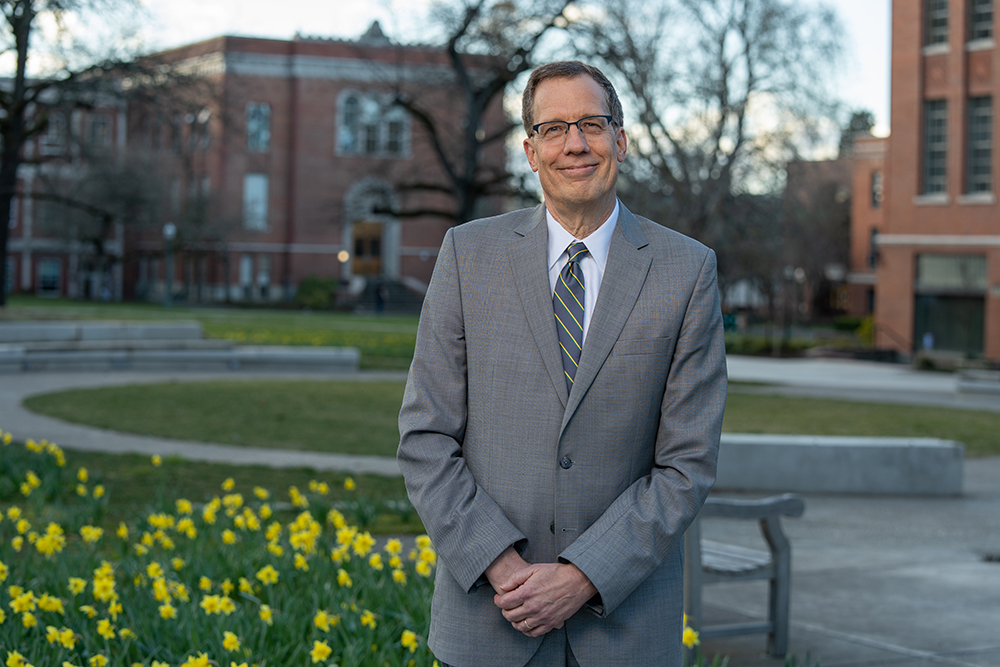
On March 13, after a search with little public scrutiny, the University of Oregon announced its new president, John Karl Scholz — an economics professor and current provost at the University of Wisconsin-Madison. Scholz will start his presidency this July.
Oregon State University did a similar search and didn’t announce finalists when it hired F. King Alexander in 2020. That hire ended with controversy and Alexander’s resignation. OSU’s next search was more public, as was Lane Community College’s recent successful presidential search.
When Ed Ray left OSU after serving as its president for 17 years, the OSU Board of Trustees undertook a national search. OSU, like the UO, used an executive search firm to help guide decisions in the search.
In July 2020, as a result of the search, Alexander was named OSU president. Alexander was the president for only nine months until he resigned due to concerns about how he and his previous institution, Louisiana State University, mishandled issues of sexual misconduct.
After the fiasco with Alexander, OSU decided that this time finalists’ names would be released to the public. There were also opportunities for community members, faculty, staff, students and other stakeholders to hear presentations by the finalists and ask questions. This search process brought in Dr. Jayathi Murthy, who began her presidency this past September. Before OSU, Murthy was a professor of mechanical and aerospace engineering at UCLA. In 2016 she was the department’s first woman dean and was dean until leaving for the presidency at OSU.
The UO’s search was confidential, meaning that finalists were not released to the public before a final candidate was named. During the process, Eugene Weekly reached out to the current search committee to understand the search and why it was not as public as that of LCC and OSU. Kay Jarvis, senior director of UO’s media relations, says that the committee would not take interviews but instead that the committee hoped “have an announcement in the spring.” That sudden announcement, before the end of the school’s winter term, was Scholz.
In LCC’s search for a new college president, Lisa Fragala of Lane Community College’s Board of Education says that LCC’s search for Dr. Stephanie Bulger was based on “inclusive practices of stakeholders.”
She says that as the board developed the characteristics for the search, the job profile, there were many opportunities for stakeholders to provide feedback. The board created a culturally diverse community advisory board that helped in the screening of applicants and made recommendations to the Board of Education. Both the Board of Education and the community advisory committee had anti-bias training. Through a recommendation of one of the board members, it was decided that in support of anti-bias practices, the names of candidates would be removed from their applications while being screened.
“There’s a lot of research to suggest that candidates of color from culturally and linguistically diverse communities experience bias in hiring processes and that women also experienced bias in the hiring process,” Fragala says. “So we really made some efforts to implement anti-bias endeavors in our search process.”
Resources that Jarvis provided said that there was “bias awareness” training done before committee members reviewed applications, no details were given as to how that training affected application review. A search advocate was used during the screening process. According to the UO, “advocates are able to explore assumptions, norms, and practices that an internal member might not question.”
When LCC’s board selected its finalists, those four candidates then came to the college. The finalists included three people of color, two of which were women. The finalists met with employee groups, and the board, and conducted public presentations and community forums.
“All of our stakeholders internal and external to the campus were able to provide feedback,” Fragala says. “You learn so much when you see somebody come and engage with the community, engage with students, engage with faculty and staff.”
Bulger began her presidency at LCC this past July. She has a Ph.D. in higher education and a master’s degree in 19th and 20th century British and American literature. She was previously vice chancellor for instructional services at the San Diego Community College District in California.
After getting little response on how the UO’s presidential search was progressing, EW then reached out to people who were on the previous presidential search committee, which selected now-former president Michael Schill. The university responded to these inquiries with a statement that said, “All members of the presidential search committee signed confidentiality agreements stating that they will not share any information about the search process or candidates. That obligation is still in place.”
Public information on the search that resulted in Scholz being named the new president indicated that there was a 22-member presidential search committee of students, faculty and staff. The UO contracted Parker Executive Search firm to work with the search committee to “attract a talented and diverse pool of candidates.” Around the O, the UO’s public relations “news” site, reported that the search committee “spent the fall engaging and listening to the campus community” through “dozens of meetings” with stakeholders.
According to Parker’s website, “PES will develop a secure website exclusively for search committee members, providing access to detailed information on the process, timeline and candidates.”
Current faculty members at UW-Madison, speaking anonymously as Scholz is still the provost, indicated he was a cookie cutter administrator and said he was sympathetic but not responsive on some union and diversity issues brought before him. “Not terrible,” but he “handles university administration the way you’d expect an economist to handle it.”
Scholz’s contract says he’ll make $725,000 in his first year. But Scholz will make more than his higher education peers throughout Oregon. At OSU, Murthy’s 2023 presidential salary is $650,000. On March 10, Portland State University appointed Dr. Ann E. Cudd of University of Pittsburgh as its new president with a base salary of $610,000. Bulger’s salary is $240,000, according to Brett Rowlett LCC’s executive director of external affairs.