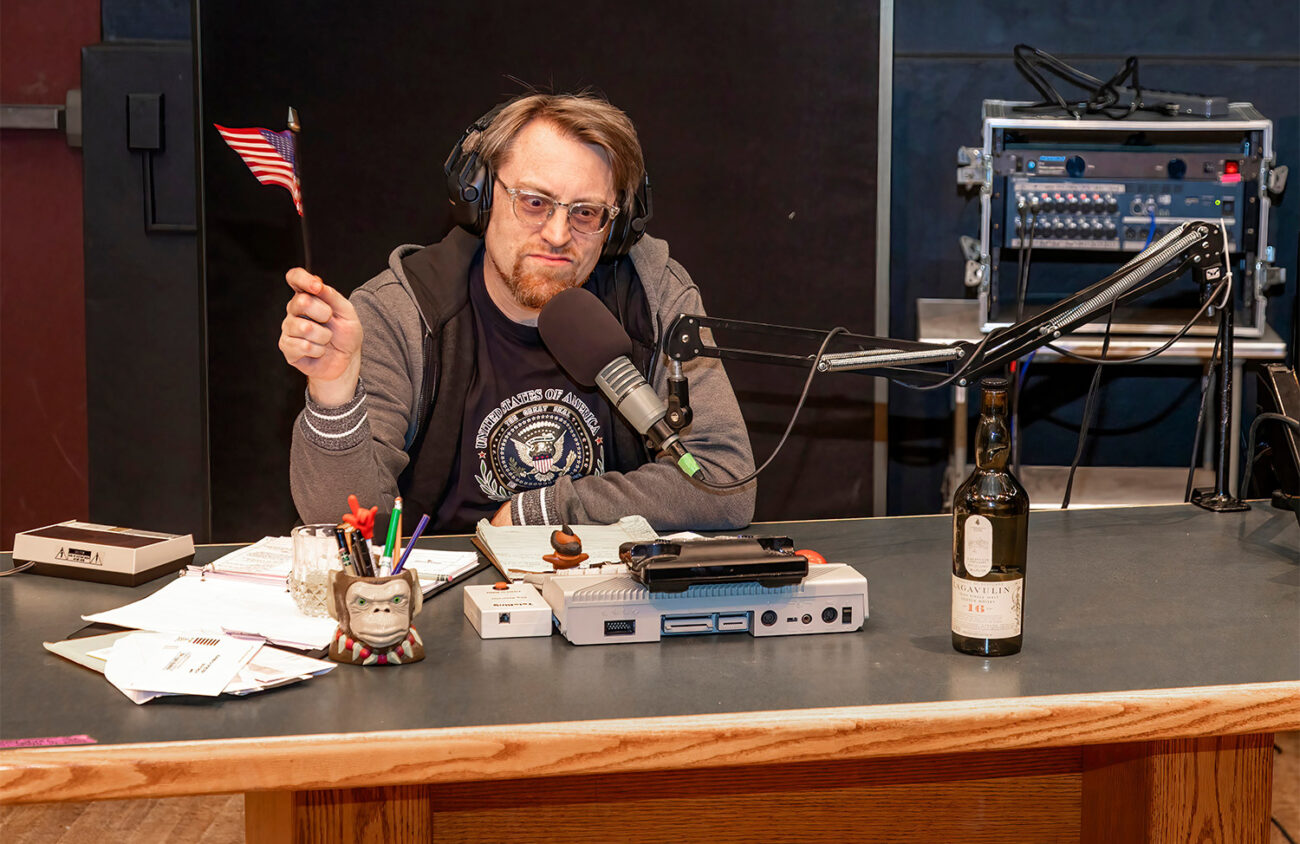
Talk Radio, now playing at The Very Little Theatre’s Stage Left, offers undeniable proof that The VLT, one of the oldest community theaters on the West Coast, can be every bit as good as professional theaters throughout the country. Any doubts you might have will be erased by this first-rate production.
Running a brisk 100 minutes without intermission, the show by Eric Bogosian, based on a concept by Bogosian and Portland artist Tad Savinar, is riveting. The play was first produced in the 1980s in Portland and then at the Public Theatre in New York, with Bogosian in the lead role. A hit right from the start, it was nominated for a Pulitzer Prize, and in 1988 a film version directed by Oliver Stone appeared.
Talk Radio tells the twisted tale of Barry Champlain, a complex shock jock who hosts a late-night call-in show based in Cleveland, Ohio. His language, as much as is allowed on the radio of that era, is generally rude and quarrelsome. Although a few gentle souls admire him, he needs a strong defense against the majority of his callers, who are aggressive and obnoxious. One caller goads him about his elegant patronym, insisting it’s a coverup for a Jewish name.
During his hours on the air, Barry, in a tour-de-force performance by Scott Machado, takes a string of calls passed to him by his faithful assistant Stu (David Mort). If the calls don’t work out the way he wants, he screams at Stu for failing him. He’s almost as disagreeable with Linda (Jennifer Appleby), a young coworker who tries to smooth things for him and keeps him supplied with whiskey.
The calls are crucial because he is being judged. If the show is brilliant, it will go national the following Monday.
As directed by Paul Rhoden, Talk Radio is hilarious, almost falling-out-of-your chair funny. But Barry, in spite of his intelligence, seems tragic at times. He clearly hates himself as much as he hates most of his callers. In the program notes, Rhoden, a talented actor, reveals that this is the first play he has ever directed. That’s hard to believe, but he credits his wife Darlene, an experienced director, for keeping him on task. He has certainly allowed Machado to successfully explore Barry’s dark depths, to the point of eventually unraveling.
And the callers, as disgusting as they might be, are mostly pitiful. One of them, however, a young man named Kent (Noah Davis), is a jokester who unexpectedly manages to get himself invited to the studio, where Barry sets him up with a microphone. Kent’s costume is covered in baubles and pins, and his hair is in stiff spikes that make it hard to put on his headphones. He’s a riot.
So are the other characters and the unseen callers, played by Dave Smith, Paul Dunckel, Damon Noyes, Rene Ragan, Vanessa Norman, Derek Rees, Jonas Israel, Emily Faulconer and Tim Rogers.
Set design is by Abby Dunn, costumes by Paula Tendick and Amy Weinkauf, and lighting by Tim Rogers.
Now, in 2024, the play seems only minimally dated. Paranoia is still rampant throughout the country, striking from right and left. Barry would tell us we’re living in a very scary time.