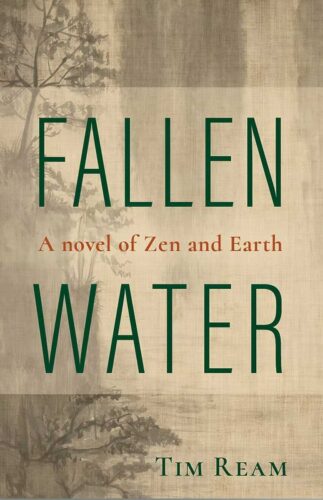
Sitting cross-legged on a cushion in a Buddhist monastery, Tim Ream had an unexpected thought that interrupted his typical meditation routine: the idea of writing a novel. Decades of meditation practice rang in Ream’s head, telling him to let the thought go and settle back into a meditative state, but the longer he sat on the cushion, the louder the idea echoed in his mind.
What began as a whisper grew into a passion project as Ream published his first novel, Fallen Water, in March 2024. The book tells the story of a fugitive who fakes his way into a remote Zen monastery while on the run along California’s rugged Big Sur Coast. Here, he collides with monastics and finds himself in a tumultuous relationship with a female Zen master who forces him to confront what he is running from.
Ream, who made headlines in the 1990s for his hunger strike in front of the old federal courthouse in Eugene against federal salvage logging, explores the role of compassion in a highly polarized world, revealing the importance of one’s connection to nature and the environment around them.
“Some people think the book is about feminism, some people think the book is about Buddhism and some people think the book is about environmentalism,” Ream says. “There are a lot of different ideas and I’m glad people are bringing their own perspectives.”
Ream describes his writing process as “very informal.” There was a time when he was writing during an intensive practice period at a monastery. Because the monastery limited technology access, Ream “bootlegged solar energy off the grid” in order to write on his laptop.
“The writing process was actually quite joyful for me,” Ream says. “It was fun to create characters that you feel like you really know and plenty of what came down on the page really surprised me.”
Spending years of his life in monasteries and working as an environmental activist, the idea of living off the grid surrounded by wilderness with a small group of spiritual people is one that Ream has experienced firsthand. These experiences heavily influenced his writing, he says, as many of the people he practiced alongside had similar perspectives to him.
“I realized most people who go to these monasteries are more on the liberal side, but what happens if someone comes who is more right-leaning?” Ream asks. “The main character has right-wing politics, but he loves hiking and spends so much time in wild places that he overlaps with the kind of values left-wing people have, so everyone is in a place to connect with him.”
Ream’s practice of ecodharma — the combination of mindfulness, meditation and Buddhist teachings with the intent to reduce threats to life on Earth — is at the backbone of all of his work, including Fallen Water. As expressed in his novel and his teachings, Ream believes “people just need to love the Earth more.”
“Whether it’s a particular tree or bird species or mountain range — the more we love the planet, the more likely we are going to be able to take care of it,” Ream says.