Walk into the spacious Barker Gallery upstairs at the Jordan Schnitzer Museum of Art this month and you might think you’ve entered a ’60s light show or one of the new tech-powered “immersive” artistic experiences that have been popular in recent years.
That’s how striking James Lavadour’s enormous, brightly colored abstract landscapes are in ‘Land of Origin,’ a retrospective exhibition of his work that fills the space with something like magic.
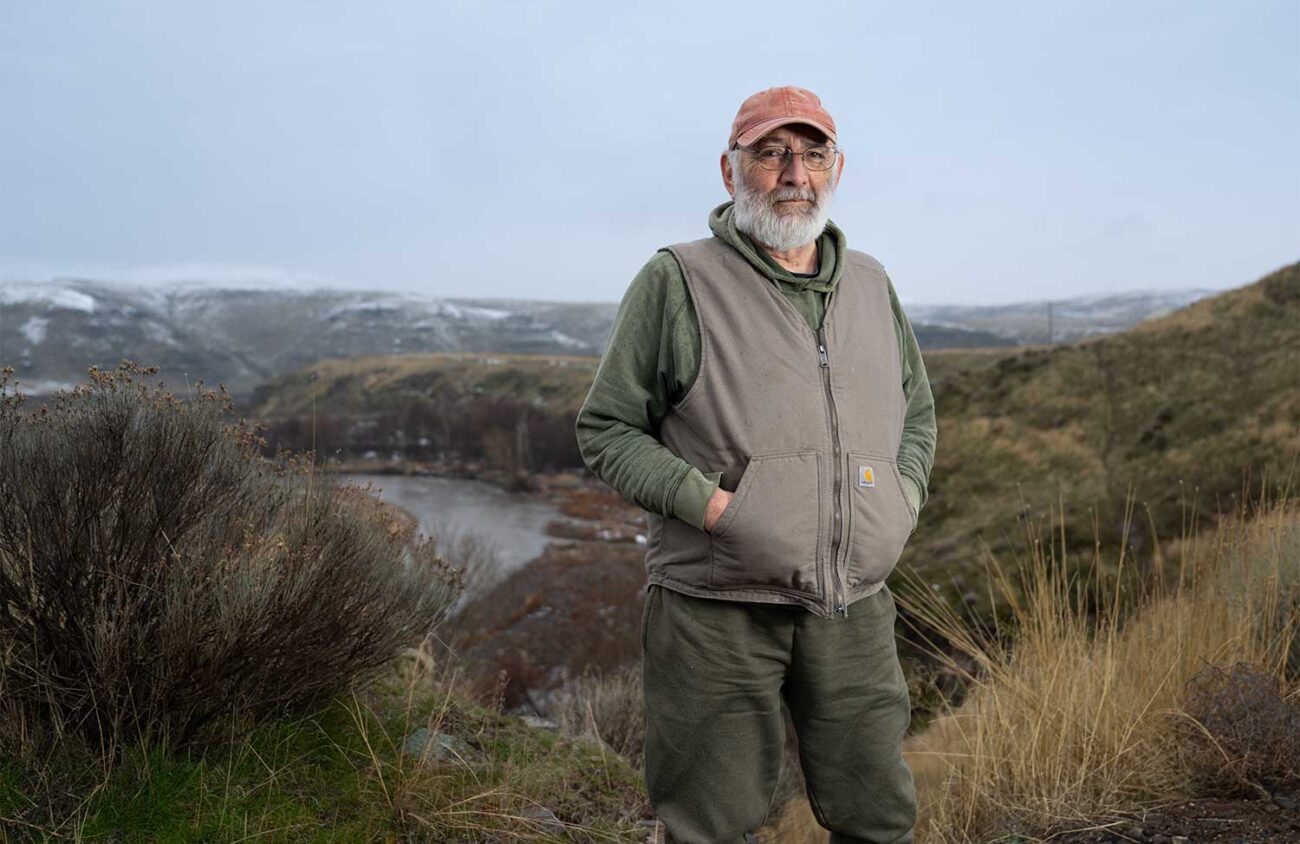
Lavadour, 74, is one of Oregon’s leading artists. Self-taught, living on the Umatilla Reservation in rural northeast Oregon, where he is an enrolled member of the Confederated Tribes, he has used paint and canvas to create a visionary world of mountains, rivers and canyons that grow from the heart instead of the eye’s literal observation.
His landscapes have been shown in venues across the country, including The Smithsonian’s National Museum of the American Indian, and are in the collections of museums around the Northwest. In 2013, his work was shown at the Venice Biennale in Italy.
Besides his own art, Lavadour is known as one of the co-founders of Crow’s Shadow Institute of the Arts near Pendleton. Established in 1992 as a fine art printmaking studio to educate and support Indigenous artists, it has featured such leading Native artists as Wendy Red Star, Marie Watt, Jeffrey Gibson, Kay WalkingStick and the late Rick Bartow, who donated a collection of his own prints to support the institute shortly before his death in 2016.
Lavadour was fascinated by art from an early age as he grew up on the reservation. His parents both worked at the state penitentiary across the border in Washington. By his own account, young James was a poor student in high school. Instead of seeking more education, he worked a series of blue-collar jobs, keeping his own young family afloat.

Though he was mentored by other artists along the way, Lavadour never went to art school. In a phone interview from the home where he now lives by himself on the reservation, he says the lack of formal training has never hurt him.
“I applied to the Pacific Northwest College of Art,” then run by the Portland Art Museum, “and I got turned down,” he says. “That was my only shot at furthering my art education. I married very young, and I had a family, so I went out and worked when I was about 18.”
In fact, he says, being turned down by art school probably was for the best.
“As you go along, you realize that art school isn’t really what I wanted. I thought at one time I missed out my opportunity to be among the creative class of people of my generation. But I realized, living on the reservation, that the community was busting with creativity, just trying to preserve culture and start a government. It just took all the faculties of the community to do those things. It was a boiling place of creativity. That was a very exciting time on the reservation. I wouldn’t have experienced that, going to school.”
These days, his typical workday starts well before dawn. “I get up at about three o’clock in the morning. I have a Jeep and I go out for a drive. About 30 miles from my house, there’s a place I like to go every morning to watch the sun rise. It’s a great piece of land, and it’s got a lot of curves and ups and downs and canyons and the river, so it’s like my library. I go out and I look at the world every day, and then I come back to the studio, and try to paint.”
Not every day in the studio is productive. “There’s usually a period of time during the month, like a week or so, where my creative faculties are really intense. And then it declines, you know. Then I do other things. I still do my routine and attempt to paint. But then there are those days that are just extraordinary. They don’t last long, but I get a lot done.”

Painting, for Lavadour, is not meant to be a literal recording of the landscape around him. Instead, it grows from the physical process of painting itself, smearing paint on canvas, watching images spread and grow intuitively under his hand.
In the studio, he often listens to 1960s jazz — the music of Miles Davis and John Coltrane and Sun Ra. “Such amazingly creative people!” he says.
“The whole principles of jazz are things that I try to employ, the sense of space and creating objects that you can turn upside down and look at from a different angle. That’s what I like about jazz is that it throws things out there, and then it kind of examines them.”
“That’s, that’s pretty much how I work. I just start working. I don’t do sketches or work from photographs or anything. I just jump in and start painting. And so most of my work is very abstract until the very end, when I’m finishing it, and it comes into some sort of focus. I always think of it like rolling a rock down a hill, you know. It accumulates things on the way down and it finds its sense of repose.”
The intensely colored result owes a debt to artists whose work Lavadour has long admired, from 19th-century English landscape painter J.M.W. Turner’s wild paintings of ocean and sky to the deeply spiritual work of the mid-20th-century artists who came to be called the “Northwest Mystics,” such as Mark Tobey and Morris Graves.
Art, for Lavadour, is a way to make the world a better place.
“Making art is, for me, like making medicine for other people. It’s not for me. I’m not doing it for me. I’m doing it because I can do it. I’m not a collector and I don’t collect my own work. I feel like I would be a failure if I didn’t get it out into the world. It goes out in the world and it does what it does. It comes from a good place. It comes from the good things of my life — the land and the spirit. And that goes out and it affects people, I hope.”
The Jordan Schnitzer Museum of Art is on the University of Oregon campus and open Wednesday 11 am to 8 pm and Thursday through Sunday 11 am to 5 pm. The JSMA is closed Dec. 17 to Jan. 6. “Land of Origin” through Jan. 11. Admission starts at $5 and is free for all college students and UO faculty/staff. More at Jsma.uoregon.edu.