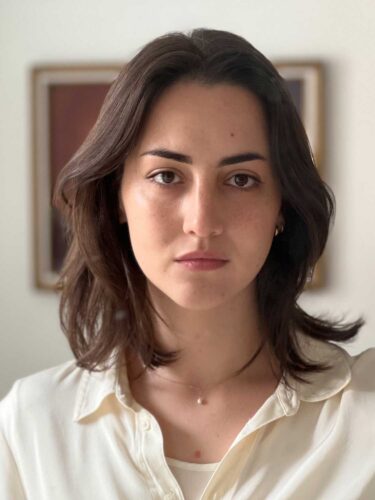
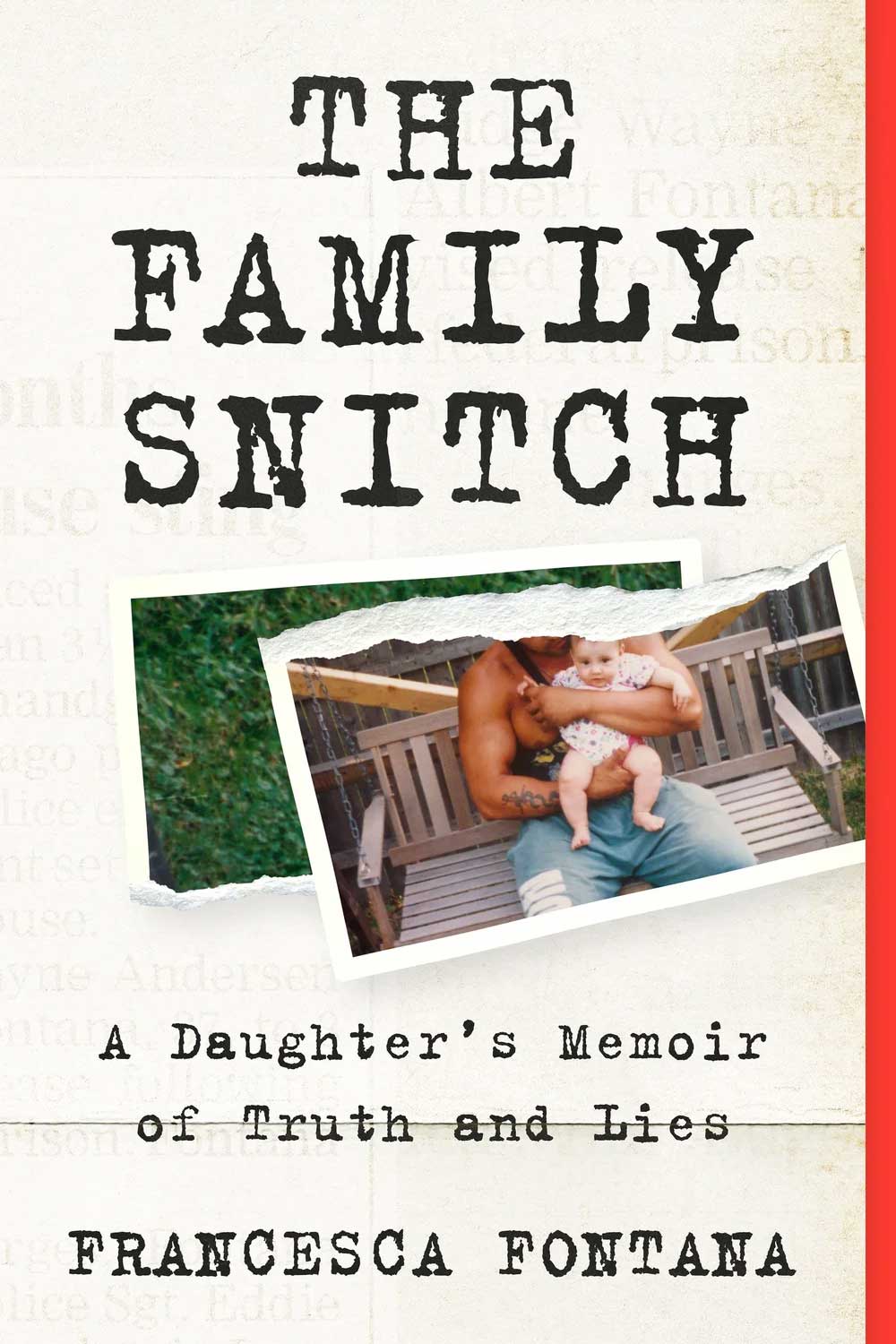
Francesca Fontana’s memoir, The Family Snitch, unfolds as a rigorously reported investigative page-turner, interspersed with bold and poetic moments of narrative craft. A 2017 University of Oregon alum, the book grew out of her thesis research, which was a journalistic investigation into her father’s secret criminal past.
Fontana establishes instant credibility and trust with the reader, and the writing is appropriately candid and vulnerable. Beyond memoir, the book delves into complex topics of self-harm, epistemology and truth. In one of my favorite passages, Fontana takes the reader deep into the stacks of the Knight Library and her discovery of Proust’s madeleines and Augustine’s visions.
After nearly a decade working as a reporter for the Wall Street Journal, Fontana was laid off in mid-January, along with the entire Weekend Section team. Her last byline for the Journal is an adapted excerpt from her memoir.
Published by Penguin Random House in early February, the memoir is available for purchase from all major online booksellers and, of course, ask for it at your local bookseller. Fontana will give a book talk in Eugene Feb. 19 at Hodgepodge Books.
The conversation has been edited for length and clarity.
How do you like to describe your book?
I always lead with the fact that it’s a reported memoir. When I started the book, I intended to write as a journalist first, and put my position as a daughter with emotions and feelings in the backseat. And as I reported and wrote the book, I quickly bumped into the limits of telling this story as an impartial, stalwart journalist.
I think it’s a common story of someone finding out who their parents really are. It’s a process we all go through, and it just so happens that my parents represented two extreme ends of a spectrum. Through finding out who my parents really were, I had to confront who I really was and put myself under the microscope as much as I was interrogating their versions of the past.
Memoir is almost always written in first person, but you wrote certain chapters of the book in third person. Why?
In the book, there are two timelines, essentially punctuated by act breaks, where all bets are off and we’re in a dreamy third space. One of the timelines is the present where I’m telling you my story of going back to Chicago and embarking on this search and everything in those sections I experienced firsthand. So I tell that story as the narrator in the first person. When I go into the past, I chose the third person because I wanted to show the reader that these are reconstructions of the past, and often of a past that I wasn’t yet alive in or that I didn’t observe. I’ve done everything I can to make it true — all of the reporting, the interviews, the digging up artifacts from my family’s past.
In the book you ask, “What is the purpose of memory?” So what’s the answer you’ve come up with?
Part of what I was asking myself was, “Can I trust anything that I remember?” In some sense, that haunted me deeply. I found comfort in the idea that if I just did enough digging and enough reporting, I could prove all of my memories to be true or false, meaning all of the love that I felt for my father as a child, I could find the source code behind and justify. Our memory is fallible, but it is also mostly truthful. The purpose of memory is evolution — to survive and learn from the past. Our memories also make up who we are.
In writing the book, I also started to understand memory as not just information, but also a place you go. You close your eyes, and all of a sudden you’re back in your childhood bedroom. I was deeply interested in how to capture that and put that down on the page.
Toward the end of the book you suggest that we write “to understand, and to be understood.” What did you learn about yourself? And what do you hope readers take away from your book?
It’s extremely hard for me to know what I think about anything until I’ve written it through. On paper, I could see the ways I was lying to myself and the ways I was tempted to stick to those lies. That may sound sinister and malicious, but they were things simply like, my father is this charismatic and manipulative person, and I never want to be anything like him. But as I’m writing through my own life, I’m realizing I can also be manipulative, I can be deceptive, and I can’t turn a blind eye to that.
I hope the reader ends the story feeling that I’ve done right by them. I hope they understand all of the ways in which, for better or for worse, the truth always comes to light. And I hope they leave considering what I think might be a less examined question, which is, “And then what?”
What’s your favorite part of the book?
I experienced great fun in writing the interludes of the book — the places where I allow myself to sit with the reader in the audience, so to speak, or I whisper to the reader, or I allow myself to break the rules of telling the story straight in the present and reconstructing all that I know in the past.
When we spoke a few months ago you mentioned that as a child seeing your name on the marquee at Powell’s was your dream. What’s it like to have that dream become a reality?
My 16-year-old self would skip class in high school and go to Powell’s and read books I couldn’t afford to buy. It feels like I’m doing right by that kid. And I think that if she could see it, she might feel a little less afraid of the future for present day me.
Book Tour: Catch Francesca Fontana in conversation with her thesis advisor, UO Associate Professor Brent Walth, 7 pm Wednesday, Feb. 18, at Powell’s on Burnside in downtown Portland and, in Eugene, at 6 pm Thursday, Feb. 19, at Hodgepodge Books and Taps on East 14th Avenue.
Nicole Dahmen is a professor at the University of Oregon’s School of Journalism and Communication and Clark Honors College.